Hasan Pasha Han by Mehmet Masum
Captured at the historic Hasan Pasha Han in Diyarbakir, this photograph highlights the enduring architectural grandeur of a 16th-century landmark. By utilizing a wide 17mm focal length, the photographer emphasizes the expansive scale of the courtyard, where the interplay of light and shadow brings the ancient stonework to life. The image serves as a poignant bridge between the site's opulent past as a 17th-century trade hub and its current role as a vibrant cultural sanctuary. Its award-worthy quality lies in the precise composition and technical clarity, which successfully document the intricate textures and historical significance of this Turkish treasure for an international audience.
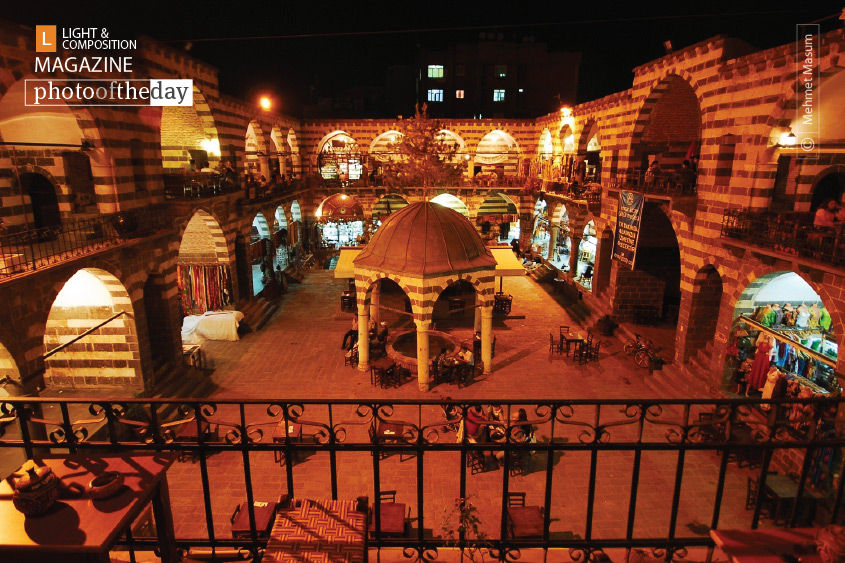
Exposure 1/3000sec @ f/4.8 | ISO 100 | Focal Length 17mm
Mehmet Masum
Mehmet Masum Suer is a Kurdish international photographer and freelance journalist based in Diyarbakir, Turkey. Following a distinguished career in journalism that began in 1974, he transitioned into professional photography in 2005, focusing his lens on the rich cultural and historical heritage of the region. His work, which documents ancient architecture and local traditions, has been featured in international exhibitions, guidebooks, and major publications. Suer is widely recognized for his commitment to preserving the visual history of cities like Diyarbakir, Mardin, and Hasankeyf through his evocative documentary-style imagery.
Resonance Score Breakdown
Transparency Note: The resonance score (11.5/20) is calculated based on social engagement metrics collected before the award announcement.
Expert Photography Reviews · 7
The Weight of Echoes
In the sixteenth century, a merchant might have stood in a courtyard like this, listening to the rhythmic clatter of hooves against stone, his mind occupied by the price of silk or the long road ahead.
Read the reflection →The Echo of Stone
The smell of old stone is not really a smell at all; it is a coolness that settles against the back of your throat, like the air inside a cellar where the sun has never reached.
Read the reflection →Reviews & Comments
Share your thoughts about this award-winning photograph. Your reviews contribute to the community engagement score.
The ochre of these ancient stones, reminiscent of a sun-bleached Morandi still life, breathes with a dusty, historical warmth that I find utterly intoxicating. It’s not merely architecture; it’s a symphony of light where the shadows possess the bruised, velvet depth of a Turner twilight. One feels the weight of centuries in those golden, honeyed tones, and honestly, I’d trade a thousand modern digital crispnesses just to linger within that amber, sun-drenched silence for a single afternoon.
Most travel photography is just digital tourism, but this frame earns its place in the archive. By pulling the 17mm lens tight against the stone arches, Masum forces the viewer into the courtyard’s rhythm. It’s the sharp contrast between the sun-drenched floor and the cool, shadowed recesses that makes me want to sit there and breathe the history. It’s not just a record of a building; it’s a feeling of stillness that will outlive us all.
The courtyard’s architecture functions as a rigid grid, anchored by the vertical axis of the central fountain. I’m struck by the 1:2 ratio between the shadowed stone arches and the sun-drenched floor; it’s a perfect spatial equilibrium. The 17mm focal length forces a converging perspective that pulls the eye toward the vanishing point with mathematical precision. It’s a beautifully solved equation of light and stone. I’ve rarely seen such complex geometry resolve into such elegant, rhythmic order.
In the Hasan Pasha Han, we don’t just see stone; we feel the echoes of merchants who once bartered their lives here. Mehmet Masum captures this vast courtyard, yet I’m drawn to the silence between the arches. It’s a space that’s breathed for centuries. When I look at these shadows, I feel a sudden, sharp ache for the stories lost to time. It’s a photograph that asks to be returned to, again and again.
You’ve captured the weight of those centuries-old stones, but I’m looking for the people who belong there. The architecture is sharp, sure, but it feels a bit cold without a heartbeat. I’ve sat in places like this, drinking tea while the world moves around me. You’ve got the technical side down, but next time, wait for the human element to break the silence. There’s a story in those arches, but it’s waiting for someone to live it.
Stone arches frame the light. It’s a heavy, ancient silence. I’ve stood in courtyards like this, feeling the weight of centuries press against my skin. The shadows don’t just fall; they anchor the frame. Nothing here is accidental. The empty corner is not empty. It’s a breath held in stone. I find myself wanting to walk into that shade, to disappear into the quiet. It’s rare to find such stillness in a crowded history.
The wide 17mm perspective forces the courtyard into a rigid geometry. Vertical stone columns anchor the frame, creating a necessary tension against the horizontal sweep of the arches. It’s a disciplined arrangement of mass. I’ve rarely seen such structural clarity in a travel shot; it doesn’t collapse under its own scale. The negative space above the central fountain provides a vital fulcrum. It’s cold, precise, and frankly, it’s a relief to see such restraint.