Hard Worker by Fernando Rodríguez
In the golden, filtered light of a late summer afternoon in Villaornate, Spain, Fernando Rodríguez captured a striking portrait of a tractor that transcends its mechanical nature. By framing the machinery with an empathetic eye, the photographer humanized the heavy equipment, likening its weary posture to a giant exhausted after a long day of labor. The image is award-worthy for its masterful use of natural light to evoke emotion from an inanimate subject, transforming a mundane agricultural scene into a poignant, minimalist study of form, texture, and the quiet dignity of work.
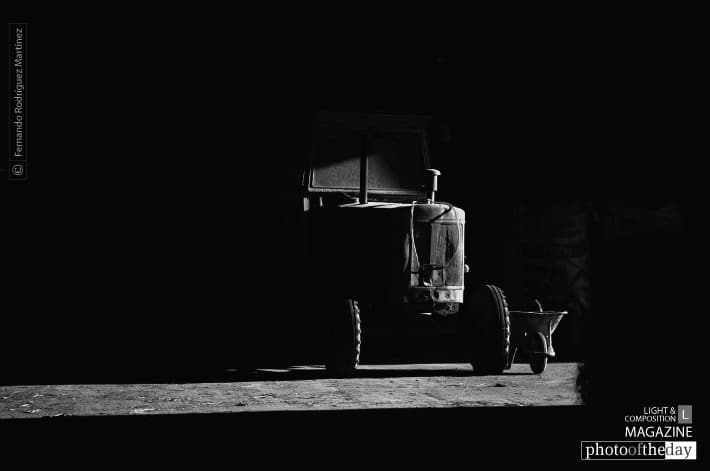
Exposure 1/640sec @ f/2.8 | ISO 400 | Focal Length 17-55mm
Fernando Rodríguez
Born in 1976 in León, Spain, Fernando Rodríguez is a Madrid-based lead programmer who discovered his passion for photography while documenting his first son's early years. His transition from a hobbyist to a dedicated artist has been marked by a keen eye for minimalist composition and evocative light. His talent gained international recognition in 2009 when his work was selected by Canon for an international brochure, solidifying his reputation as a photographer who finds profound narrative depth in the everyday world.
Resonance Score Breakdown
Transparency Note: The resonance score (14.9/20) is calculated based on social engagement metrics collected before the award announcement.
Expert Photography Reviews · 4
The Weight of Rest
There is a specific exhaustion that belongs to the earth. It is not the fatigue of a man who has run too far, but the stillness of something that has held the weight of the world for a season.
Read the reflection →The Weight of Rest
We often speak of labor as a thing that happens in motion—the turning of a wheel, the furrowing of soil, the rhythmic pulse of a day spent in pursuit of a harvest. Yet, there is a profound, quiet language in the stillness that follows.
Read the reflection →Reviews & Comments
Share your thoughts about this award-winning photograph. Your reviews contribute to the community engagement score.
One suspects the light cooperated on the first attempt. It often does, for the patient. Rodríguez has captured the weary slump of that tractor with a precision that suggests he didn’t just stumble upon it. I’ve spent enough afternoons in the León heat to know that rust doesn’t glow like that by accident. It’s a quiet, honest bit of work. I find myself wanting to offer the machine a drink. It’s earned its rest, and clearly, so has he.
Shadows don’t merely cling to this tractor; they define its exhaustion. In Villaornate, the light isn’t golden—it’s a heavy, dying weight pressing against rusted iron. I’ve spent hours staring at these dark, recessed gears, and it’s unsettling how they mirror our own fatigue. It doesn’t just depict a machine; it captures the silence of labor. When the sun retreats, the metal finally stops pretending it’s alive. It’s a brutal, honest surrender to the encroaching dark.
The ochre of the León soil bleeds into the tractor’s rusted iron, a palette reminiscent of Morandi’s dust-choked still lifes, where the light doesn’t merely illuminate but clings to the metal like a tired sigh. It’s a chromatic exhaustion that I find profoundly moving; the way the burnt sienna shadows deepen against the fading amber sky makes my heart ache for the quiet, heavy stillness of a day’s end, where even machines finally surrender their weary, mechanical ghosts.
Most agricultural studies I’ve reviewed this year are cluttered, noisy, and forgettable. Rodríguez succeeds because he understands that silence is a visual element. The way the light catches the rusted metal isn’t just technical precision; it’s an act of empathy. I’ll admit, looking at this tractor’s weary, slumped posture actually makes me feel a bit tired myself. It’s a rare, quiet dignity that’ll still resonate thirty years from now when the machinery is long gone.
Simple with deep meaning. I love it!