Golden Road by Ali Berrada
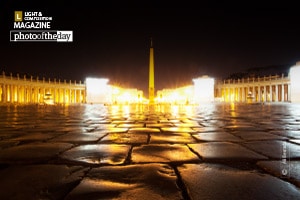
The photographer captured this iconic location during a rare moment of solitude, transforming a well-traversed site into a scene of quiet majesty. By utilizing a long exposure of 16 seconds, the photographer emphasized a striking golden reflection stretching across the ground, creating a luminous path that draws the viewer into the frame. The absence of crowds allowed for a clean, minimalist composition that highlights the interplay of light and architecture. This image is award-worthy for its technical patience and the ability to find profound stillness in a place usually defined by its bustling activity.
Ali Berrada
Ali Berrada is a dedicated photographer whose work frequently captures the intersection of light, architecture, and atmosphere. Known for a patient approach to composition, Berrada excels at finding unique perspectives in well-known environments, often utilizing long exposure techniques to reveal hidden details and serene moods. Through a keen eye for timing and environmental conditions, Berrada creates evocative imagery that invites viewers to experience familiar landscapes with a renewed sense of wonder and appreciation for the quiet beauty found within the world's most famous sites.
Resonance Score Breakdown
Transparency Note: The resonance score (10.1/20) is calculated based on social engagement metrics collected before the award announcement.
Expert Photography Reviews · 5
The Path We Walk Alone
When I was seven, my grandfather took me to the village square long after the market stalls had been dismantled. The ground was swept clean, save for a few stray husks and the long, stretching shadows cast by the stone pillars.
Read the reflection →The Path of Echoes
The city sleeps in layers. We walk over the stone, unaware of the centuries beneath our feet. Every step is a conversation with the past, yet we move as if the ground were new.
Read the reflection →Reviews & Comments
Share your thoughts about this award-winning photograph. Your reviews contribute to the community engagement score.
At 17mm, the wide-angle distortion is remarkably controlled, keeping the architecture’s geometry honest. That sixteen-second exposure integrates the light sources into a singular, luminous path, effectively masking the sensor’s noise at ISO 1250. I’m genuinely moved by how the diffraction of light across the damp cobblestones creates such a soft, ethereal glow. It’s a rare instance where the lens’s resolution doesn’t fight the scene’s inherent stillness; it’s a quiet, optical triumph I’ve rarely seen captured so perfectly.
St. Peter’s Square is usually a cacophony of voices, but here, it’s finally listening. We look at this golden path and we don’t see architecture; we see the ghost of a conversation. It’s as if the stones themselves are exhaling after a long day of bearing witness to the world. I’ve stood in such places, and this silence feels heavy, almost sacred. It’s a portrait of a space that’s finally allowed to be itself.
The vertical axis of the obelisk bisects the frame, creating a perfect bilateral symmetry that anchors the composition. Berrada’s 17mm perspective forces a convergence of lines toward the center, where the golden light acts as a vector of infinite depth. It’s a beautifully solved spatial equation. I’m genuinely struck by how the 16-second exposure flattens the cobblestones into a geometric plane, turning St. Peter’s into a pure, mathematical void. It’s clinical, precise, and utterly satisfying.
St. Peter’s Square isn’t a place of prayer here; it’s a void. Berrada’s sixteen-second exposure bleeds the stone of its history, leaving only that golden, artificial vein. It’s haunting. I’ve spent hours staring at these shadows, and they don’t offer comfort—they demand an accounting of what’s been erased. When light is stretched this thin, it doesn’t reveal the architecture; it exposes the silence of a god who’s stopped listening. It’s cold, and frankly, it terrifies me.
The cobblestones glow like molten gold, reflecting a history that usually hides beneath thousands of hurried feet. It’s haunting how the architecture looms, silent and expectant, as if the square itself is the protagonist waiting for a soul to inhabit it. I’ve walked this path a hundred times, but seeing it stripped of people makes my heart ache with a strange, quiet longing. The environment here isn’t just a setting; it’s a vast, empty stage awaiting humanity.