Golden City by Joy Dasgupta
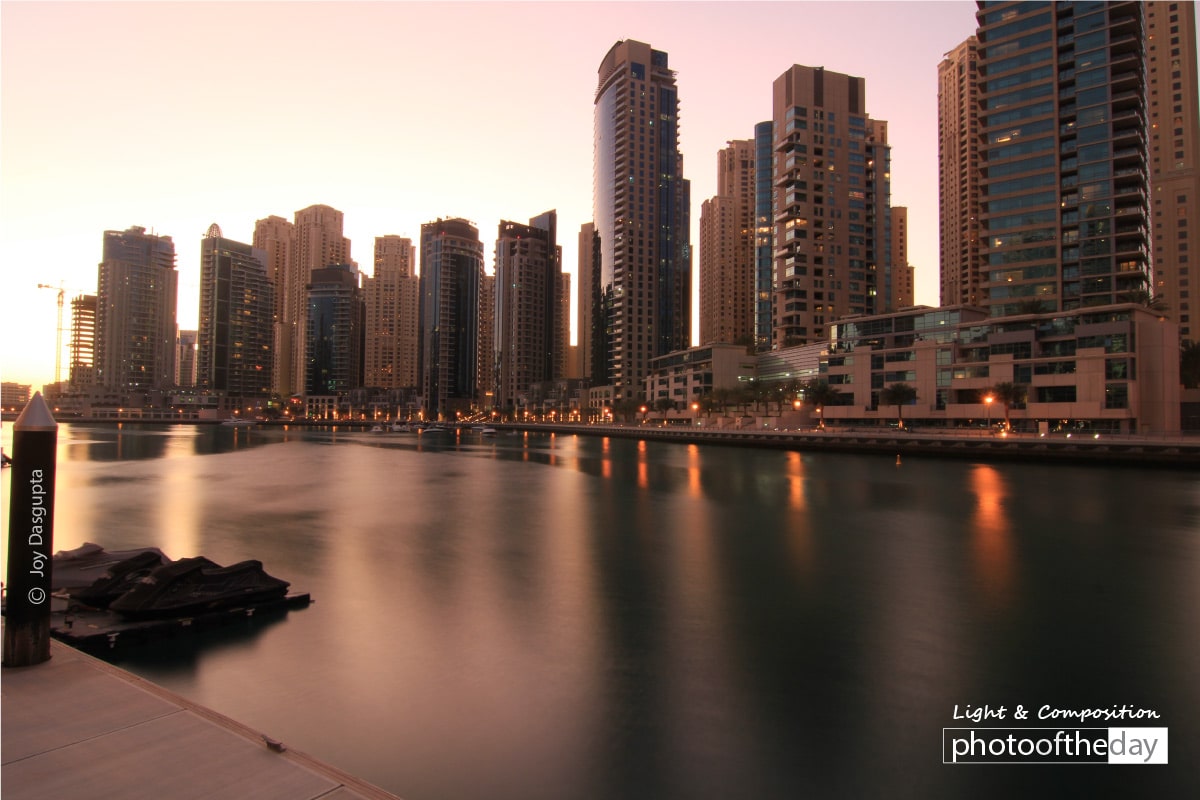
Captured along the two-mile stretch of the Persian Gulf, this long-exposure photograph showcases the architectural brilliance of Dubai Marina. By utilizing a 25-second exposure at f/18, the photographer masterfully smoothed the canal waters while capturing the vibrant, golden glow of the city's modern skyline. This image is award-worthy for its technical precision in night photography, effectively balancing the artificial illumination of the renaissance-inspired buildings against the deep, tranquil tones of the night. It serves as a compelling testament to the rapid urban evolution of the 'Golden City,' highlighting the harmony between man-made structures and the surrounding coastal environment.
Joy Dasgupta
Born in India in 1977 and a graduate of Calcutta University, Joy Dasgupta has resided in the United Arab Emirates for the past seven years. An active member of both the Emirates Photography Club and the Kolkata Photographers Club, he views photography as a profound passion and a dedicated pursuit of artistic growth. Inspired by the masters of the craft, Dasgupta continuously challenges himself to refine his technical skills and vision, seeking to capture the world through a unique, observant lens.
Resonance Score Breakdown
Transparency Note: The resonance score (11.3/20) is calculated based on social engagement metrics collected before the award announcement.
Expert Photography Reviews · 7
Lights That Never Sleep
I was walking home late last night, the kind of night where the air feels heavy and the streets are mostly empty. I found myself counting the windows in the apartment block across from mine.
Read the reflection →The Architecture of Ambition
We often mistake the skyline for the city. We look at the vertical reach of glass and steel and assume it represents progress, a testament to human ingenuity rising above the dust.
Read the reflection →Reviews & Comments
Share your thoughts about this award-winning photograph. Your reviews contribute to the community engagement score.
Twenty-five seconds of stillness. It’s technically sharp, sure, but where’s the pulse? Street photography isn’t about smoothing water into glass; it’s about the chaos you can’t control. I look at this Dubai skyline and I’m bored. It’s too static, too perfect. Cartier-Bresson would’ve hunted for a stray boat or a shadow crossing that frame. Without a human heartbeat, the moment doesn’t exist. It’s just architecture. I need the street to bite back, not pose.
Dubai Marina is a glittering stage, but where are the people? I’ve spent my life looking for the pulse of a city in the eyes of those who live there. Here, the architecture is perfect, yet it’s hollow. It’s a beautiful, golden shell, but it doesn’t breathe. I find myself aching for a single human face in these windows. Without a soul to anchor it, this city feels like a lonely, expensive dream.
The frame’s geometry relies on the canal’s horizontal axis to anchor the vertical thrust of the towers. It’s a rigid, calculated architecture. The long exposure flattens the water into a sterile mirror, forcing the eye toward the golden highlights. It’s almost too clinical, yet I’m struck by the cold, mathematical precision of the reflection. The composition holds, but it doesn’t breathe. It’s a triumph of structure over the chaos of the city.
Technically, it’s a textbook long exposure, but that’s exactly why it leaves me cold. By stopping down to f/18, Dasgupta has flattened the city into a sterile, hyper-resolved postcard. It’s too safe. I’d have preferred the chaos of motion, something closer to Sugimoto’s blurred theatres. Why resolve every window when the light could have bled into something visceral? It’s technically perfect, yet it’s missing the soul that only a deliberate, beautiful failure can provide.
Dubai Marina glows, but at what cost? This long exposure turns the canal into a sterile, glass-like void, erasing the labor that built these towers. I feel a cold detachment looking at this golden facade. Why does the frame exclude the people who actually inhabit this space? It’s technically sharp, sure, but it’s also hollow. Whose city are we really celebrating here? It’s a beautiful, gilded cage that leaves me wanting something human, something real.
The water doesn’t move. It’s a sheet of glass, holding the gold of the towers in a perfect, silent grip. I’ve spent minutes staring at the black void beneath the bridge. It’s heavy. It’s quiet. Most would crowd this frame with more light, more noise. Dasgupta chose the dark. Nothing here is accidental. The empty corner is not empty. It’s a breath. I feel my own pulse slow down in the presence of this stillness.
Of the thousands of cityscapes I’ve reviewed, most are just postcards. What separates this from the rest is the f/18 aperture; it forces the city lights into sharp, star-like points that anchor the frame. I’m genuinely moved by how the stillness of the water creates a mirror for that excess. It’s a snapshot of a fleeting era of expansion. In thirty years, we’ll look back at this golden glow and finally understand the ambition.
Nice!