Generation Next by Kamalesh Das
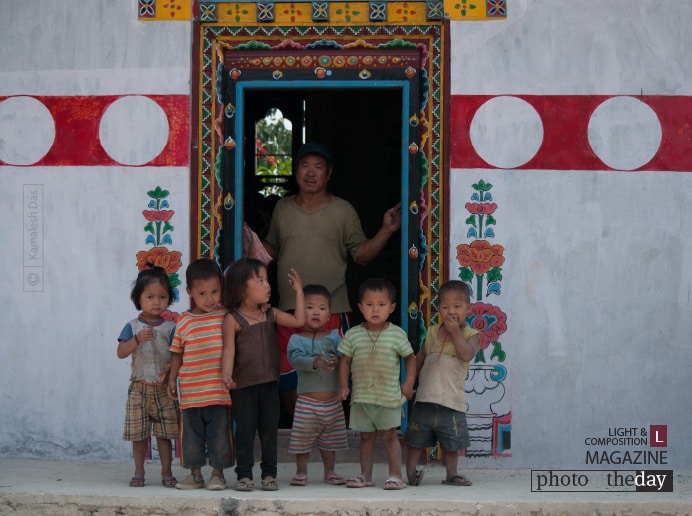
In the quiet village of Lepcheka, Kamalesh Das captured a poignant moment of transition. While children played before the backdrop of a newly constructed monastery, a worker emerged from the doorway, creating an immediate, compelling juxtaposition. The photographer acted instinctively, framing the scene to highlight the interplay between the innocence of the next generation and the labor that shapes their environment. This image is award-worthy for its candid composition and the evocative storytelling achieved through a fleeting, perfectly timed encounter, grounding the viewer in a specific cultural moment.
Kamalesh Das
Based in Cooch Behar, West Bengal, Kamalesh Das balances a career as a school teacher with a dedicated pursuit of street photography. Since acquiring his first DSLR in 2008, he has cultivated a keen eye for finding profound visual narratives in everyday surroundings, from local landscapes to his own home. Driven by a philosophy of constant renewal, he approaches every shutter release as a fresh challenge, consistently striving to evolve his perspective and capture the unique essence of his subjects.
Resonance Score Breakdown
Transparency Note: The resonance score (13.2/20) is calculated based on social engagement metrics collected before the award announcement.
Expert Photography Reviews · 6
The Architecture of Becoming
We often speak of the future as if it were a distant country, a place we might eventually visit if we pack the right intentions. Yet, the future is not a destination; it is a slow, rhythmic accumulation of the present.
Read the reflection →The Architecture of Becoming
We build our monuments out of stone and intention, hoping they will hold the weight of our dreams long after our hands have grown tired.
Read the reflection →Reviews & Comments
Share your thoughts about this award-winning photograph. Your reviews contribute to the community engagement score.
The monastery wall stretches. It’s a vast, pale silence. The children are small, blurred motion against the stone. Then, the worker. He steps from the dark threshold. It’s a sudden, sharp interruption. I’ve spent minutes staring at that sliver of shadow behind him. It’s heavy. It’s where the story hides. Nothing here is accidental. The empty corner is not empty. It’s the weight of the future, pressing against the stillness of the present. I feel breathless.
The ochre dust of Lepcheka clings to the air, a warm, earthy pigment reminiscent of a Morandi still life, yet it’s the sudden, startling intrusion of the worker’s deep indigo tunic that truly arrests the senses. It’s a chromatic collision I find utterly intoxicating, a sharp, cool dissonance against the sun-bleached monastery walls. One feels the weight of that blue, a heavy, velvet silence that anchors the fleeting, golden innocence of the children playing in the light.
The monastery’s rigid geometry anchors the frame, providing a necessary counterpoint to the chaotic movement of the children. It’s a precarious balance. The worker’s emergence from the doorway creates a sharp fulcrum, pulling the eye toward the center. I’ve rarely seen such spatial tension held so effectively. The negative space doesn’t just exist; it dictates the rhythm. It’s a clinical success. The frame holds, though the narrative sentiment threatens to collapse the structure entirely.
The monastery doorway doesn’t merely frame a worker; it acts as a threshold between the unburdened play of children and the crushing weight of structural labor. I’m struck by how the shadow swallows the man’s features, turning him into a silhouette of necessity. It’s a stark reminder that progress isn’t built on light, but on the darkness we force others to inhabit. It’s haunting, really. Das understands that history is written in the shade, not the sun.
The light in Lepcheka doesn’t rush. It clings to the monastery walls, waiting for the children to find their rhythm. I’ve spent enough mornings in the hills to know that worker didn’t just appear; he emerged when the air grew still. It’s a quiet, heavy grace. Seeing these small lives framed against such labor makes my chest ache with a familiar, bittersweet recognition. He stood there, patient, until the land finally allowed him to see.
At 55mm, the Nikkor’s focal plane renders the monastery’s texture with clinical sharpness, yet the f/5 aperture introduces a gentle bokeh that softens the background’s harsh geometry. It’s a delicate balance; the diffraction limit hasn’t compromised the worker’s silhouette against the light. I’m genuinely moved by how the lens captures the children’s movement—it’s a fleeting optical intersection of labor and youth. You don’t often see such precise physics grounding a moment of pure, human transition.
superb