Front Door by Claudio Bacinello
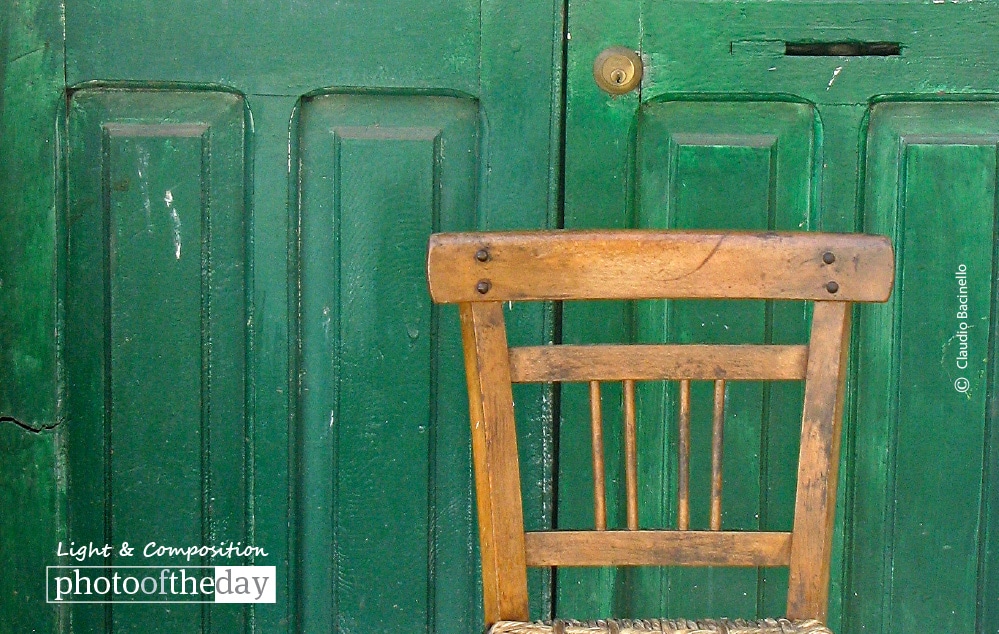
In the quiet town of St. Onofrio, Italy, the photographer captured a poignant slice of local life. Drawn to the simple architecture and the communal tradition of neighbors gathering outside their homes, the photographer focused on a weathered wooden chair resting against a vibrant green door. By moving in tight, the composition emphasizes the striking color contrast and the texture of the scene, transforming a mundane domestic fixture into a compelling study of stillness and culture. This image stands out for its ability to find profound visual interest in the everyday rhythms of Italian village life.
Claudio Bacinello
Born in Italy, Claudio Bacinello is a seasoned photographer now based in Thornhill, Canada. With a career spanning three decades, he has mastered diverse disciplines ranging from wedding and portraiture to corporate and stock photography. His current work focuses on travel, wildlife, and nature, driven by a global pursuit of compelling stories. Bacinello’s work has been published internationally and is widely collected as fine art for both private and corporate spaces.
Resonance Score Breakdown
Transparency Note: The resonance score (5.0/20) is calculated based on social engagement metrics collected before the award announcement.
Expert Photography Reviews · 4
The Threshold of Belonging
A doorway is never just a physical barrier; it is a social contract. In the architecture of our daily lives, the threshold acts as the primary filter between the private sanctuary of the home and the collective pulse of the street.
Read the reflection →The Weight of a Threshold
I remember a house in a village near the coast where the paint on the front door had peeled away in long, sun-baked ribbons. My grandmother used to say that a door is never just a barrier; it is a promise of who might arrive and a record of who has already left.
Read the reflection →Reviews & Comments
Share your thoughts about this award-winning photograph. Your reviews contribute to the community engagement score.
Most entries I see in this category rely on tired tropes of Italian nostalgia. Bacinello avoids that trap by tightening the frame until the chair’s splintered wood and that aggressive, peeling green paint become a tactile confrontation. It’s not just a door; it’s a portrait of abandonment. I’ve stared at this for weeks, and I still feel a strange, quiet ache for the person who isn’t sitting there. That’s why it’ll still matter in thirty years.
You’ve caught the quiet weight of a life lived in St. Onofrio. That weathered chair against the green paint isn’t just a still life; it’s a ghost of a conversation that ended ten minutes ago. I can almost smell the dust and the espresso. Because you didn’t clutter the frame, I feel the loneliness of that empty seat. You waited for the stillness to settle. There’s something honest happening here. It’s a beautiful, aching silence.
A weathered chair against a green door. It’s a tidy composition, but one wonders if the photographer simply happened upon it during a stroll. I’ve spent enough mornings shivering in Italian doorways to know that the best shots aren’t found; they’re invited. Did he return when the light hit that paint just right, or was it a lucky snap? It’s pleasant enough, but I’m left wanting the grit of a longer, colder commitment.
The vertical axis of the door frame bisects the composition, creating a perfect 1:1 tension against the chair’s lateral sprawl. Bacinello’s framing forces a rigid grid where the chair’s legs act as vectors grounding the vibrant green mass. I’m genuinely struck by how the weathered wood grain disrupts the geometric purity of the door’s panels. It’s a beautifully solved spatial equation; the negative space doesn’t just exist, it balances the entire weight of the frame.