Footprints in the Snow by Payman Mollaie
Captured in the serene landscapes of Taleghan, this photograph masterfully utilizes the pristine, blank canvas of a snow-covered environment to isolate and emphasize its subject. By stripping away visual clutter, the photographer highlights the rhythmic pattern of human footprints, which serve as a powerful leading line that draws the viewer into the frame. The decision to focus on these tracks creates a profound sense of depth and scale, transforming a simple walk through the snow into a compelling narrative of solitude and exploration. This image stands out for its minimalist aesthetic and the intentional use of negative space to evoke a quiet, contemplative atmosphere.
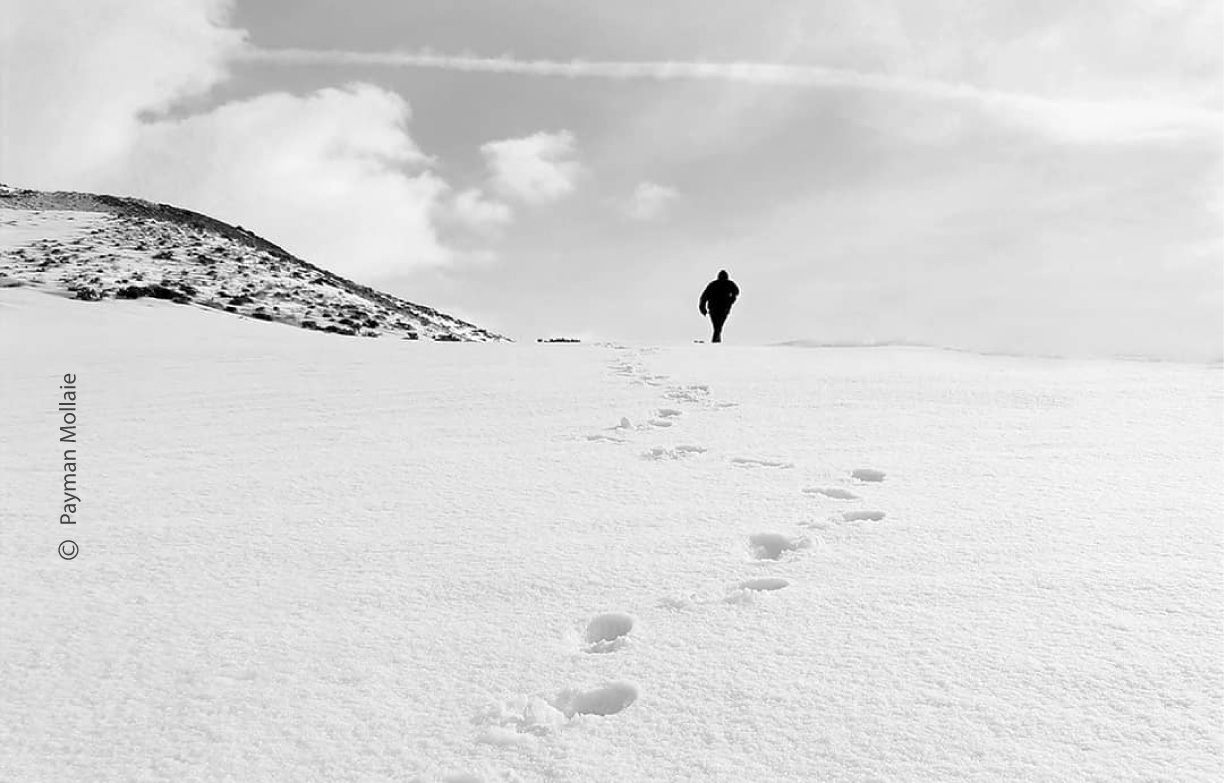
Exposure 1/160sec @ f/10 | ISO 100 | Focal Length 18mm
Payman Mollaie
Born in 1981 in Qazvin, Iran, Payman Mollaie is a dedicated photographer with a profound passion for travel and the minimalist beauty of winter landscapes. Often working with analogue equipment, he focuses on clean compositions that strip away the superfluous to reveal the essence of his subjects. His work is defined by a deep appreciation for the transformative power of snow, which he uses to create stark, evocative imagery that captures the quiet stillness of the Iranian countryside.
Resonance Score Breakdown
Transparency Note: The resonance score (11.2/20) is calculated based on social engagement metrics collected before the award announcement.
Expert Photography Reviews · 6
The Geometry of Passage
When a fox moves through deep snow, it does not walk in a straight line; it leaves a series of rhythmic, singular indentations, a trail that functions as a map of its singular intent.
Read the reflection →The Weight of a Step
There is a specific, heavy silence that descends when the air turns to ice and the sky settles into that flat, bruised violet of a winter afternoon. In the north, we learn to read the snow not as a surface, but as a ledger.
Read the reflection →Reviews & Comments
Share your thoughts about this award-winning photograph. Your reviews contribute to the community engagement score.
Taleghan in winter isn’t for the faint of heart. One suspects Mollaie didn’t just stumble upon these tracks; he likely spent hours shivering while the wind erased his own path. It’s a stark, honest frame. I’ve spent enough mornings in sub-zero temperatures to recognize the ache in those footprints. He didn’t just find a composition; he committed to the cold until the light finally felt right. It’s a quiet, earned piece of work.
The palette here isn’t merely white, but a shivering, glacial blue—the hue of shadows cast upon a Vermeer floor—that makes one’s own skin ache with the cold. It’s a quiet, monochromatic rapture where the footprints, etched in the bruised violet of deep winter dusk, pull the eye into a void of infinite stillness. I’ve never felt such a profound, icy solitude; it’s as if the light itself has been drained of all warmth.
It’s a strange shift for me, trading the crushing pressure of the deep for this stark, terrestrial silence. I’m used to fighting water’s refractive index and the relentless loss of the red spectrum, but here, the light is unfiltered and brutal. Those footprints are a clean, rhythmic trail—a stark contrast to the chaotic backscatter I usually battle. It’s hauntingly beautiful. I’ve spent my life chasing bioluminescence, but this cold, crisp clarity actually makes me shiver.
Most entries in this category rely on grand vistas, but this work succeeds by shrinking the world down to a single, rhythmic path. The footprints don’t just lead the eye; they anchor a vast, empty silence. I’ve seen thousands of snowy landscapes, yet this one feels intimate, almost fragile. It’s the restraint that makes it endure. I find myself wanting to walk that trail just to see if the solitude feels as heavy as it looks.
The silence here is heavy, but it’s the silence of a human path, not the wild. I find myself searching the edges for a fox’s print or a raptor’s shadow, but there’s nothing. It’s a clean, cold composition, yet it feels hollow. When I’m out in the drifts, I’m looking for the animal’s story, not my own. This is just a walk in the snow, and honestly, it leaves me feeling quite cold.
Footprints carve a path through Taleghan, but where do they lead? The frame isolates the tracks, yet it erases the walker. Why must we romanticize this void? It’s a clean, quiet aesthetic, but I find the silence unsettling. Does the snow hide a history, or does the photographer simply prefer the landscape empty? I’m left wondering whose solitude we’re consuming here. Is this exploration, or just a beautiful way to ignore the people who actually live there?