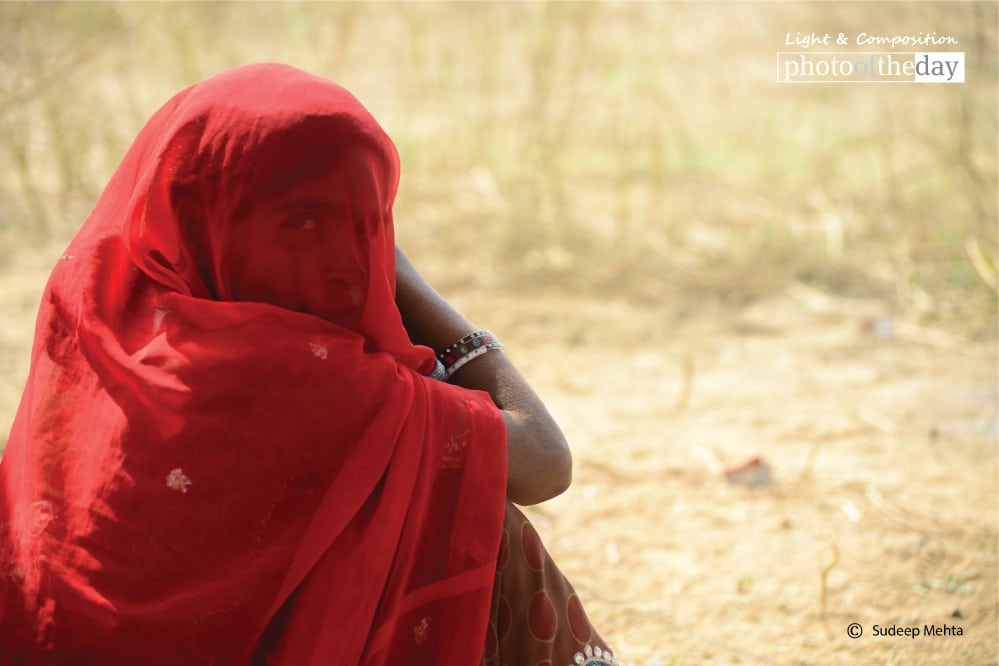
Eyes Of The Nomad by Sudeep Mehta
In this striking portrait, a nomad woman gazes directly into the lens from behind the delicate folds of her Ghoonghat. The photographer captures a moment of raw, human connection amidst the vibrant cultural backdrop of Pushkar. By focusing on the interplay between the traditional veil and the subject's expressive eyes, the image transcends a simple portrait to become a profound study of identity and resilience. The composition is masterfully balanced, drawing the viewer into the subject's world and highlighting the quiet dignity of a nomadic life, ultimately earning recognition for its evocative storytelling and technical precision.
Sudeep Mehta
Based in Mumbai, India, Sudeep Mehta is a versatile freelance photographer with a deep specialization in portraiture, event, and wedding photography. His professional journey began in film editing, a background that transitioned him into documentary and short filmmaking, while his commitment to environmental advocacy informs his visual perspective. Driven by a lifelong passion for the craft, Mehta balances his commercial work with a dedicated pursuit of photojournalism, consistently seeking to capture authentic human narratives that resonate with global audiences.
Resonance Score Breakdown
Transparency Note: The resonance score (12.2/20) is calculated based on social engagement metrics collected before the award announcement.
Expert Photography Reviews · 4
The Geography of the Veil
We often mistake visibility for presence. In the modern city, we are conditioned to believe that to be seen is to be known, and that to be hidden is to be absent. Yet, there is a profound power in the threshold—the space between the public gaze and the private self.
Read the reflection →The Weight of a Gaze
I remember sitting in a tea stall in Pushkar, watching the dust settle on the main road as the afternoon heat began to break. An old woman sat across from me, her face partially obscured by the heavy fabric of her veil.
Read the reflection →Reviews & Comments
Share your thoughts about this award-winning photograph. Your reviews contribute to the community engagement score.
Most portraits from Pushkar are just tourist trophies, but this one hits differently. I’ve seen thousands of veiled faces, yet the way the fabric frames her gaze here forces a confrontation I can’t look away from. It’s the tension between the heavy, textured veil and the startling clarity of her iris that makes me stop. Thirty years from now, that specific, weary intensity will still feel like a secret being whispered directly to the viewer.
The veil’s geometry dictates the frame. It’s a rigid architecture of fabric that forces the eye toward the ocular fulcrum. The negative space surrounding the Ghoonghat provides the necessary tension, preventing the portrait from collapsing into mere sentiment. I’ve grown weary of such ethnographic tropes, yet the structural discipline here holds. The balance is precise. It doesn’t rely on the subject’s gaze for impact; it relies on the sharp, unforgiving intersection of line and shadow.
The ochre dust of Pushkar clings to the fabric, a burnt-sienna warmth that echoes the sun-baked stillness of a Morandi study, yet it’s the piercing, cobalt-ink intensity of her gaze that truly undoes me. One finds the interplay between the veil’s dusty, muted terracotta and those liquid, shadow-drenched irises creates a chromatic tension so profound, it’s as if the very air between us has thickened into a heavy, resonant, and utterly breathless indigo silence.
The jury’s obsession with technical precision here feels suffocating. Why resolve the veil’s texture so clinically when the eyes could have been a haunting, kinetic blur? It’s a missed opportunity for abstraction. I’m genuinely frustrated; the Ghoonghat offers a perfect canvas for motion, yet it’s frozen in static clarity. This approach is closer to a passport photo than Hiroshi Sugimoto’s long-exposure theatres. What did Mehta fear losing by letting the focus slip into something truly visceral?