Enjoyment of Freedom by Saumalya Ghosh
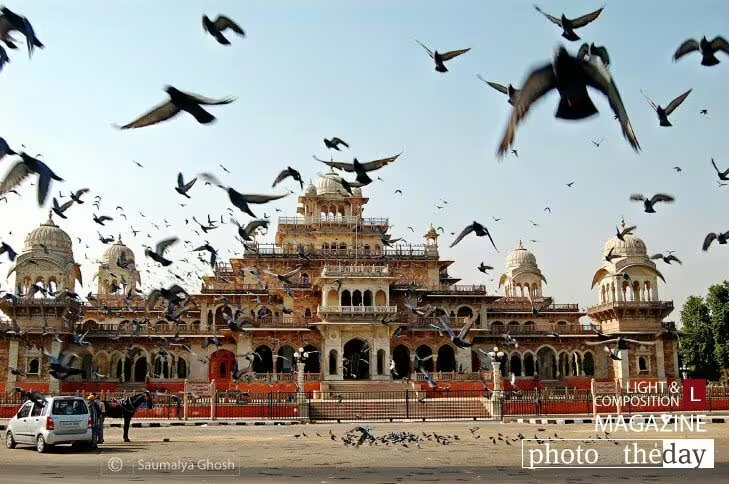
Captured in the vibrant atmosphere of Jaipur, India, this photograph depicts a breathtaking moment in front of the Albert Hall Museum. On a bright, sun-drenched day, thousands of pigeons took to the air, embodying a sense of unbridled liberty. The photographer expertly utilized a wide-angle perspective to frame the sheer scale of the flock against the historic architecture. This image is award-worthy for its masterful capture of motion and the poetic juxtaposition of urban heritage with the spontaneous, rhythmic energy of nature, perfectly encapsulating the theme of freedom in a single, decisive frame.
Saumalya Ghosh
Based in Kolkata, India, Saumalya Ghosh balances a professional career as a software engineer with a profound dedication to the art of photography. Since 2010, he has cultivated a unique visual language centered on the philosophy of seeing with the eyes and shooting with the heart. His diverse portfolio spans landscape, portrait, travel, and street photography, all driven by a belief that creative vision and passion far outweigh the importance of technical gear. Ghosh continues to pursue his dream of making a meaningful contribution to the global photographic community.
Resonance Score Breakdown
Transparency Note: The resonance score (13.2/20) is calculated based on social engagement metrics collected before the award announcement.
Expert Photography Reviews · 6
The Architecture of Breath
To be unanchored is a terrifying grace. We spend our lives building stone walls and naming the corners of our rooms, convinced that stability is the only way to survive the wind. Yet, there is a secret language in the way things scatter when the air suddenly shifts.
Read the reflection →The Pulse of Air
The smell of dry, sun-baked stone always brings me back to the heat of a summer afternoon, the kind that makes the air shimmer like a held breath.
Read the reflection →Reviews & Comments
Share your thoughts about this award-winning photograph. Your reviews contribute to the community engagement score.
Pigeons are notoriously uncooperative subjects, yet here they’ve been coaxed into a perfect, swirling geometry against the Albert Hall. One suspects Ghosh didn’t just stumble upon this; he likely stood in that Jaipur heat until his boots felt fused to the pavement. It’s a rare, disciplined bit of timing. I’ve spent enough afternoons chasing birds to know the frustration of a missed frame. He clearly earned this one. It’s a fine, patient piece of work.
The Albert Hall’s rigid geometry anchors the frame, providing a necessary fulcrum for the chaotic dispersal of avian forms. It’s a precarious balance. The wide-angle lens stretches the architecture, yet the pigeons’ rhythmic density prevents the composition from collapsing into mere noise. I’m genuinely unsettled by how the negative space above the dome threatens to swallow the flock. It doesn’t always hold, but here, the structural discipline keeps the chaos contained within the frame’s edge.
Of the thousands of motion shots I’ve reviewed, most are just blurry chaos. What separates this from the pack is the geometry; the Albert Hall’s rigid symmetry acts as a cage, making the chaotic explosion of pigeons feel genuinely liberating. It’s a rare, visceral contrast. I’ll admit, the sheer scale of the birds actually made me hold my breath. Thirty years from now, we won’t remember the gear, but we’ll still feel that sudden, frantic rush.
Jaipur’s sun is a tyrant, bleaching the Albert Hall into a flat, historical ghost. Ghosh captures the pigeons, but he’s terrified of the void between them. It’s all frantic motion, yet it lacks the gravity of true silence. I’ve spent hours staring at these wings, hoping for a single, deep shadow to anchor the chaos. It’s beautiful, sure, but it’s a hollow freedom. Without darkness, the birds are just noise against a blinding, indifferent sky.
The air in Jaipur holds a heavy, ancient stillness, yet here, it’s shattered by a thousand beating wings. I’ve stood in squares like this, waiting for the birds to decide when the sky belongs to them. Ghosh didn’t just capture motion; he listened to the sudden, frantic pulse of life against the stone. It’s a dizzying, beautiful chaos. I feel a strange, quiet ache in my chest watching them reclaim the horizon from the museum.
Jaipur’s sandstone glow, that dusty ochre of a Turner sunset, anchors the frame, yet it’s the grey-blue flurry of wings—the colour of slate caught in a sudden, cold downdraft—that truly steals one’s breath. I’ve found myself mesmerized by how these avian shadows quarrel with the warm, historic masonry, creating a rhythmic, chromatic dissonance that feels like a Morandi still life suddenly shattered into a thousand frantic, living, breathing shards of pure, unadulterated kinetic joy.