Emptiness by Jabbar Jamil
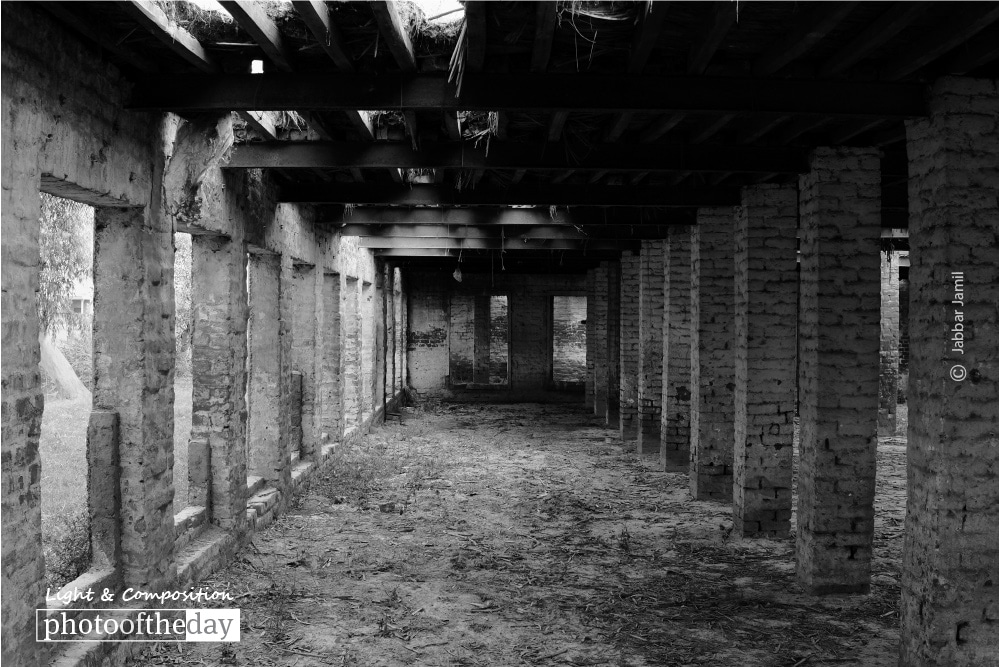
Captured while traveling near Sialkot, this photograph highlights a solitary structure standing amidst open fields. The photographer was struck by the profound sense of emptiness, finding beauty in the stark symmetry and the interplay of light and shadow across the landscape. Recognizing the scene's potential for a minimalist aesthetic, the image was composed specifically for a black-and-white medium to emphasize form and texture. This straight-out-of-camera shot is award-worthy for its disciplined composition and the photographer's ability to transform a quiet, overlooked moment into a compelling study of space and atmosphere.
Jabbar Jamil
Based in Sialkot, Pakistan, Jabbar Jamil is a dedicated street photographer who views his craft as both a creative outlet and a vital stress-relieving practice. Through his lens, he seeks to step outside his comfort zone, prioritizing the human connections he makes in the field as much as the images themselves. His work is defined by an honest approach to his surroundings, capturing the world exactly as he sees it, whether the subject matter is traditionally beautiful or raw and challenging.
Resonance Score Breakdown
Transparency Note: The resonance score (11.9/20) is calculated based on social engagement metrics collected before the award announcement.
Expert Photography Reviews · 8
The Architecture of Silence
In the high alpine tundra, the soil remains frozen for most of the year, creating a landscape so sparse that only the most resilient mosses and lichens can gain a foothold.
Read the reflection →The Weight of Silence
I once spent an afternoon in a farmhouse outside of Sialkot, sitting with a man named Rashid who had spent his entire life tending to the fields that surrounded his home.
Read the reflection →Reviews & Comments
Share your thoughts about this award-winning photograph. Your reviews contribute to the community engagement score.
We look at this solitary structure in Sialkot and we don’t just see stone; we hear the silence of the fields. Jabbar Jamil didn’t just frame a building; he listened to the wind passing through it. It’s a portrait of absence, where the walls hold the ghosts of a conversation we weren’t invited to join. I feel a sudden, sharp ache of loneliness here. It’s a photograph that asks to be returned to, again and again.
The horizon line bisects the frame with surgical precision, anchoring the solitary structure against a vast, monochromatic void. It’s a study in geometric restraint. The negative space doesn’t merely surround the subject; it dictates the visual weight, forcing the eye toward the center. I’m genuinely unsettled by how the light refuses to soften the harsh edges of the architecture. The composition holds because it doesn’t apologize for its own silence. It’s a rare, disciplined architecture of emptiness.
Most entries in this category rely on heavy contrast to mask a lack of subject. Jamil avoids that trap. By centering the structure, he forces us to confront the silence of the Sialkot plains. It’s a brave, quiet choice. I’ve stared at this for years, and it still feels like a deep breath. It’s the restraint that ensures this will matter in thirty years. It doesn’t scream for attention; it simply exists, perfectly still and entirely complete.
At f/5.6, the Fujifilm’s 23mm lens hits its sweet spot, resolving the Sialkot dust with clinical precision. The focal plane is razor-thin, yet it captures the texture of the soil with a clarity that defies the eye’s natural limitations. I’m genuinely moved by how the diffraction of light across that solitary structure creates such stark, geometric tension. It’s a rare moment where the sensor’s resolution perfectly aligns with the landscape’s quiet, haunting emptiness. It’s simply beautiful.
It’s a quiet bit of work, isn’t it? One suspects Jabbar Jamil didn’t just stumble upon this structure while passing through. The way the light clings to those stark, geometric walls suggests he’s spent a fair few hours shivering in the Sialkot dust, waiting for the sun to align just so. I’ve spent enough mornings in similar fields to recognize that particular stillness. It’s earned, not found. A rare, disciplined bit of patience in a hurried world.
The silence here is deafening. It’s a wide shot that refuses to cut, holding the Sialkot horizon with a tension that makes my chest tighten. Jamil didn’t just find a structure; he found the exact frame where the world stops breathing. The 33mm lens keeps the geometry honest, stripping away the noise until only the architecture of solitude remains. It’s a perfect, frozen establishing shot. I’d give anything to know what happened just before the shutter clicked.
Sialkot’s fields aren’t just empty space; they’re someone’s livelihood. By stripping away the color and context, Jamil turns a working landscape into a minimalist abstraction. It’s technically precise, sure, but why does the structure feel so lonely? Does the frame erase the labor that sustains this land? I find the clinical detachment here unsettling. We’ve turned a living, breathing geography into a mere aesthetic exercise. Is beauty worth the cost of rendering this place invisible?
Before the eye identifies the structure, something in the chest tightens. It’s a sudden, hollow stillness. Jamil’s Sialkot landscape doesn’t just show space; it demands a physiological surrender. I find my own breath shallowing, mirroring that stark, lonely geometry. When I return to this frame, the silence feels heavier, almost tactile. It’s the kind of image that follows you into sleep, leaving a phantom ache for a place you’ve never actually been. It’s hauntingly, perfectly vacant.