Education for All by Nazmul Shanji
Captured at the Rema Kalenga Wildlife Sanctuary, this poignant documentary photograph depicts a young girl diligently studying outside her home. The image serves as a visual testament to the profound quote, "Give me an educated mother, I'll give you an educated nation." By framing this candid moment of academic pursuit within a rural setting, the photographer highlights the universal importance of education. The composition is award-worthy for its ability to transform a simple, quiet scene into a powerful narrative on social progress and the resilience of the human spirit, masterfully balancing the subject against the backdrop of her environment.
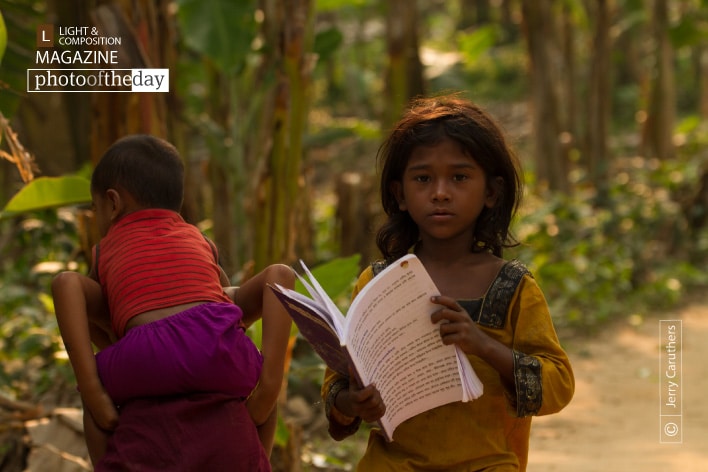
Exposure 1/400sec @ f/5.6 | ISO 400 | Focal Length 124mm
Nazmul Shanji
Born in 1986 and based in Dhaka, Bangladesh, Nazmul Shanji is an electrical power engineer who transitioned into photography as a dedicated passion. His work spans diverse genres, including nature, wildlife, street photography, and candid portraiture, all unified by a desire to capture the unseen narratives of daily life. Through a commitment to self-learning and formal training in photojournalism, Shanji strives to develop a unique artistic signature that reflects his personal observations and deep appreciation for the human experience.
Resonance Score Breakdown
Transparency Note: The resonance score (12.9/20) is calculated based on social engagement metrics collected before the award announcement.
Expert Photography Reviews · 7
The Quiet Architecture of Becoming
There is a quiet, persistent geometry to how we grow. We often imagine that learning happens in grand halls or under the weight of heavy books, but the most foundational shifts usually occur in the margins of a day.
Read the reflection →The Ink of Morning
We often mistake growth for something loud, a sudden bloom or a thunderous arrival. But the most enduring roots are those that anchor themselves in the quietest hours, drinking deep from the soil while the rest of the world is still shaking off the dew.
Read the reflection →Reviews & Comments
Share your thoughts about this award-winning photograph. Your reviews contribute to the community engagement score.
The light here doesn’t merely illuminate; it interrogates. By placing the girl against the encroaching gloom of the Rema Kalenga, Shanji forces us to confront the fragility of her focus. It’s a heavy, quiet resistance against the void. I’ve stared at the way the shadows swallow the edges of her book, and frankly, it breaks my heart. We aren’t watching a student; we’re watching a soul carving out a sliver of meaning from the dark.
1/400sec at f/5.6, 124mm, ISO 400. The Canon 7D’s sensor struggles here; the noise in the shadows is palpable. Using f/5.6 at 124mm provides just enough separation to isolate the subject from the cluttered background, which is a correct tactical choice. It’s a functional capture, though the shutter speed didn’t quite freeze the subtle motion in her hands. I’ve seen sharper, but the technical restraint keeps the narrative focused. It’s honest work, and that’s rare enough.
Before the eye identifies the book, something in the chest tightens. It’s the stillness of the Rema Kalenga light that catches me; I feel a sudden, sharp ache for the quiet focus of a child who doesn’t know she’s being watched. When I return to this, I’m not looking at a lesson. I’m feeling the weight of her concentration. It’s a fragile, breathing activation that stays with me long after I’ve turned away.
At 124mm and f/5.6, the Canon 7D’s sensor resolves the girl’s focus with startling clarity against the Rema Kalenga foliage. The bokeh, a function of the lens’s optical construction, renders the background into a soft, chromatic wash that doesn’t distract from the page. I’m genuinely moved by the way the light catches her concentration; it’s a rare moment where the diffraction limit hasn’t softened the intent in her eyes. It’s technically precise, yet deeply, humanly resonant.
The ochre dust of Rema Kalenga clings to the girl’s skin, a warm, earthy pigment reminiscent of a Morandi still life, grounding her against the cool, verdant shadows of the sanctuary. It’s a chromatic tension that makes my heart ache; the way that vibrant, sun-drenched amber dances against the deep, humid greens of the forest floor creates a symphony of light that feels almost sacred, as if the very air itself is holding its breath.
The light here isn’t forced; it’s the soft, diffused glow of a humid Sylhet afternoon. She sits in that quiet, persistent focus, oblivious to the lens. I’ve spent enough time in the sanctuary’s shade to know that stillness. It’s a sacred, heavy silence. Watching her study, I feel a sudden, sharp ache for the simplicity of her ambition. It’s not just a portrait; it’s a prayer for the future, caught in the cooling, gentle air.
Most documentary work from this region relies on tired tropes of poverty, but this frame avoids that trap. By focusing on the girl’s intense concentration against the textured, weathered backdrop of her home, Shanji captures a quiet defiance. I’ve seen thousands of portraits, yet the way her posture anchors the composition makes me feel genuinely hopeful for her future. It’s a rare, enduring image because it prioritizes her intellect over her circumstances. That’s why it lasts.