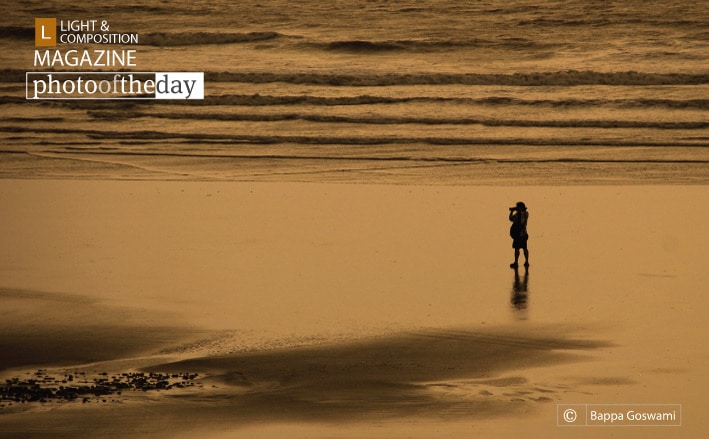
Early Shooter by Bappa Goswami
Captured during the quiet, golden hours of the morning at the sea beach of Mandarmoni, West Bengal, this image documents a serendipitous moment of observation. From the vantage point of a hotel balcony, the photographer spotted a fellow enthusiast immersed in the act of creation. The composition highlights the intersection of human curiosity and the vast, serene coastal landscape. This photograph is award-worthy for its minimalist aesthetic and its ability to transform a simple, candid scene into a poignant narrative about the shared passion for photography, framed by the soft, early light of a new day.
Bappa Goswami
Born and raised in Kolkata, India, Krishna Kalyan Goswami—widely known as Bappa—is a Bangalore-based Network Consulting Engineer at Cisco Systems. A self-taught photographer, he discovered his passion for the craft upon acquiring his first DSLR, the Nikon D80, and has since evolved his practice while balancing a demanding professional career. Though he treats photography as a dedicated creative pursuit outside of his engineering work, his keen eye for minimalist storytelling and candid observation has earned him recognition within the international photography community.
Resonance Score Breakdown
Transparency Note: The resonance score (12.1/20) is calculated based on social engagement metrics collected before the award announcement.
Expert Photography Reviews · 6
The Architecture of Morning
There is a specific silence that belongs only to the edge of the world, where the land loses its nerve and dissolves into the tide. In these hours before the sun has fully claimed the sky, the air feels thin, like a held breath.
Read the reflection →The Edge of the Tide
The morning is a thin line. It separates what we know from what we are about to lose. To stand at the edge of the water is to admit that the land is only a temporary arrangement.
Read the reflection →Reviews & Comments
Share your thoughts about this award-winning photograph. Your reviews contribute to the community engagement score.
The morning light in Mandarmoni doesn’t just fall; it breathes against the wet sand. Bappa stood on that balcony, waiting for the tide to yield its secrets. I’ve felt that same stillness, watching the horizon soften into a pale, golden hum. It’s a quiet communion between two souls—one behind the lens, one before the sea. It makes my own heart ache for that salt-heavy air. He didn’t rush the moment; he simply listened.
Morning light at Mandarmoni isn’t a gift; it’s a confrontation. Goswami’s frame traps the lone figure against an indifferent, encroaching tide. I’m unsettled by how the shadow doesn’t just anchor the subject—it consumes his intent. It’s a stark reminder that we’re all just silhouettes waiting for the sun to fail us. When I look at this, I don’t see a hobbyist; I see a man desperately trying to outrun the inevitable darkness of the frame.
Watching from a balcony is a comfortable way to work, though it rarely yields a photograph that bites. One suspects the light cooperated on the first attempt; it often does, for the lucky. While the composition is tidy, I’m left wanting the grit of the sand. I’ve spent enough mornings shivering in the surf to know that true connection requires getting one’s boots wet. It’s a pleasant scene, but it hasn’t been earned.
The morning light here isn’t merely illumination; it’s a viscous, honeyed amber that clings to the wet sand like a Turner seascape, dissolving the boundary between earth and sky. I’m utterly breathless at how the photographer captures that specific, pale ochre of the Bengal coast, a hue so fragile it feels as if it might evaporate. It’s a quiet, chromatic conversation where the shadows don’t quarrel, but rather whisper in muted, melancholic tones of soft, sun-drenched solitude.
Most entries in this category rely on heavy processing to force minimalism, but this succeeds by simply waiting. The vast, empty negative space of the Mandarmoni sand doesn’t just frame the subject; it isolates the photographer’s solitude. I’ve seen thousands of beach shots, yet this one makes me feel that quiet, early-morning chill. It’s the restraint of the 135mm lens that keeps the narrative intimate. It’s a rare, honest look at why we actually pick up cameras.
The frame’s geometry is its salvation. A solitary figure anchors the lower quadrant, creating a necessary fulcrum against the vast, horizontal void of the Mandarmoni tide line. It’s a precarious balance, yet the negative space doesn’t collapse. I’ve grown weary of sentimental beach scenes, but the clinical isolation here holds my attention. The composition demands a stillness that the subject itself mirrors. It’s a rare instance where the architecture of the frame justifies the silence.