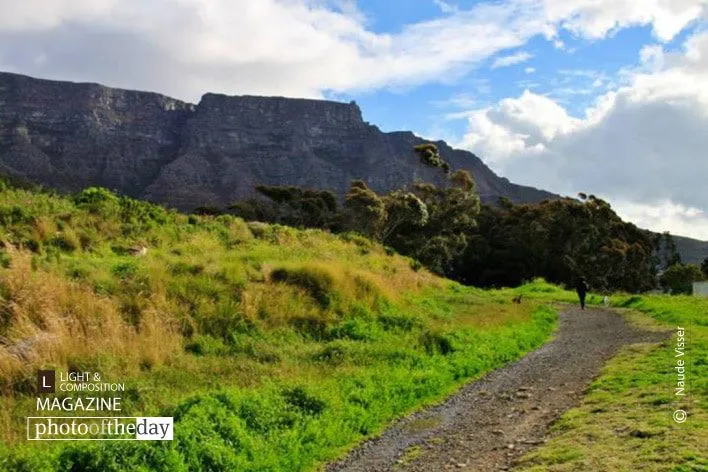
Dirt Road up the Mountain by Naude Visser
Captured along the rugged slopes of Table Mountain, this image highlights the utilitarian beauty of the fire-break paths used by firefighters during the dry season. The photographer masterfully frames the dirt road as it winds upward, juxtaposing the stark, functional landscape against the natural majesty of the mountain. By choosing a mid-range aperture, the photographer ensures both the immediate texture of the path and the distant mountain slopes remain sharp. This composition is award-worthy for its ability to transform a common, overlooked walkway into a compelling narrative of human presence within a wild, protected environment.
Naude Visser
Born in Harrismith and raised in Pretoria, Naude Visser is a South African lawyer and qualified tourist guide now based in the Vredehoek suburb of Cape Town. Though he began his photographic journey relatively recently, his work is deeply influenced by the scenic landscapes he encounters while traveling between Cape Town and his family retreat at Struis Bay. Visser approaches photography with a dedicated, inquisitive spirit, focusing on the natural beauty of the Western Cape as he continues to refine his technical skills and artistic vision.
Resonance Score Breakdown
Transparency Note: The resonance score (12.8/20) is calculated based on social engagement metrics collected before the award announcement.
Expert Photography Reviews · 5
The Geometry of Ascent
In the quiet hours of the morning, I often find myself thinking about the lines we draw across the earth. We are a species obsessed with passage, with the need to carve a way through the wild, stubborn resistance of the landscape.
Read the reflection →The Architecture of Ascent
We are taught to fear the path that scars the earth, as if every line drawn across a hillside is a wound. But perhaps the mountain does not mind the intrusion.
Read the reflection →Reviews & Comments
Share your thoughts about this award-winning photograph. Your reviews contribute to the community engagement score.
The mountain doesn’t yield its secrets to the hurried. Naude stood here in the cooling hour, listening to the dust settle on the fire-break. It’s a quiet, humble scar against the ancient stone. I’ve walked paths like this, feeling the earth’s slow pulse beneath my boots. Looking at this, I feel a sudden, sharp ache for the silence of the Cape. He didn’t just frame a road; he waited until the land finally exhaled.
Most mountain shots are just postcards, but this one sticks. I’ve seen thousands of landscapes, yet Visser’s choice to focus on a utilitarian fire-break instead of the summit is what keeps me looking. It’s the grit of that dirt path cutting through the fynbos that makes it feel real. It’s honest. I actually felt the dry heat of that Cape Town afternoon just looking at it. That’s why it’ll still matter in thirty years.
One suspects the light cooperated on the first attempt. It often does, for the patient. While the composition holds, I find myself wondering if Visser ever returned when the mountain wasn’t so obliging. It’s a tidy shot, certainly, but it lacks the grit of a long, cold vigil. I’ve spent enough hours on those slopes to know that dirt road demands more than a casual afternoon stroll. It’s competent, but it hasn’t been earned.
The diagonal trajectory of the path creates a necessary fulcrum against the mountain’s mass. It’s a rigid geometry that anchors the frame. The aperture choice maintains a sharp, unforgiving depth of field, forcing the eye to reconcile the foreground grit with the distant slope. I’m genuinely unsettled by how the road cuts the composition in two. It doesn’t offer comfort, yet the structural discipline holds. The frame is tight, precise, and entirely sufficient.
At f/11, the 25mm focal length pushes the diffraction limit, yet it’s precisely this trade-off that renders the granular texture of the dirt path with such clinical honesty. I’m genuinely moved by how the lens resolves the micro-contrast of the scree against the mountain’s mass. It’s a rare moment where the optics don’t just capture a scene; they define the physical reality of the slope. It’s sharp, it’s honest, and it’s beautifully, mathematically precise.