Deserted in Desert by Meet Kochar
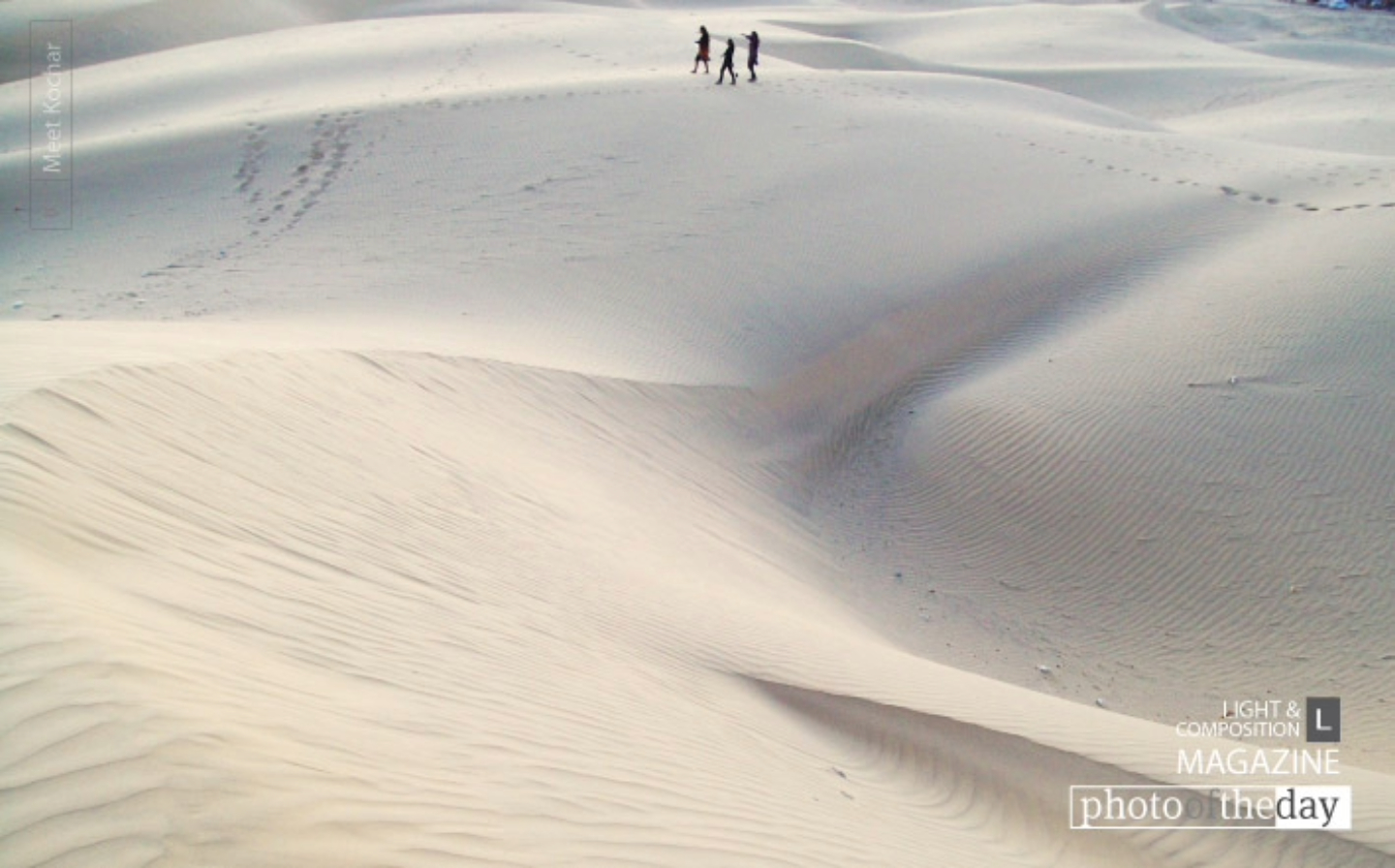
Captured during the early evening in the Jaisalmer Thar Desert, this photograph masterfully conveys the profound immensity and stillness of the landscape. The photographer highlights the vast, serene environment by placing three figures against the muted grey sands, creating a striking color contrast that emphasizes the scale of the dunes. The composition is both graceful and elegant, inviting the viewer to contemplate the depth and quiet majesty of the desert. It is this ability to distill the hugeness of a wilderness into a single, peaceful frame that makes the image truly award-worthy.
Meet Kochar
Based in Phagwara, Punjab, Meet Kochar is a multi-talented artist who balances a background in fashion design with a deep-seated passion for photography. Her work is driven by a desire to document the rich traditions and human emotions found within India's diverse heritage, viewing the camera as an essential tool for revealing hidden secrets in everyday life. Beyond her photographic pursuits, Kochar is an avid painter and craft enthusiast who aspires to combine her creative vision with humanitarian efforts, ultimately aiming to establish a fashion house and an art-focused orphanage.
Resonance Score Breakdown
Transparency Note: The resonance score (9.5/20) is calculated based on social engagement metrics collected before the award announcement.
Expert Photography Reviews · 8
The Weight of Silence
I keep a small, smooth stone in my pocket that I once picked up from a dry riverbed. It is heavy for its size, cool to the touch, and carries the memory of a place where water has not flowed for a very long time.
Read the reflection →The Geometry of Silence
I once spent three days in a remote stretch of the high plains where the wind didn't howl, but hummed a low, constant note against the scrub brush. I was traveling with a guide named Elias who insisted that we stop walking every time the sun hit the meridian.
Read the reflection →Reviews & Comments
Share your thoughts about this award-winning photograph. Your reviews contribute to the community engagement score.
The Thar’s muted palette echoes the stark, reductive sensibilities of Minor White’s late-career abstractions, yet Kochar’s placement of figures feels more indebted to the human-scale isolation found in early 20th-century pictorialism. It’s a quiet, deliberate framing. I’ve spent decades staring at dunes, but the way these three silhouettes puncture the grey expanse genuinely caught my breath. It’s not just another desert study; it’s a rare, rhythmic stillness that feels both ancient and entirely, refreshingly present.
The muted, ash-dusted ochre of these Jaisalmer dunes evokes the hushed, melancholic stillness of a Morandi still life, yet it’s the sudden, piercing intrusion of those three figures—clad in the sharp, saturated blue of shallow tidal water at dusk—that truly steals one’s breath. It’s a chromatic dissonance that I find utterly ravishing, a quiet quarrel between the infinite, cooling sand and the vibrant, human pulse that’s anchored within this vast, lonely, sun-bleached expanse.
The figures are mid-stride, but the timing is off. In a sprint, you look for the moment of full extension, where the kinetic chain is unbroken. Here, the lead foot is already planting, killing the momentum. It’s a static pose, not a peak moment. I’ve spent my life chasing that perfect, weightless instant, and this isn’t it. It’s a pretty landscape, sure, but it lacks the physiological truth of a body truly in motion.
The silence here is deafening. It’s a wide shot that refuses to cut, holding the three figures in a vast, grey void. I’ve spent hours in editing suites, and I know this is the frame the editor keeps—the one where the pacing finally settles. The scale is terrifying, yet I feel a strange, quiet comfort in their isolation. It’s a perfect cinematic pause. Kochar understood exactly what he was holding when the shutter clicked.
Three figures drift across the Jaisalmer sands, small echoes against the vast, grey silence. We look at them and we understand something about our own insignificance. Did Meet Kochar listen to the wind before capturing this stillness? It’s a quiet conversation between humanity and the infinite. I find myself holding my breath, feeling the weight of that desert heat. It’s a photograph that asks to be returned to, a story told in the language of space.
The desert’s vastness here feels almost too polite. While the composition is undeniably elegant, I’m left craving a rupture in that clinical stillness. Why resolve the dunes with such sterile precision? It’s a missed opportunity to let the heat haze or wind blur the horizon into something visceral. I’d love to see these figures dissolved by motion, pushing beyond mere documentation. It’s technically sound, sure, but I’m bored by how much it refuses to risk.
The desert doesn’t reveal itself to the hurried. Meet stood here in the cooling hour, waiting for the shadows to lengthen across the Jaisalmer sands. The light here isn’t just illumination; it’s a heavy, silent presence. Those three figures, small against the grey expanse, remind me of my own solitude in the dunes. I feel a sudden, sharp ache for that stillness. It’s a rare, quiet grace to let the land dictate the frame.
You waited for those three figures to find their place in that vast, grey silence. It’s a lonely frame, but there’s a quiet dignity in how they hold their own against the dunes. I’ve spent enough time in the desert to know that kind of stillness—it’s heavy, almost suffocating. And you captured that weight perfectly. You didn’t just take a picture of sand; you felt the scale of being small. There’s something honest happening here.