Depicting Dream by Debjani Chowdhury
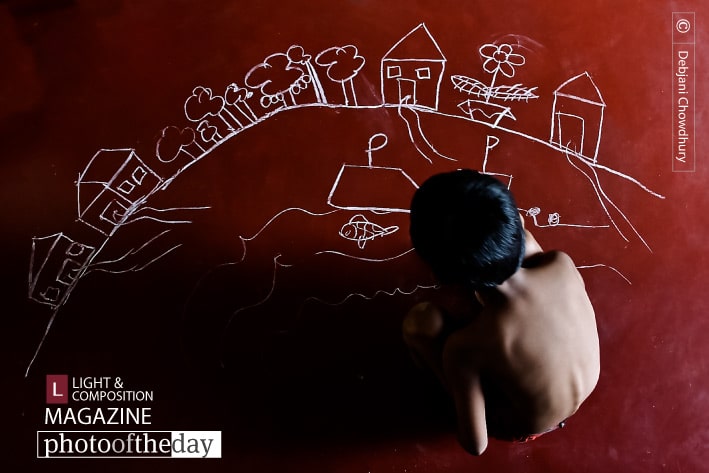
Captured on a humid afternoon, this intimate portrait depicts the photographer's daughter sketching her vision of an ideal home nestled in nature. The image was taken shortly after the child returned from school, transforming a quiet moment on the bedroom floor into a poignant narrative of youthful imagination. By utilizing a slow shutter speed of 0.3 seconds, the photographer emphasizes the stillness of the scene, creating a soft, dreamlike atmosphere. This photograph is award-worthy for its ability to elevate a simple, domestic moment into a universal reflection on childhood innocence and the purity of creative expression.
Debjani Chowdhury
Based in Howrah, West Bengal, Debjani Chowdhury is a dedicated homemaker and economics student who has rapidly emerged as a compelling voice in photography. Since beginning her formal artistic journey, she has garnered significant international acclaim, including features in Asian Photography and the prestigious National Geographic 'Your Shot' editor's choice section. Her work is defined by a passionate, observant approach to capturing the beauty of everyday life, reflecting a deep commitment to mastering the technical and emotional nuances of the craft.
Resonance Score Breakdown
Transparency Note: The resonance score (13.3/20) is calculated based on social engagement metrics collected before the award announcement.
Expert Photography Reviews · 6
The Architecture of Quiet
We spend so much of our lives building walls, both literal and metaphorical. We stack bricks to keep the wind out, and we construct habits to keep the uncertainty at bay. But there is a specific, fragile architecture that exists only in the mind of a child.
Read the reflection →The Architecture of a Breath
We are all born with a map of a house we have never visited, a blueprint drawn in the soft, unhurried ink of childhood. It is a place where the walls are made of light and the floors are paved with the quiet dust of afternoon dreams.
Read the reflection →Reviews & Comments
Share your thoughts about this award-winning photograph. Your reviews contribute to the community engagement score.
Shadow isn’t merely the absence of light here; it’s the heavy, humid silence of a Howrah afternoon pressing against the child’s focus. By choosing a 0.3-second exposure, Chowdhury lets the darkness bleed into the edges of the sketch, blurring the boundary between reality and the dream being drawn. It’s haunting. I’ve felt that same ache—the realization that innocence is just a fragile light we’re desperately trying to keep from being swallowed by the inevitable, encroaching dark.
The ochre of the child’s skin, reminiscent of a sun-drenched Vermeer interior, dissolves into the hazy, bruised-plum shadows of a humid Howrah afternoon, creating a chromatic suspension that feels almost liquid. It’s a delicate, breathless palette; I’ve found myself utterly transfixed by the way the soft, muted terracotta of the floorboards anchors the ethereal, chalky whites of her sketch, as if the very air itself were holding its breath, waiting for the dream to settle.
The light here doesn’t fall; it breathes. It’s that heavy, humid glow of a Howrah afternoon, filtering through the room like a soft prayer. She stood there, waiting for the child’s hand to settle, listening to the quiet rhythm of the pencil. I’ve felt that same stillness, that ache of wanting to hold a fleeting dream in place. At 0.3 seconds, the world blurs just enough. It’s beautiful, really. It makes me miss my own childhood.
The frame’s geometry is surprisingly tight. Chowdhury’s use of a 22mm focal length forces a spatial tension that anchors the subject against the floor’s rigid lines. It’s a disciplined architecture. The slow shutter speed softens the periphery, yet the child’s focus remains the fulcrum. I’m genuinely unsettled by how the negative space swallows the domestic clutter. It doesn’t rely on sentiment; the composition holds its own weight. It’s a rare, precise balance of stillness and form.
Most domestic portraits wither within a decade, but this one persists. The 0.3-second exposure isn’t just technical; it’s a deliberate blurring of reality that mirrors the hazy, fragile nature of a child’s ambition. I’ve seen thousands of sketches captured on film, yet the way the light catches the pencil’s arc here feels startlingly intimate. It’s a quiet, aching reminder of the dreams we eventually outgrow. I’d keep this on my wall for thirty years, easily.
A 0.3-second exposure in a humid room isn’t merely a technical choice; it’s a gamble against a fidgety subject. One suspects the photographer spent hours on that bedroom floor, waiting for the child’s focus to settle into that specific, quiet stillness. It’s a rare, earned intimacy. I’ve spent enough afternoons chasing light in damp corners to recognize the patience required here. It’s a lovely, fragile thing, and frankly, I’m quite moved by the effort.