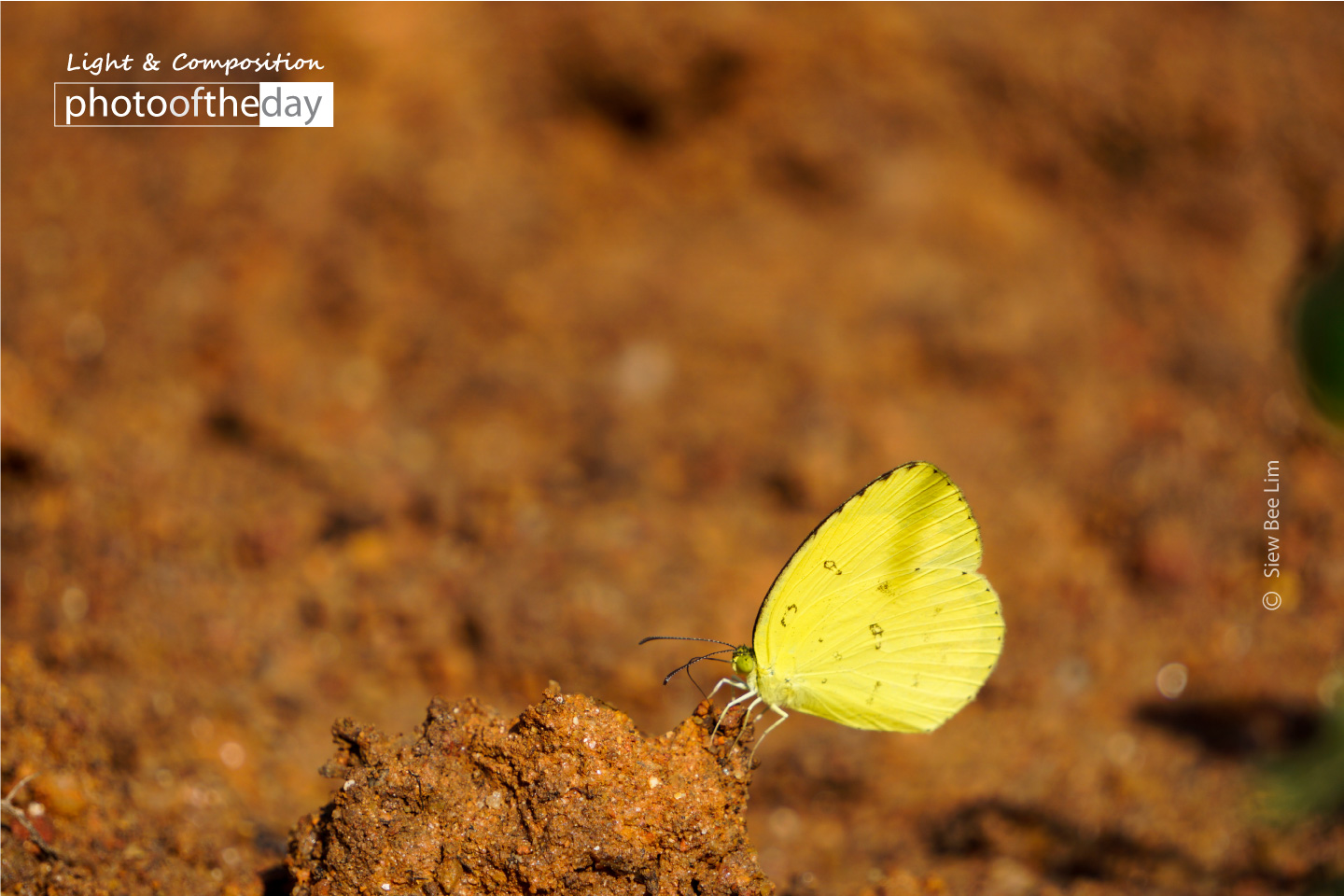
Common Grass Yellow by Siew Bee Lim
On a bright, sun-drenched day in a local park, the photographer set out to document the delicate beauty of butterflies. While exploring a community vegetable plot, she encountered a Common Grass Yellow (Eurema hecabe) resting amidst the greenery. By utilizing a long focal length, she successfully isolated the insect against a soft, blurred background, capturing the intricate textures of its wings and the vibrant environment. This image is award-worthy for its sharp focus and the patient observation required to document such a small, fleeting subject in its natural habitat, turning a simple garden encounter into a compelling macro study.
Siew Bee Lim
Born in Singapore in 1965, Siew Bee Lim is a dedicated photographer who rediscovered her passion for the craft later in life. After an early introduction to film photography and darkroom techniques during her career as a programmer, she has returned to the medium with a renewed commitment to formal learning. Drawing inspiration from her lifelong appreciation for Chinese painting and literature, she now focuses on capturing the natural world, striving to refine her artistic vision through the Light & Composition platform.
Resonance Score Breakdown
Transparency Note: The resonance score (10.7/20) is calculated based on social engagement metrics collected before the award announcement.
Expert Photography Reviews · 6
The Weight of Stillness
I remember sitting on a rusted bench in a botanical garden in Kyoto, watching an elderly man try to photograph a dragonfly. He didn't move for twenty minutes.
Read the reflection →The Weight of a Wing
There is a profound stillness found in the smallest of lives. We often measure importance by scale, by the reach of a shadow or the volume of a voice, yet the world reveals its deepest secrets when we slow our own pulse to match the rhythm of the garden.
Read the reflection →Reviews & Comments
Share your thoughts about this award-winning photograph. Your reviews contribute to the community engagement score.
We look at this Common Grass Yellow and we aren’t just seeing an insect; we’re meeting a neighbor. Siew Bee Lim didn’t just point a lens; she waited until the butterfly felt safe enough to reveal its delicate, sun-drenched textures. It’s a quiet conversation held in a Singaporean garden. I find myself holding my breath, afraid to disturb its stillness. It’s a portrait of a fleeting life, captured because someone finally took the time to listen.
It’s refreshing to see such crisp detail without fighting the refractive index of water. Down here, I’m constantly battling light absorption and backscatter, but Siew Bee Lim’s butterfly enjoys pure, unscattered sunlight. The yellow pigments on those wings are so vivid; I’m genuinely envious. Without the orange and red wavelengths being swallowed by the ocean, she’s captured a clarity that’s impossible at depth. It’s a beautiful, sharp reminder of what light can do when it isn’t stolen.
It’s a decent enough capture, though one wonders if the sun-drenched park was merely a convenient stop. The focus is sharp, certainly, but I’ve spent enough damp mornings waiting for a wing to settle to know when a shot was snatched rather than earned. Still, the delicate texture of that yellow wing is undeniably lovely. I’ll admit, it’s a quiet, pleasant bit of work. Did she return, or was she just passing through?
Macro photography often traps us in the clinical sterility of the Victorian specimen cabinet. Lim avoids this by embracing the Eurema hecabe’s erratic, sun-drenched vitality. It’s a delicate dance of light that recalls the soft focus of Julia Margaret Cameron, yet sharpened by modern optics. I’ve spent decades cataloging these winged subjects, but the way this yellow wing bleeds into the bokeh—it actually made me catch my breath. It’s a quiet, vital conversation with nature.
Architecture is usually about scale, but here, the butterfly’s wing becomes the facade. The delicate fenestration of those veins against the blurred green void creates a datum of pure light. It’s a lesson in how a single, sharp detail defines a space. I’m struck by how the depth of field mimics the way we perceive a threshold, focusing on the immediate while the rest dissolves. It’s a quiet, structural marvel I’d love to inhabit.
Isolation is a choice, not a natural state. By blurring the community plot into a featureless smear, Lim strips the butterfly of its context. Why must we sanitize nature to appreciate it? I’m honestly exhausted by this clinical detachment. It’s a pretty wing, sure, but it’s also a refusal to engage with the environment that sustains the insect. Does the butterfly exist only for our aesthetic consumption, or does it belong to that garden?