Color Splash by Nirupam Roy
In this striking macro capture, the photographer focuses on the vibrant, intricate patterns of a Common Jezebel butterfly. Taken in the Himalayan Dooars, the image highlights the creature's natural brilliance, which the photographer only fully appreciated upon reviewing the shot on the camera screen. The composition is a testament to the beauty found in the natural world, elevated by the photographer's keen eye for detail and color. This award-winning photograph stands out for its technical precision and the way it transforms a common insect into a captivating, artistic splash of color.
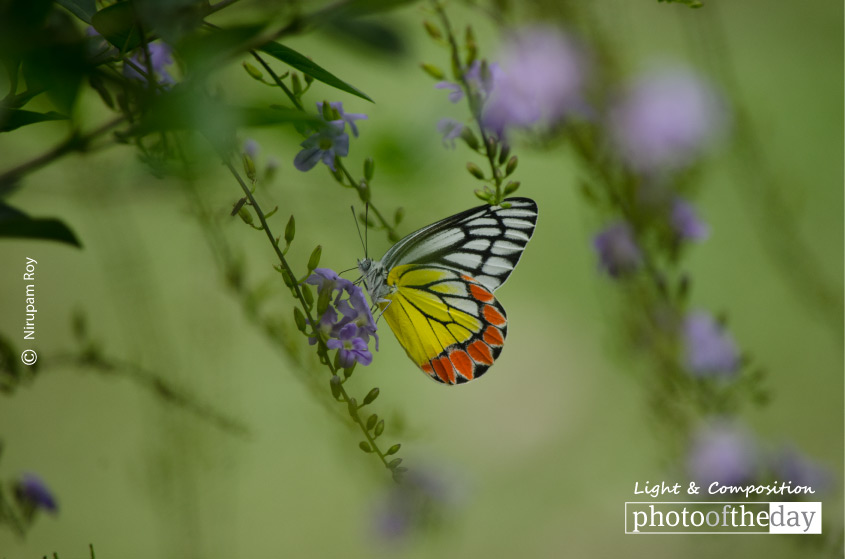
Exposure 1/640sec @ f/5.6 | ISO 240 | Focal Length 300mm
Nirupam Roy
Hailing from the small town of Tufanganj in West Bengal, India, Nirupam Roy balances his professional life as a school teacher with a profound dedication to photography. His journey began with a desire to document family travels, but quickly evolved into a passionate pursuit of artistic expression and nature observation. Through his lens, Roy explores the beauty of the world around him, finding peace and a new perspective on humanity and nature. His work reflects a constant evolution of creative concepts and a deep-seated commitment to his craft.
Resonance Score Breakdown
Transparency Note: The resonance score (11.0/20) is calculated based on social engagement metrics collected before the award announcement.
Expert Photography Reviews · 6
The Architecture of the Ephemeral
Why do we insist that permanence is the only measure of value? We build monuments of stone and write histories in ink, hoping to defy the inevitable erosion of time.
Read the reflection →The Weight of Wings
We look for meaning in the grand gestures, in the storms that strip the trees bare or the long, heavy silence of a frozen lake. We forget that the world is also held together by the fragile. A wing, a vein, a pulse of pigment against the grey.
Read the reflection →Reviews & Comments
Share your thoughts about this award-winning photograph. Your reviews contribute to the community engagement score.
1/640sec at f/5.6, 300mm. It’s a tight margin for error. At 300mm, the depth of field is razor-thin, yet you’ve locked focus on the Jezebel’s wing pattern with clinical accuracy. I’ve spent years chasing this kind of sharpness; it’s genuinely frustrating how well you nailed it. The ISO 240 keeps the noise floor quiet, letting the color saturation hold without artifacting. You didn’t just capture a butterfly; you calculated the exact intersection of light and biology.
The shutter snaps, and the frame freezes a frantic, vibrant pulse. It’s a macro sequence where the Common Jezebel’s wings become a flickering edit, caught mid-beat. I’m breathless looking at the saturation; it’s like a jump cut into pure pigment. Roy didn’t just capture an insect; he locked the motion of a living stained-glass window. It’s the frame the editor keeps because the movement is still humming inside the stillness. I’d kill for that color.
You caught the Jezebel in a moment of quiet intensity. It’s easy to get lost in the macro details, but I’m struck by the stillness you found in the Dooars. You didn’t just document a pattern; you waited for the light to hit those wings just right. I felt a genuine sense of calm looking at this. It’s honest work. You weren’t just clicking a shutter; you were really looking. That’s where the truth lives.
At 300mm, the focal plane is razor-thin, yet Roy’s capture of the Jezebel’s wing scales is startling. The diffraction of light across those chitinous surfaces is, in the strictest physical sense, extraordinary. I’m genuinely moved by how the f/5.6 aperture renders the background into a soft, creamy bokeh, isolating the insect’s vibrant geometry. It’s a rare moment where the lens’s resolution finally catches up to the complexity of nature. I’ve rarely seen such precise optical clarity.
The frame’s geometry hinges on the butterfly’s diagonal axis. It’s a rigid, calculated placement that anchors the chaotic saturation of the wings. The negative space doesn’t merely exist; it forces the eye back to the central fulcrum. While I’m usually repulsed by such garish color palettes, the structural discipline here is undeniable. It’s a rare instance where the composition survives the subject’s inherent sentimentality. The visual architecture holds, even if it’s almost too loud.
We look at this Common Jezebel and we don’t see an insect; we see a life lived in vibrant, fragile geometry. Nirupam Roy caught a gaze that isn’t human, yet it feels deeply familiar. It’s as if the butterfly paused to tell us a secret about the Himalayan light. I’m genuinely moved by how the colors pulse against the shadows. It’s a portrait of a fleeting existence, reminding us that listening is how we truly see.