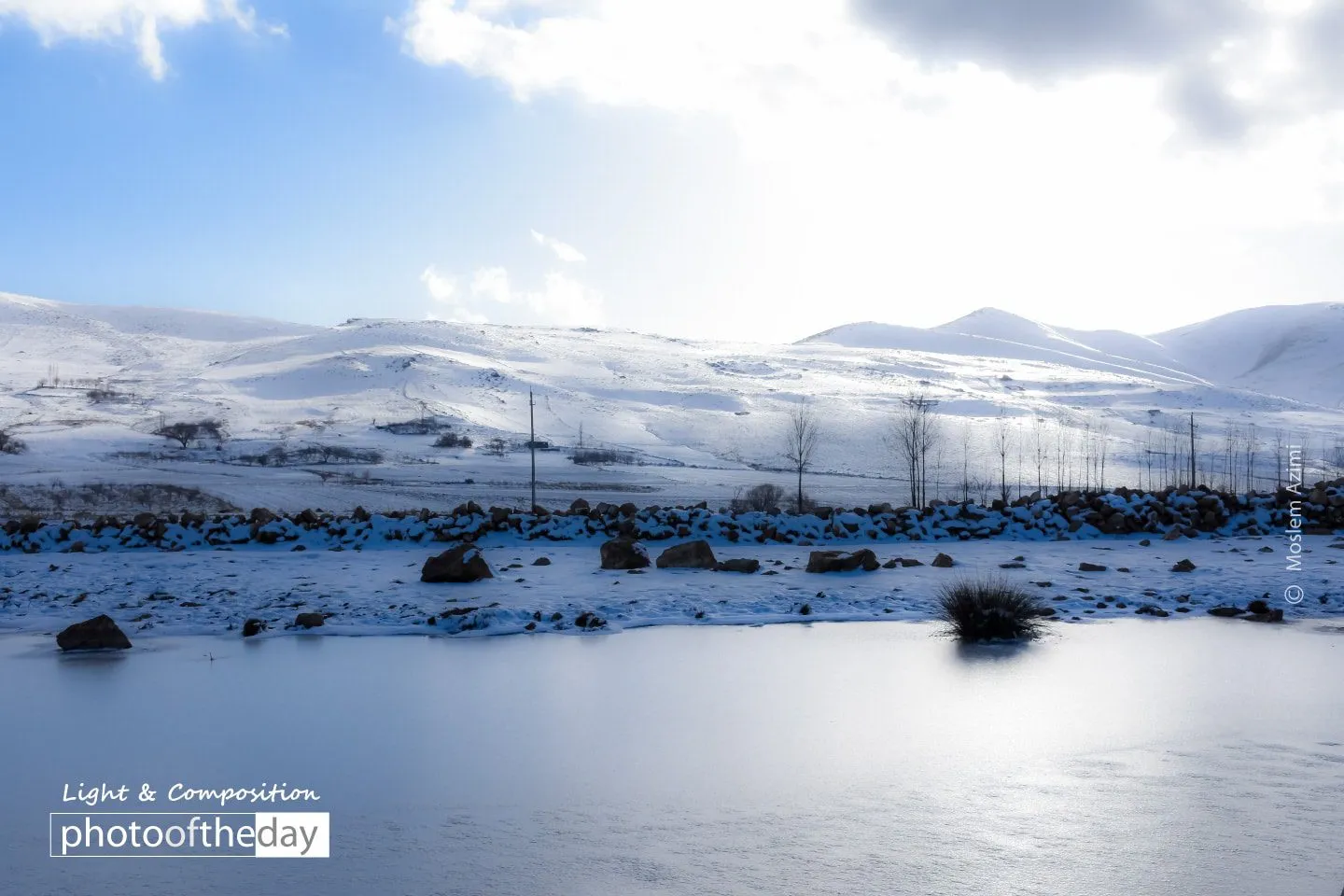
Cold Winter by Moslem Azimi
Captured amidst the serene, frost-covered landscapes of Kermanshah, this photograph highlights the stark, minimalist beauty of winter. The photographer meticulously selected a frame that emphasizes the stillness of frozen water against a backdrop of falling snow, transforming a quiet village scene into a compelling study of texture and light. By focusing on the interplay between the monochromatic elements of the season, the image evokes a profound sense of tranquility. It is this deliberate attention to composition and the ability to find artistic depth in natural, wintry conditions that make this work a standout example of nature photography.
Moslem Azimi
Moslem Azimi is a Kurdish photographer based in Javanrud, Iran, who has dedicated his craft to documenting the rich traditions and daily life of the Kurdish people. Though he holds a Bachelor of Arts in English Translation and is entirely self-taught in the visual arts, his work has gained significant recognition through various national and international exhibitions. Driven by a desire to preserve his cultural heritage, Azimi uses his lens to bridge the gap between his community's unique lifestyle and a global audience, showcasing a deep, intuitive understanding of composition and narrative.
Resonance Score Breakdown
Transparency Note: The resonance score (10.8/20) is calculated based on social engagement metrics collected before the award announcement.
Expert Photography Reviews · 6
The Silence of Snow
I remember a morning in a small village in the mountains where the snow fell so thick it seemed to erase the very idea of a road. I sat in a kitchen with a woman named Elara, who was stirring a pot of tea.
Read the reflection →The Silence of Still Water
Why do we mistake stillness for an absence of life? We often view the dormant months as a period of loss, a time when the world retreats into a monochromatic sleep, stripping away the vibrancy we rely on to define our own vitality. Yet, there is a profound integrity in the pause.
Read the reflection →Reviews & Comments
Share your thoughts about this award-winning photograph. Your reviews contribute to the community engagement score.
Most winter landscapes are forgettable, but this one sticks. Of the thousands I’ve reviewed, it’s the jagged, icy geometry cutting through the soft, falling snow that keeps me looking. It doesn’t just show cold; it makes me shiver. The composition works because the negative space isn’t empty—it’s heavy with silence. I’ll be glad this exists in thirty years because it captures a fleeting, brutal stillness that most photographers are too impatient to wait for.
The frost on these Javanroud stones feels like a temporary veil over the ancient, unyielding earth. I’ve spent my life chasing the deep sky, but there’s a quiet, shivering beauty here that makes me catch my breath. The thermal noise of a sensor matters little when the scene itself is this cold. It’s a fragile, monochromatic moment, yet it holds the same stillness I find in the dark, silent vacuum between the distant, burning stars.
It’s quiet, isn’t it? I’ve spent enough time in the cold to know that silence has a weight, and you’ve captured that heavy, frozen stillness perfectly. Because you didn’t clutter the frame, I can almost feel the bite of that Kermanshah air on my own skin. You waited for the snow to settle just right. There’s something honest happening here. It’s not just a landscape; it’s a moment of genuine, shivering peace. I respect that.
The frost here is beautiful, but it’s a cold, lonely beauty. I’m looking for a pulse in this landscape, a sign that someone actually lives in this stillness. It’s technically sound, sure, but it feels like a scene waiting for a soul to walk into the frame. I’ve spent my life chasing the warmth of a human gaze, and honestly, I find myself shivering. It’s a quiet study, but it’s missing the heartbeat I crave.
Winter in Javanroud isn’t a season; it’s a silence that demands an accounting. Azimi’s frost doesn’t merely coat the earth; it suffocates the light until only the essential remains. I’m unsettled by how the shadows here refuse to soften, biting into the frozen water like a blade. It’s a cold, existential clarity. When I look at these jagged, monochromatic depths, I feel a sudden, sharp ache for the warmth we’ve all long since abandoned.
The monochromatic austerity here echoes the starkness of early pictorialist winter studies, yet it avoids their sentimentality. Azimi’s focus on the frozen water’s texture against the falling snow recalls the precise tonal control of Minor White’s abstractions. I’m genuinely struck by how the silence feels tactile; it’s a rare, quiet intensity I haven’t felt in years. It doesn’t just document Kermanshah; it reclaims the minimalist tradition, proving that even in a saturated genre, stillness remains a radical act.