Coconut Trees by Siew Bee Lim
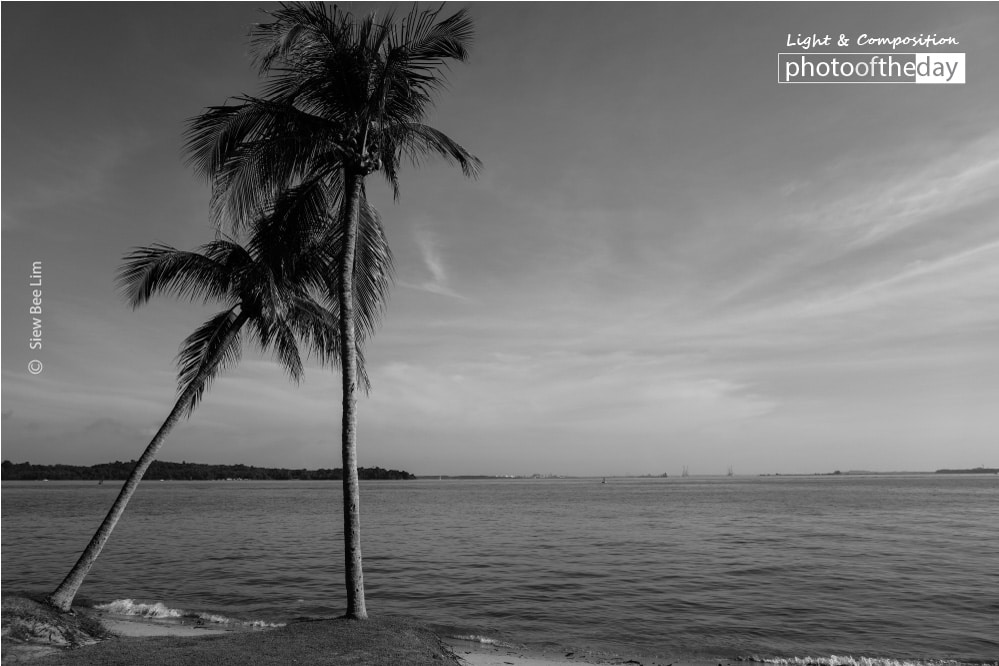
Captured on a crisp October morning at a local beach park, this evocative black and white photograph centers on two iconic coconut trees standing against the shoreline. Drawing inspiration from the nostalgic aesthetic of vintage Taiwanese cinema, the photographer sought to translate the cool, rhythmic movement of the seaside waves into a timeless monochromatic study. By isolating the trees against the vast coastal backdrop, the image successfully captures a sense of quiet solitude and cinematic atmosphere. Its award-worthy quality lies in the deliberate composition and the effective use of high-contrast monochrome to transform a simple landscape into a poignant, narrative-driven visual experience.
Siew Bee Lim
Born in 1965, Siew Bee Lim is a Singapore-based photographer who has long nurtured a passion for the craft. Currently refining her technical expertise through the Light & Composition platform, she demonstrates a commitment to lifelong learning and artistic growth. Her work reflects a thoughtful approach to capturing the quiet beauty of her surroundings, blending personal inspiration with a developing mastery of photographic composition and narrative storytelling.
Resonance Score Breakdown
Transparency Note: The resonance score (11.0/20) is calculated based on social engagement metrics collected before the award announcement.
Expert Photography Reviews · 5
The Weight of Standing Still
There is a specific silence that lives in the space between two trees. It is not the silence of a void, but the silence of a conversation that ended years ago, leaving only the architecture of the speakers behind.
Read the reflection →Standing Still in the Wind
I spent this morning trying to fix a wobbly chair in the kitchen. I kept tightening the screws, but the floor is uneven, and no matter what I did, it still tilted whenever I sat down. I eventually gave up and just left it there, leaning slightly against the wall.
Read the reflection →Reviews & Comments
Share your thoughts about this award-winning photograph. Your reviews contribute to the community engagement score.
The air here feels heavy with the salt of a morning that hasn’t quite woken up. Siew Bee Lim didn’t just frame these palms; she waited for the light to strip away the noise, leaving only the rhythm of the tide. I’ve stood in that exact, cooling silence, feeling the sand shift beneath me. It’s a lonely, beautiful ache. She’s captured the precise moment the land stopped breathing, letting the monochrome stillness finally take hold.
Shadows here aren’t merely absences; they are the heavy, silent anchors of the frame. Siew Bee Lim forces these coconut trees to confront their own silhouettes against the void of the Singaporean shore. It’s a stark, rhythmic tension that pulls at my chest, reminding me that we are all just fleeting shapes carved out of darkness. I’ve rarely seen such stillness. It doesn’t invite us in; it demands we acknowledge the weight of the coming night.
Two trunks rise. They don’t crowd the frame. The sky is a vast, pale weight. It’s the silence between the palms that catches my breath. I’ve spent minutes watching the grey horizon. It doesn’t demand attention. It simply exists. Nothing here is accidental. The empty corner is not empty. It’s a breath held in the salt air. Siew Bee Lim knows the value of what isn’t there. It’s a rare, quiet grace.
The verticality of these trunks anchors the frame against a horizon that doesn’t quite resolve. It’s a rigid geometry. The negative space between the palms creates a necessary tension, forcing the eye to navigate the void rather than the subject. I’ve grown weary of such predictable framing, yet the tonal contrast here holds the picture plane together. It’s technically precise, even if the composition’s reliance on symmetry feels a bit too safe for my taste.
Before the eye identifies the palms, something in the chest tightens. It’s the silence of the horizon that hits first, a rhythmic stillness that demands a held breath. I’ve returned to these trees three times today; they don’t just occupy space, they anchor a specific, aching solitude. When I look at the grain, I feel the grit of sand against my own skin. It’s a quiet, monochromatic haunting that follows me long after I turn away.