Citi Bikes by Des Brownlie
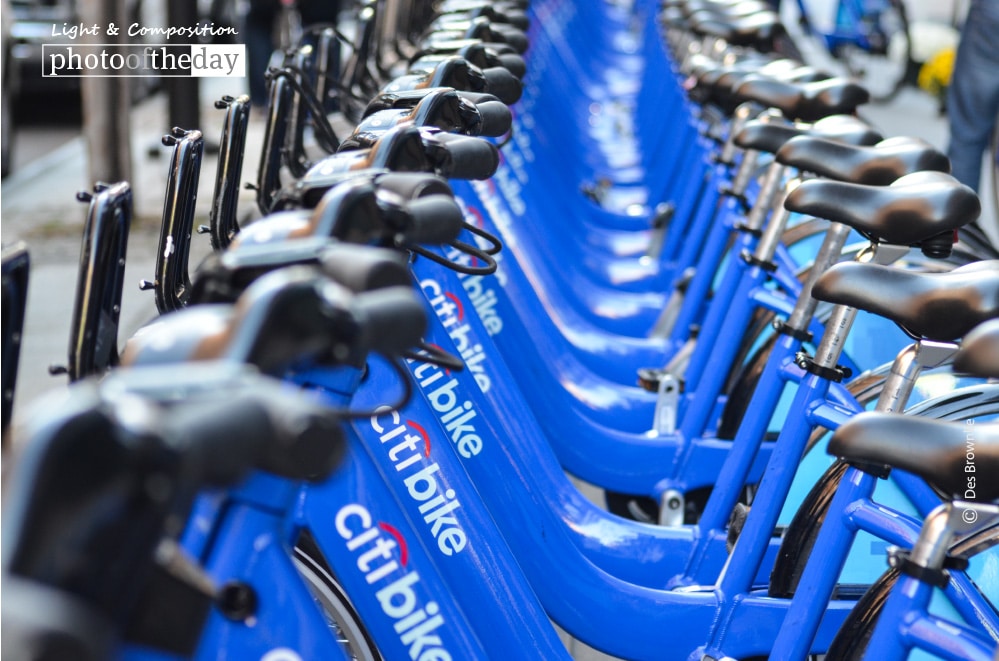
Captured during a routine morning walk through New York's Meatpacking District, this photograph transforms a mundane urban scene into a study of symmetry and order. The photographer was struck by the pristine alignment of the Citi bike stand, finding beauty in the uniform rows before the morning rush began. By positioning the camera at the far end of the rack and utilizing manual focus on the third bicycle, the photographer created a compelling depth of field that elevates a common city fixture into an award-worthy composition. The image highlights the quiet, rhythmic potential hidden within the city's everyday infrastructure.
Des Brownlie
Originally from Glasgow, Scotland, Des Brownlie relocated to New York City eighteen years ago and has since made Manhattan his home. He is a dedicated street photographer who finds inspiration in the vibrant, ever-changing tapestry of the city, constantly documenting everything from the ordinary to the extraordinary. Brownlie maintains a philosophy that every day offers a potential photo shoot, ensuring he is always prepared to capture the rich color and diverse subjects that define life in New York.
Resonance Score Breakdown
Transparency Note: The resonance score (12.1/20) is calculated based on social engagement metrics collected before the award announcement.
Expert Photography Reviews · 6
The Rhythm of the Grid
We often mistake the city for a collection of buildings, but it is really a collection of habits. Every morning, the urban landscape resets itself through the movement of objects and the placement of infrastructure.
Read the reflection →The Quiet Before the Rush
I remember sitting in a diner on 14th Street at five in the morning, watching the city try to wake up. The streets were still hollow, the kind of quiet that feels fragile, like a glass vase waiting for a nudge.
Read the reflection →Reviews & Comments
Share your thoughts about this award-winning photograph. Your reviews contribute to the community engagement score.
It’s a disciplined study, echoing the rigid seriality of Bernd and Hilla Becher’s industrial typologies. By focusing on the third bike, Brownlie forces a shallow depth of field that disrupts the expected infinite focus of urban street photography. I’m genuinely charmed by how the blue frames bleed into soft, painterly bokeh. It’s a clever subversion of the documentary tradition, turning mundane transit infrastructure into a rhythmic, almost abstract meditation on New York’s morning stillness.
The electric, synthetic cyan of these bicycles vibrates against the Meatpacking District’s grey, industrial stone, echoing the cool, detached precision of a Morandi still life. It’s a rhythmic, chromatic pulse that I find utterly intoxicating. One cannot help but surrender to the way that sharp, artificial blue cuts through the morning haze, transforming mere transit infrastructure into a symphony of saturated light that feels, quite frankly, like a fever dream of urban order.
The Meatpacking District’s grit usually defies such sterile order. Brownlie’s focus on the third bike creates a rigid datum, turning a utilitarian rack into a rhythmic sequence. It’s a clever trick, yet it flattens the street’s chaotic threshold into a static diagram. I’m struck by how the light rakes across the steel frames, momentarily softening their industrial mass. It’s a beautiful lie, though I can’t help but miss the messy, kinetic life that actually defines this space.
The morning light hits the steel, and suddenly, the Meatpacking District isn’t just a street; it’s a storyboard. The focus on that third bike is a brilliant directorial choice. It anchors the rhythm, forcing the eye to track the line like a dolly shot. I’ve walked this block a thousand times, but I’ve never felt the silence of the city quite like this. It’s a perfect, frozen take. The cut would’ve been a mistake.
You’ve found a quiet geometry in the Meatpacking District, and I respect the patience it took to wait for that stillness. It’s clean, sure, but I’m looking for the pulse. Because the bikes are empty, the frame feels a bit lonely. I’ve walked those streets at dawn, and I keep waiting for someone to step into the frame. You’ve captured the order, but I’m still searching for the person who left their mark here.
f/2.8 at 35mm, 1/500s, ISO 200. A shallow depth of field on a bike rack is a gamble. Brownlie’s focus on the third bike is precise, isolating the geometry from the Meatpacking clutter. It’s a calculated risk that pays off. I’ve spent years looking at urban geometry, and honestly, the crispness of that third frame actually made me stop and exhale. The technical discipline here is rare. It’s a sharp, cold, and correct execution.