Carpet Repair by Keith Goldstein
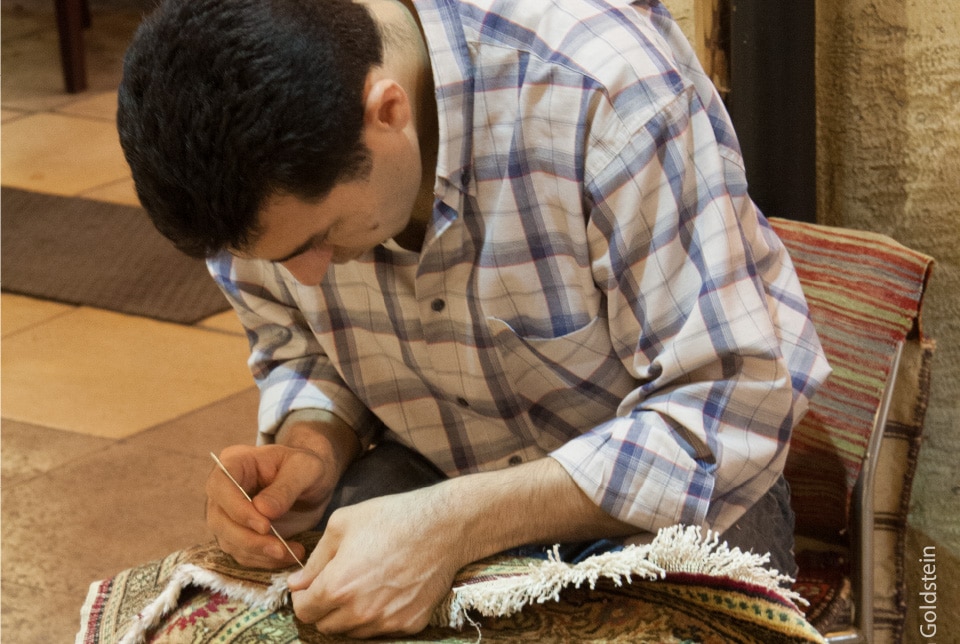
In the heart of Istanbul’s historic Grand Bazaar, the photographer captures the meticulous art of carpet repair, a craft steeped in centuries of Turkish tradition. By focusing on the artisan's focused movements amidst the bustling energy of one of the world's oldest markets, the image bridges the gap between ancient skill and modern observation. The choice of a 56mm focal length provides an intimate perspective, drawing the viewer into the intricate textures of the woven fabric. This photograph is award-worthy for its ability to transform a quiet moment of labor into a profound cultural narrative, highlighting the human element within a vast, historic architectural space.
Keith Goldstein
Born in Brooklyn in 1957, Keith Goldstein is a seasoned fine art and commercial photographer based in Hamilton Heights, New York City. After earning his BFA from the School of Visual Arts and an MFA from the Cranbrook Academy of Art, he developed a deeply emotive photographic style that has been exhibited internationally since 1980. His extensive career spans diverse roles as a stock shooter, corporate photographer, and photo editor, with his work featured in numerous prestigious publications and media outlets worldwide.
Resonance Score Breakdown
Transparency Note: The resonance score (10.3/20) is calculated based on social engagement metrics collected before the award announcement.
Expert Photography Reviews · 5
The Weaving of Time
There is a quiet dignity in the act of mending. We live in a world that often rushes toward the new, discarding what has frayed or worn thin.
Read the reflection →The Mending of Things
I spent an hour this morning trying to fix a snag in my favorite wool sweater. I kept pulling at the loose thread, making it worse, until I finally sat down with a needle and a bit of patience. It’s strange how we are so quick to discard things the moment they show a little wear.
Read the reflection →Reviews & Comments
Share your thoughts about this award-winning photograph. Your reviews contribute to the community engagement score.
The light here doesn’t shout; it filters through the Bazaar’s ancient stone, catching the dust of centuries. He stood in that dim, amber glow, waiting for the artisan’s hands to find their rhythm. It’s a quiet, sacred labor. I’ve felt that same stillness in the desert, where time simply stops. Watching those fingers pull the thread, I’m struck by how he didn’t rush the moment. He let the scene breathe, and that’s a rare, beautiful grace.
The bazaar hums, yet here, it’s quiet. The artisan’s needle pulls thread through history. I’ve spent minutes watching his hands. They don’t rush. The frame holds the tension of the weave, but it’s the shadow behind him that pulls me in. A dark, hollow space. It’s not empty. It’s a breath. I feel a sudden, sharp ache for that stillness. Nothing here is accidental. The empty corner is not empty. It’s where the work lives.
The frame’s geometry is tight, almost suffocating. Goldstein’s placement of the artisan’s hands creates a necessary fulcrum against the chaotic weave of the carpet. It’s a rigid, calculated architecture that keeps the eye from wandering into the bazaar’s clutter. I’m genuinely unsettled by how the vertical threads pull the gaze toward the lower edge. It’s a precarious balance, yet the composition holds. The visual weight is distributed with a cold, clinical precision that demands total attention.
The ochre of the worn wool, reminiscent of a faded Morandi still life, anchors the frame, pulling one into a tactile, dusty warmth that feels like a secret whispered in the Grand Bazaar. I’m utterly breathless at how the shadows bleed into the deep, bruised plum of the carpet’s border, creating a chromatic tension that’s both ancient and aching. It’s a gorgeous, heavy atmosphere where the light doesn’t just illuminate; it breathes, it lingers, it mourns.
At 1/13th of a second, Goldstein’s shutter lingers just long enough to turn the artisan’s hands into a ghostly, rhythmic blur. It’s a relief to see the Grand Bazaar’s chaos rendered as motion rather than static sharpness. I’m genuinely moved by how he’s let the weave dissolve into a soft, kinetic hum. Why resolve the texture when you can capture the labor? It’s closer to Sugimoto’s temporal experiments than to any tired travelogue.
Thank you!