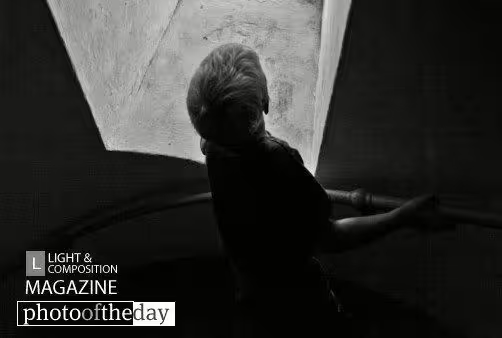
Boy Looking Out of the Window by Nuno Alexandre
Captured within the historic walls of Skagen’s lighthouse in Denmark, this evocative image features a young boy gazing out toward the sea. The photograph masterfully utilizes the interplay of light and shadow inherent in the lighthouse’s architecture to frame the subject’s contemplative moment. By juxtaposing the timeless, storied history of the 16th-century structure with the quiet curiosity of youth, Nuno Alexandre creates a poignant narrative of discovery. The composition is award-worthy for its emotional depth and the clean, monochromatic execution that emphasizes the stillness of the scene against the vast, unseen horizon.
Nuno Alexandre
Based in Aalborg, Denmark, Nuno Alexandre is a dedicated freelance photographer with a primary focus on live performance and photojournalism. With four years of professional experience behind the lens, he has developed a keen eye for capturing authentic human moments and atmospheric storytelling. His work reflects a deep passion for the craft, consistently demonstrating a commitment to visual narrative that resonates with audiences across his diverse portfolio.
Resonance Score Breakdown
Transparency Note: The resonance score (9.8/20) is calculated based on social engagement metrics collected before the award announcement.
Expert Photography Reviews · 3
The Salt on the Glass
The air in Skagen has a specific grit to it, a fine, invisible sand that settles on your skin and tastes faintly of cold salt. I remember standing in places like this, where the wind pushes against your chest, demanding you lean into it.
Read the reflection →The Architecture of Longing
We are all born with a compass needle that points toward the horizon, a restless instinct to see what lies beyond the threshold of our own skin. To stand at a window is to practice the art of departure while remaining perfectly still.
Read the reflection →Reviews & Comments
Share your thoughts about this award-winning photograph. Your reviews contribute to the community engagement score.
Skagen’s stone walls don’t just frame the boy; they consume him. It’s a brutal, necessary erasure. When I look at those deep, suffocating blacks, I feel a sudden, cold ache for the boy’s inevitable loss of innocence. He’s staring at a horizon that refuses to answer, caught in a silence that isn’t empty, but heavy with the weight of time. Alexandre understands that light is merely the distraction; the shadow is where the truth hides.
The frame’s geometry is its only salvation. The lighthouse aperture acts as a rigid fulcrum, forcing the boy’s silhouette into a stark, vertical alignment. It’s a disciplined study in spatial tension. The negative space surrounding the figure doesn’t collapse; it holds. I’ve grown weary of sentimental subjects, yet the sheer architectural weight here commands attention. The composition works because it refuses to be soft. It’s a rare instance where the structure actually justifies the gaze.
Stripped of pigment, the Skagen light doesn’t vanish; it merely transmutes into a silvered, melancholic mercury that recalls the quietude of a Morandi still life. It’s a haunting, monochromatic ache, where the boy’s silhouette dissolves into the lighthouse’s stone-grey shadows. I’m truly breathless at how the absence of colour forces one to feel the cold, salt-stung air against the glass. It’s not just a window; it’s a portal into a vast, silent, and beautifully lonely void.