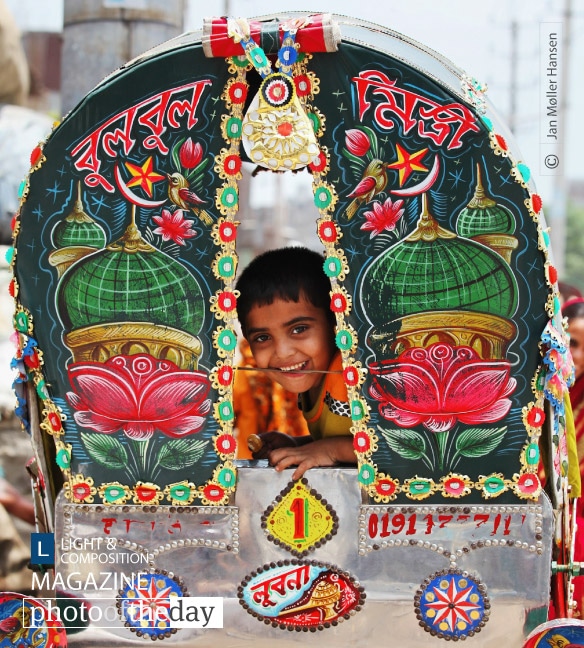
Boy in Rickshaw by Jan Møller Hansen
Captured on a quiet Friday morning in May 2011, this portrait depicts a young boy traveling by rickshaw through the bustling streets of Dhaka. Amidst a city defined by its massive rickshaw population, the photographer sought to document the human spirit behind the urban chaos. By focusing on the boy’s genuine, radiant smile, the image transcends its documentary roots to become a poignant testament to joy in everyday life. This photograph is award-worthy for its ability to distill the vast, complex energy of Bangladesh into a single, intimate moment of connection, showcasing the photographer’s keen eye for authentic human emotion.
Jan Møller Hansen
Jan Møller Hansen is a self-taught photographer and diplomat whose work focuses on social documentary and street photography. Drawing on over 25 years of experience living and working across Asia and Africa, he uses his camera to bridge cultural divides and capture the fleeting, unpredictable nature of human existence. His approach emphasizes the importance of timing, light, and genuine interaction, aiming to create images that resonate with viewers by telling profound stories without the need for words.
Resonance Score Breakdown
Transparency Note: The resonance score (13.2/20) is calculated based on social engagement metrics collected before the award announcement.
Expert Photography Reviews · 6
The Architecture of a Smile
We often mistake joy for a destination, something to be reached only after the long climb of a difficult day. We treat it as a reward, a rare fruit plucked from the highest branch.
Read the reflection →The Weight of a Smile
We carry our histories in the lines of our faces. Some are etched by the cold, by the long wait for a spring that arrives late and leaves too soon.
Read the reflection →Reviews & Comments
Share your thoughts about this award-winning photograph. Your reviews contribute to the community engagement score.

Most street portraits I review are forgettable snapshots of poverty. What separates this from the pack is the boy’s unforced, genuine grin. It’s not a performance for the lens; it’s a moment of pure, unguarded delight that cuts through the rickshaw’s clutter. I’ve looked at thousands of these, and honestly, this one makes me smile back every single time. Thirty years from now, that raw, infectious joy will still be the only thing that matters here.
Dhaka’s morning light is rarely this soft, yet here it settles gently on the boy’s face, turning the rickshaw into a sanctuary. He stood there in the humid quiet, waiting for the city’s frantic pulse to pause. I’ve spent enough dawns watching shadows shift to know he didn’t rush this. It’s a rare, radiant stillness. Looking at that smile, I feel a sudden, sharp ache for the simple grace we so often overlook in our hurry.
The boy’s shirt, a vibrant, sun-drenched cadmium yellow, cuts through the Dhaka haze like a Vermeer window, grounding the frame in an almost unbearable optimism. It’s a chromatic collision against the muted, dusty teal of the rickshaw’s metal, a pairing that makes my heart ache with its quiet, unforced elegance. One finds here a rare, atmospheric resonance where the light doesn’t merely illuminate the subject; it breathes, turning the chaos into a soft, golden-hued sanctuary.
Dhaka’s humidity is a physical weight, yet Hansen’s managed to find a moment of genuine levity amidst the exhaust. It’s easy to snap a rickshaw in passing, but catching that specific, unforced expression requires lingering until the subject forgets you’re there. I’ve spent enough hours sweating in similar crowds to know he didn’t just stumble upon this. He waited for the chaos to settle. It’s a rare, honest bit of humanity. I’m quite impressed.
The rickshaw’s frame creates a rigid, geometric cage that anchors the boy’s kinetic energy. It’s a tight, claustrophobic geometry. The vertical bars slice the picture plane, forcing the eye toward the subject’s off-center placement. It’s a precarious balance. I’m genuinely unsettled by how the negative space threatens to swallow him whole. The composition doesn’t collapse, though. It holds. The tension between the chaotic urban backdrop and the boy’s stillness is the only thing keeping this frame intact.
Light doesn’t merely touch the boy’s face; it interrogates it. While the curator praises his smile, I’m haunted by the rickshaw’s encroaching gloom. It’s a heavy, suffocating darkness that threatens to swallow the joy entirely. I feel a sudden, sharp ache in my chest looking at it. Why are we so desperate to ignore the void? Møller Hansen captures a fleeting defiance, but the shadows here aren’t just background—they’re the inevitable, silent end of the road.