Blinded by the Sun by Ryszard Wierzbicki
Captured during a serene sojourn at the Shwe Yaunghwe Kyaung Monastery near Inle Lake, this photograph offers an intimate glimpse into the daily life of novice monks. The photographer, having stayed overnight among the adepts, utilized the soft morning light to document the young monks as they performed their ritual cleaning duties. The image is award-worthy for its authentic, candid portrayal of monastic life, characterized by the striking contrast of the vibrant purple robes against the monastery's weathered architecture. It captures a fleeting, quiet moment of devotion and discipline, elevated by the photographer's deep immersion in the local culture.
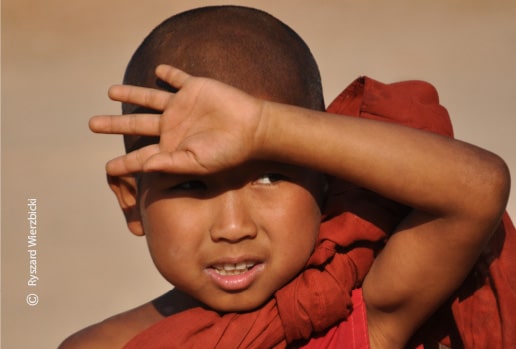
the Sun, by Ryszard Wierzbicki
Born in Poland in 1963, Ryszard Wierzbicki is a University of Gdańsk graduate who transitioned from a diverse career in education and marketing to a life of global exploration. After relocating to the United Kingdom in 2006, he dedicated himself to photography and travel, frequently volunteering with organizations supporting orphans in Southeast Asia. As a PADI scuba instructor and marketing advisor, Wierzbicki balances his professional life with a deep passion for documenting the human experience, sharing his insights through his established travel and photography forums.
Resonance Score Breakdown
Transparency Note: The resonance score (11.9/20) is calculated based on social engagement metrics collected before the award announcement.
Expert Photography Reviews · 8
The Weight of Light
There is a specific silence that follows the departure of a morning fog. It is not a true silence, of course, but a thinning of the world, as if the air itself has been scrubbed clean of everything that happened the night before.
Read the reflection →The Architecture of Radiance
In the quiet hours of the morning, before the world has fully committed to its noise, there is a particular quality to the air. It feels thin, almost fragile, as if the day is still deciding whether to arrive at all.
Read the reflection →Reviews & Comments
Share your thoughts about this award-winning photograph. Your reviews contribute to the community engagement score.
The frame’s geometry is compromised. While the purple robes provide a necessary chromatic anchor, the vertical lines of the weathered timber fail to resolve into a coherent architecture. It’s a cluttered visual field. The light doesn’t define the space; it merely washes over it, leaving the composition adrift. I’m frustrated by the lack of a clear fulcrum. Without a disciplined anchor, the eye wanders aimlessly. It’s a missed opportunity for true structural rigor.
We look at this young monk and we see the weight of the morning sun. He isn’t just cleaning; he’s listening to the silence of the monastery. Ryszard didn’t just point a lens; he sat with them until the purple robes felt like a second skin. It’s a quiet, honest exchange. I feel a sudden, sharp ache for the simplicity of his devotion. This is a photograph that asks to be returned to, again and again.
The saturated violet of those robes, bleeding into the monastery’s parched, ochre-dusted wood, creates a chromatic tension that’s almost visceral. It’s as if Vermeer’s lapis lazuli had been spilled across a sun-scorched floor in Myanmar. I’m breathless, truly, watching how the light softens that aggressive purple into something tender, almost bruised. One finds here a rare, quiet alchemy where the heat of the sun doesn’t just illuminate; it transfigures the very air into gold.
The light here doesn’t just fall; it breathes through the teak, catching the dust of a morning ritual. I’ve spent enough dawns waiting for that specific, golden haze to know Ryszard didn’t rush this. He stood in the cooling air, watching the monks move through the shadows. It’s a quiet, aching beauty. My own heart slows just looking at the way those purple robes anchor the space. He didn’t take this; he let it happen.
The light hits the wood. It’s harsh, yet it carves a path for the novices. I’ve spent hours looking at the way the purple robes pull against the grain of the monastery walls. It’s quiet. The space between the monks isn’t just distance; it’s breath. I feel a sudden, sharp ache for that stillness. Nothing here is accidental. The empty corner is not empty. It’s the weight of the morning. It’s enough.
Before the eye identifies the monks, something in the chest tightens. That sudden, blinding flare of light against the weathered wood triggers a physiological recoil, a held-breath moment I’ve felt only in the presence of true stillness. When I return to this, the purple robes don’t just pop; they ache. It’s the color of a fading bruise. I find myself squinting, trying to see past the glare, searching for a quiet I haven’t earned yet.
f/2.8 at 105mm, 1/1250s, ISO 200. A shallow depth of field isolates the subject, but the focus plane is razor-thin. It’s technically precise, yet the exposure struggles with the high-contrast backlighting. I’ve seen this light handled better. The purple robes bleed into the shadows, losing texture. It’s a clean capture, but the optics feel restricted. I find myself wishing for a wider aperture to pull more detail from the weathered wood. It’s competent, nothing more.
Most candid shots of monks are tired clichés, but Wierzbicki’s work survives because of the light. That harsh, blinding flare hitting the weathered wood isn’t just atmosphere; it’s the physical weight of the morning. I’ve seen thousands of monastery shots, yet this one makes me feel the heat on my own skin. It’s the tension between the boy’s stillness and that aggressive sun that ensures this will still matter in thirty years. It’s a rare, honest capture.