Big and Small Waterfalls by Darshan Vaishnav
In this evocative capture of Glen State Park, the photographer chose to move beyond a traditional wide-angle landscape, opting instead for a deliberate creative experiment. By focusing sharply on a small, intimate water stream while utilizing a wide aperture to soften the background, the photographer highlights the delicate textures of the water against the lush, blurred forest. This technical decision shifts the viewer’s perspective, transforming a standard waterfall scene into a study of depth and motion. The resulting image is award-worthy for its intentionality, demonstrating a sophisticated eye for composition that prioritizes artistic narrative over mere documentation.
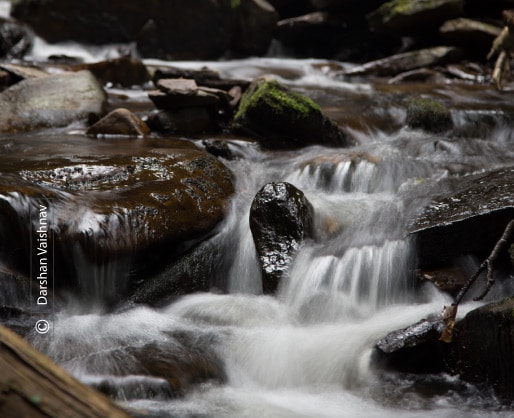
Exposure 1/2sec @ f/4 | ISO 100 | Focal Length 84mm
Darshan Vaishnav
Based in Maryland, USA, Darshan Vaishnav balances a professional career in Information Technology with a dedicated pursuit of photography. His work spans a diverse range of subjects, including nature, landscape, architecture, and street photography, driven by a constant desire to learn and explore. Through his lens, he seeks to freeze fleeting, beautiful moments and share his unique perspective on the world with a global audience, finding deep fulfillment in the hours spent traveling and capturing the beauty inherent in his surroundings.
Resonance Score Breakdown
Transparency Note: The resonance score (12.8/20) is calculated based on social engagement metrics collected before the award announcement.
Expert Photography Reviews · 4
The Architecture of Falling
Gravity is a conversation between the sky and the earth, a long, silver sentence spoken in a language of descent. We often mistake the fall for a loss, a surrender to the inevitable pull of the ground, but look closer at the way the liquid ribbons fray against the stone.
Read the reflection →The Rhythm of Letting Go
I spent this morning trying to fix a leaky faucet in the kitchen. I kept tightening the handle, convinced that if I just applied enough pressure, the dripping would stop. It didn't.
Read the reflection →Reviews & Comments
Share your thoughts about this award-winning photograph. Your reviews contribute to the community engagement score.
Most landscape photographers drown their subjects in depth of field, but Vaishnav’s choice to isolate the stream at f/4 is why this survives. It’s a quiet, deliberate refusal to document the entire park. I’ve seen thousands of waterfall shots, and frankly, most are forgettable noise. This one lingers because the soft, painterly background forces you to actually look at the water’s texture. It’s a rare, intimate moment I’d happily revisit thirty years from now.
The forest here doesn’t shout; it whispers through the blur. Darshan stood in the damp, cooling air of the glen, listening to the water’s rhythm until the shutter felt like an exhale. At half a second, the stream becomes a silk thread, untethered from the stone. It’s a quiet, intimate prayer. I’ve spent hours in such places, and looking at this, I can almost feel the mossy chill settling against my own skin. It’s beautiful.
The frame doesn’t collapse under the weight of the blurred foliage. It’s a precarious balance. The sharp, vertical descent of the water acts as a rigid fulcrum against the soft, chaotic background. It’s a rare moment where the depth of field actually serves the architecture rather than obscuring it. I’ve seen enough messy landscapes to appreciate this restraint. The composition holds its own, refusing to dissolve into the sentimentality that usually plagues such scenes.
Water doesn’t just flow here; it fractures the light into a desperate, stuttering rhythm. Vaishnav’s choice to blur the forest into a verdant void forces us to confront the stream’s sharp, crystalline violence. It’s unsettling. I’ve spent minutes staring into those dark, recessed crevices where the water vanishes, and I feel a sudden, cold vertigo. He hasn’t just captured a waterfall; he’s mapped the precise boundary where clarity dies and the shadow begins to breathe.