Bearer by Ryszard Wierzbicki
Captured during a September visit to the vibrant Boudhanath Stupa in Kathmandu, this photograph documents a quiet, heavy moment amidst the constant motion of the site. The photographer observed a man laboring under the weight of a large bag, his rhythmic walk encircling the stupa. By isolating this individual against the bustling backdrop, the image transforms a routine act of labor into a poignant study of human endurance. The composition is award-worthy for its candid authenticity, capturing the intersection of personal struggle and spiritual devotion in one of Nepal’s most iconic locations.
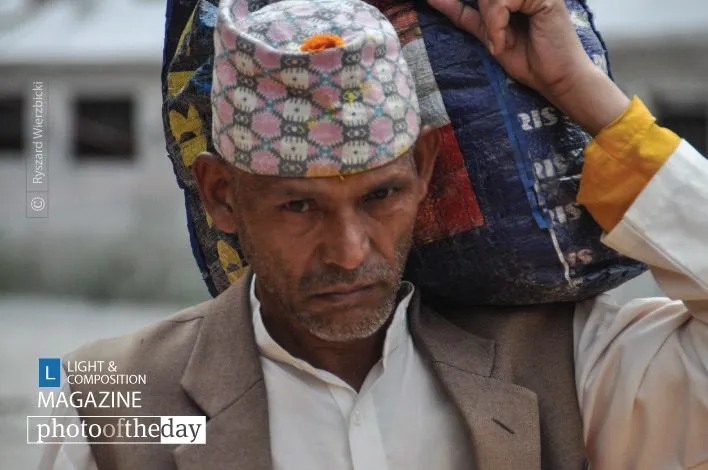
Exposure 1/1000sec @ f/6.3 | ISO 720 | Focal Length 200mm
Ryszard Wierzbicki
Born in 1963, Ryszard Wierzbicki is a Polish-born photographer and educator currently based in Swindon, United Kingdom. After a diverse career in social sciences and marketing, he transitioned into a life of exploration, focusing his lens on the cultures and landscapes of South-East Asia. His work is deeply informed by his extensive travels and his commitment to humanitarian efforts, including his volunteer work with orphanages. Through his photography and travel forums, he shares a unique perspective on the world, blending a background in social care with a profound passion for visual storytelling.
Resonance Score Breakdown
Transparency Note: The resonance score (11.1/20) is calculated based on social engagement metrics collected before the award announcement.
Expert Photography Reviews · 3
The Architecture of Burden
We carry our lives in bundles, slung across shoulders like the heavy, unread chapters of a book. There is a certain rhythm to the weight, a cadence that settles into the spine until the burden becomes a part of the anatomy, as natural as the curve of a rib or the reach of a root.
Read the reflection →The Weight of Devotion
There is a specific gravity to the things we carry. We often think of burden as something to be set down, a heaviness that keeps us from the sky. But perhaps there is a different way to see the weight we bear.
Read the reflection →Reviews & Comments
Share your thoughts about this award-winning photograph. Your reviews contribute to the community engagement score.
The frame’s geometry hinges on the subject’s diagonal trajectory. It’s a rigid vector cutting through the chaotic blur of the stupa’s periphery. The negative space above the burden provides the necessary breathing room, preventing the composition from collapsing under the weight of the load. I’ve rarely seen such precise isolation of a figure within a crowd. It doesn’t rely on sentiment; it relies on the stark, unforgiving placement of mass against the picture plane.
The burden here isn’t merely the sack; it’s the gravity of existence itself. Wierzbicki forces us to confront the man’s silhouette against the blinding, indifferent white of the stupa. It’s a brutal collision. I’ve stared at this frame for an hour, and I feel a cold ache in my own shoulders. The shadows don’t just cling to his frame; they define the limits of his endurance. He doesn’t walk through light; he survives it.
Before the eye identifies the man, something in the chest tightens. It’s the weight—that heavy, slumped burden pulling his spine toward the Kathmandu dust. I feel my own breath shallowing in sympathy with his rhythmic, labored gait. When I return to this a year later, the stupa’s blur feels less like scenery and more like the indifference of time itself. It’s a quiet, aching reminder that we’re all just carrying our own invisible, crushing loads.