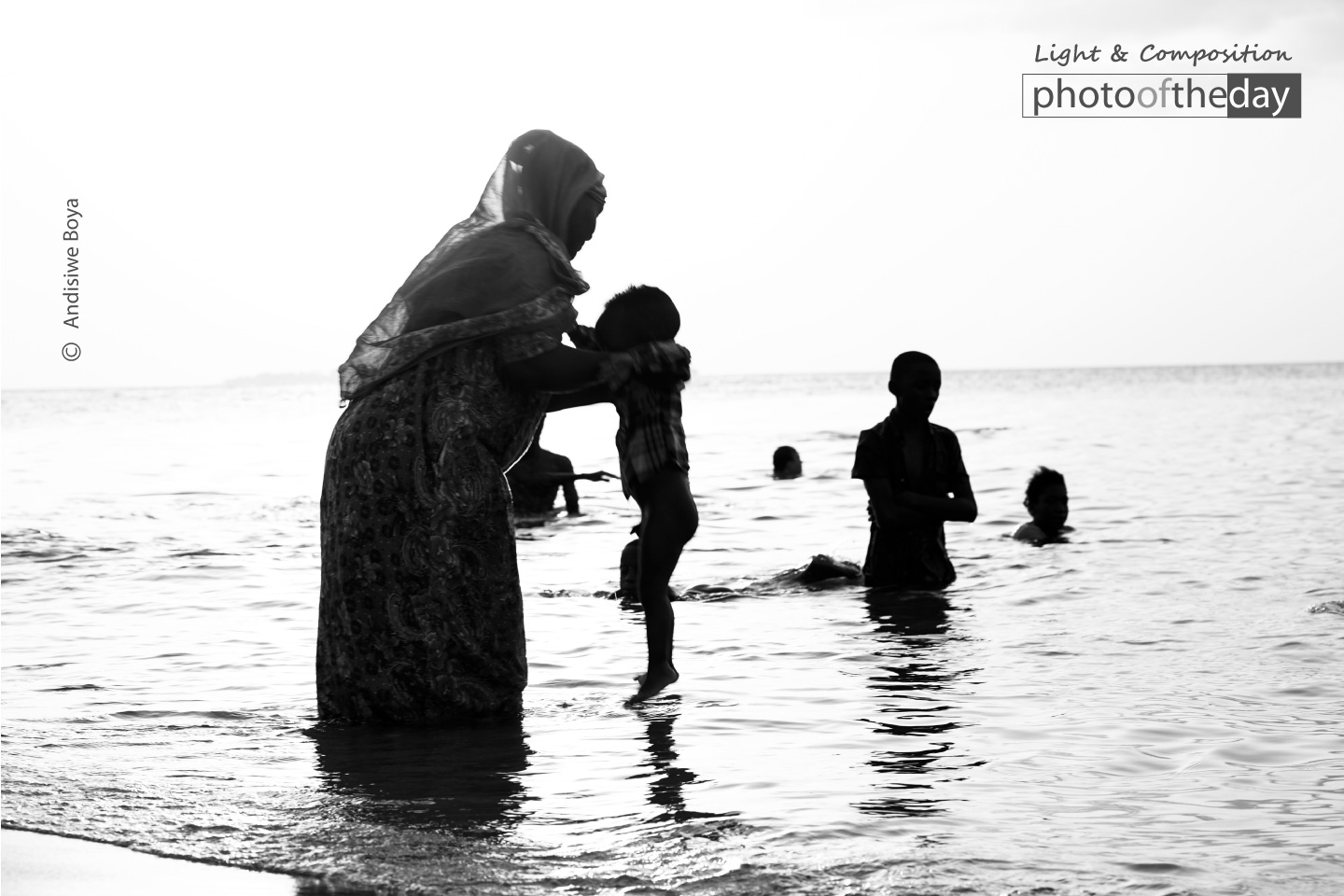
Beach Sunset with Granny by Andisiwe Boya
Captured during a visit to the exotic shores of Stone Town, Tanzania, this poignant image documents a tender moment between a grandmother and her grandson. As the sun dips below the horizon, the pair engages in the local tradition of evening swimming, a ritual deeply embedded in the lives of the island's youth. The photographer masterfully frames this intimate interaction against the backdrop of the shifting tides, highlighting the universal bond of family. The image is award-worthy for its authentic storytelling and the evocative way it captures a fleeting, culturally significant moment of joy and connection in the soft, fading light.
Andisiwe Boya
Based in Johannesburg, South Africa, Andisiwe Boya is a 26-year-old photographer dedicated to the art of documentary storytelling. With a diverse portfolio spanning portraiture and event photography, Boya focuses on capturing authentic human experiences and cultural narratives. Through a keen eye for detail and a commitment to visual storytelling, the photographer continues to document the vibrant life and traditions of the communities encountered throughout Africa.
Resonance Score Breakdown
Transparency Note: The resonance score (10.9/20) is calculated based on social engagement metrics collected before the award announcement.
Expert Photography Reviews · 5
The Rhythm of Returning
There is a rhythm to the day that we often forget to honor. It is the slow, inevitable pull of the tide, a movement that mirrors the way we return to those who hold our roots.
Read the reflection →The Salt in the Air
There is a specific weight to the air when the tide begins to turn, a heavy, humid stillness that feels like the world is holding its breath. In the north, we are used to light that retreats, light that pulls away from the skin and leaves us shivering in the sudden dark.
Read the reflection →Reviews & Comments
Share your thoughts about this award-winning photograph. Your reviews contribute to the community engagement score.
There’s a quiet grace in how that grandmother holds the boy against the Zanzibar tide. You can tell she isn’t performing for a lens; she’s entirely anchored in the child. It’s a rare, unhurried intimacy that makes me ache for my own home. When a subject forgets the camera exists, they give you their soul. Boya didn’t just take a picture here; she was invited into a private, sacred rhythm. That’s a gift, plain and simple.
One suspects the tide didn’t cooperate on the first attempt. It rarely does for the patient. Boya clearly spent hours in the salt spray, waiting for the light to soften just so against those Stone Town silhouettes. It’s a rare, quiet intimacy that doesn’t feel staged for a tourist’s lens. I’ve spent enough shivering evenings on similar shores to know when a photographer has truly earned their keep. It’s a fine, honest piece of work.
The light hits the water and the frame breathes. It’s a long take, a quiet moment of rhythm where the tide dictates the pace. I’m struck by the way the grandmother’s silhouette anchors the grandson’s movement; it’s a perfect match cut between generations. The shutter speed caught the exact pulse of the evening. I’d have held this shot for an eternity. It’s the frame the editor keeps because the story doesn’t need a second act.
Stone Town’s architecture is defined by the threshold between the dense, coral-stone urban fabric and the infinite void of the Indian Ocean. Here, the silhouette of the seawall creates a datum against which the figures play. I’m struck by how the fading light softens the masonry’s mass, turning the wall into a stage. It’s a rare, honest capture of space; the architecture doesn’t just frame the scene, it breathes with the tide’s rhythmic movement.
The composition relies on a sharp 1:2 vertical division, anchoring the figures in the lower-left quadrant. The horizon line acts as a rigid horizontal vector, perfectly balancing the dark, dense mass of the swimmers against the expansive, luminous negative space of the sky. I’m genuinely moved by how the boy’s outstretched arm creates a subtle diagonal, pulling the eye toward the center. It’s a beautifully solved spatial equation where geometry finally gives way to pure, quiet human connection.