Banarasi Handloom by Ashik Masud
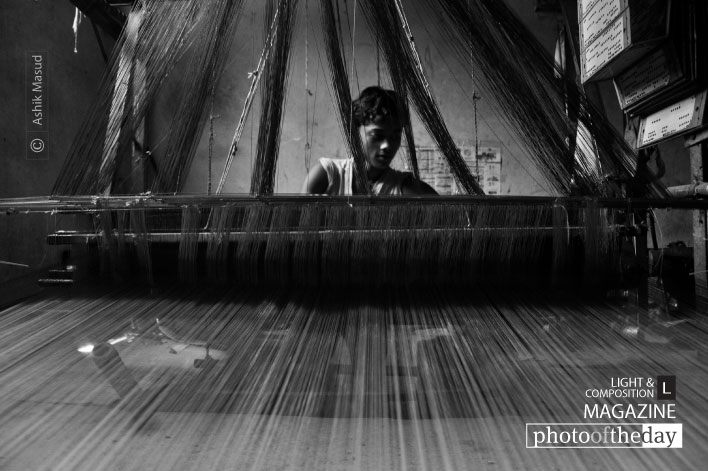
Captured in the bustling heart of Mirpur, this photograph documents the intricate world of the Benarasi handloom industry. Ashik Masud frames the artisans amidst the rhythmic motion of their looms, highlighting the cultural legacy brought by migrant families from Benaras. The image captures the delicate balance of light and shadow within the workspace, emphasizing the tactile nature of the silk and the focused intensity of the weavers. This work is award-worthy for its profound documentary value, effectively bridging the history of a displaced community with the vibrant, evolving reality of Bangladesh’s textile heritage through a lens of deep respect and visual storytelling.
Ashik Masud
Based in Dhaka, Bangladesh, Ashik Masud is a dedicated documentary photographer and IT professional who captures the vibrant essence of his homeland. His work is defined by a colorful, energetic approach that focuses on the human experience and the cultural intersections of daily life. As a self-taught artist, he views the camera as a vital tool for fostering connection and discovery, consistently seeking to represent the diverse narratives of the people he encounters through his evocative and respectful visual storytelling.
Resonance Score Breakdown
Transparency Note: The resonance score (13.0/20) is calculated based on social engagement metrics collected before the award announcement.
Expert Photography Reviews · 8
The Rhythm of the Thread
I spent this morning untangling a box of old necklaces. Some were knotted so tightly that I almost gave up, my fingers aching from the effort of pulling at the tiny, stubborn loops. It felt like a chore, but as I worked, I found myself slowing down.
Read the reflection →The Weaver’s Quiet Pulse
We are all composed of threads we did not spin ourselves. We inherit the colors of our ancestors—the deep indigo of a grandmother’s patience, the frayed gold of a migration, the stubborn crimson of survival.
Read the reflection →Reviews & Comments
Share your thoughts about this award-winning photograph. Your reviews contribute to the community engagement score.

Darkness here isn’t a void; it’s the loom’s own memory. Masud captures the silk not as a commodity, but as a struggle against the encroaching gloom of the Mirpur workshop. I’ve stared at these threads until my eyes ached, feeling the weight of the displaced hands pulling against the light. It’s a haunting, claustrophobic intimacy. When the shadows swallow the weaver’s periphery, we aren’t just seeing a craft; we’re watching time itself being woven into silence.
The dust in these Mirpur workshops is a lung-clogger, yet Masud has managed to keep his composure. One senses he didn’t just wander in for a quick snap; he’s clearly spent hours breathing that air, waiting for the loom’s rhythm to align with the light. It’s a gritty, honest bit of work. I’ve spent enough time in cramped, dim spaces to know when a photographer has earned their seat. He’s paid the price. It’s a fine, quiet achievement.
The loom’s vertical geometry anchors the frame, creating a necessary grid against the chaotic depth of the workshop. It’s a rigid architecture that forces the eye to navigate the silk’s tension. The light doesn’t merely illuminate; it defines the spatial weight of the weaver’s posture. I’m genuinely unsettled by how the negative space threatens to collapse the composition. It’s a precarious balance, yet the frame holds. The structure is disciplined. The visual logic remains intact.
The ochre dust of Mirpur settles like a Morandi still life, yet it’s the bruised, electric magenta of the silk that truly haunts me. It’s a violent, beautiful discord against the loom’s weathered timber, a chromatic ache that feels like a secret whispered in a crowded room. I’m breathless at how the light catches those threads; it’s not merely documentary, it’s a tactile, shimmering collision of history and pigment that makes my own heart stutter in the dark.
Dust motes dance in the sliver of light. The loom’s frame cuts the room. It’s heavy, dark, and precise. I’ve spent minutes watching the silk threads. They don’t move. The weaver is absent, yet the tension remains. It’s a quiet ache in my chest. Nothing here is accidental. The empty corner is not empty. It holds the weight of a displaced history. Silence fills the space between the warp and the weft. It’s enough.
The light here doesn’t just illuminate; it clings to the silk threads like a prayer. Ashik stood in that cramped Mirpur space, waiting for the loom’s rhythm to align with the soft, filtered glow. I’ve felt that same stillness, where the air grows heavy with history. It’s quiet, isn’t it? Watching these hands work, I feel a sudden, sharp ache for the patience required to weave a life from nothing but shadow and golden dust.
At f/3.5, the Nikon’s focal plane is razor-thin, isolating the silk’s weave against the loom’s chaotic geometry. The 18mm wide-angle distortion stretches the workspace, yet the chromatic aberration is surprisingly well-controlled. I’m genuinely moved by how the light catches those individual fibers; it’s a tactile resolution the human eye simply can’t process in real-time. It’s not just documentary work; it’s a forensic capture of human rhythm, where the diffraction of light across the threads feels almost sacred.
Most documentary work from Mirpur fades into visual noise, but Masud’s frame survives because of that singular, rhythmic blur of the loom. It’s the tension between the static weaver and the kinetic silk that anchors the history here. I’ve seen thousands of workshop shots, yet this one makes me feel the heat of that cramped space. It doesn’t just document a trade; it preserves the frantic, tactile pulse of a dying craft before it’s gone forever.