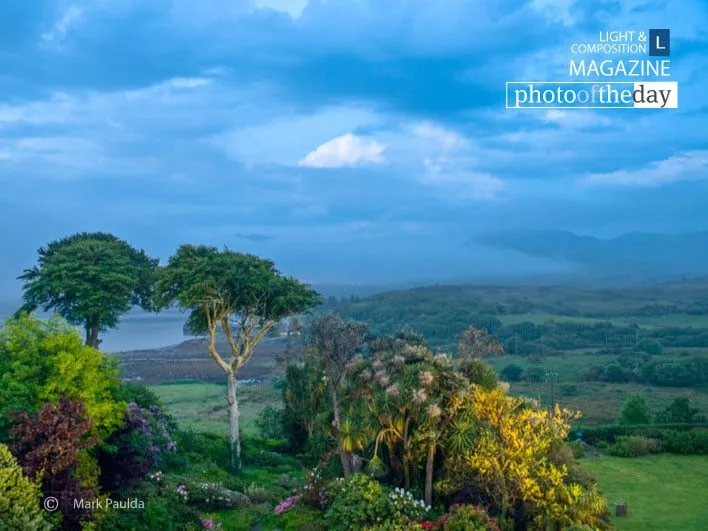
Ballinakill Bay by Mark Paulda
Captured during the serene blue hour, this photograph showcases the lush, verdant gardens overlooking Ballinakill Bay along the Connemara Loop in West Ireland. By utilizing a long four-second exposure, the photographer emphasizes the tranquil atmosphere of the landscape, allowing the soft, ambient light of dusk to saturate the scene. The composition draws the viewer toward the bay, contrasting the vibrant greenery with the quiet, ethereal quality of the Irish coastline. This image is award-worthy for its masterful use of natural light and its ability to transform a popular tourist vantage point into a deeply atmospheric and meditative visual experience.
Mark Paulda
Dividing his time between London, UK, and Texas, USA, Mark Paulda is a multifaceted photographer celebrated for his evocative, painterly approach to landscape and travel photography. His work is characterized by a mystical, intuitive style that transforms everyday environments into abstracted, sensuous forms reminiscent of Renaissance art. An award-winning photographer and best-selling author, Paulda continuously explores the paradoxes of human experience, seeking to capture the emotional tension between spontaneity and technical precision in his search for deeper meaning behind the lens.
Resonance Score Breakdown
Transparency Note: The resonance score (11.3/20) is calculated based on social engagement metrics collected before the award announcement.
Expert Photography Reviews · 8
The Quiet After the Rain
I was standing by the kitchen window this morning, waiting for the kettle to boil. It had been raining for three days straight, and the garden looked heavy, almost tired, under the weight of all that water.
Read the reflection →The Geography of Belonging
We often mistake the landscape for a backdrop, a static stage upon which human history is merely performed. Yet, the land itself is a document. Every fence line, every cleared path, and every manicured garden tells a story of enclosure and access.
Read the reflection →Reviews & Comments
Share your thoughts about this award-winning photograph. Your reviews contribute to the community engagement score.
Four seconds at f/3.5 in the Connemara damp. It’s a gamble that usually results in a blurry mess, yet here, the stillness feels hard-won. One suspects Paulda didn’t just stumble upon this blue hour; he likely sat shivering until the wind died down. I’ve spent enough miserable evenings on that coast to recognize the commitment required to keep the tripod steady. It’s a quiet, disciplined piece of work. I find myself wanting to be there.
The blue hour in Connemara doesn’t just fall; it breathes. Mark waited four seconds for the tide to soften, letting the light settle into the verdant gardens like a prayer. I’ve stood in that damp Irish air, feeling the stillness seep into my bones. It’s a quiet, heavy peace. Looking at this, I feel a sudden, sharp ache for the silence of that bay. He didn’t capture a view; he listened until the land spoke.
Most landscapes from the Connemara Loop are postcard clichés, but this four-second exposure earns its place because it captures the silence of the Irish coast rather than just the scenery. The blur in the water against the rigid, saturated greens creates a tension that feels genuinely lonely. I’ve looked at thousands of coastal shots, and this one makes me want to stand in that cold, damp air. It’s a rare, quiet victory for atmosphere over spectacle.
At f/3.5, the Olympus E-3’s sensor captures the blue hour’s low-frequency photons with surprising grace. The four-second exposure renders the bay’s surface into a laminar flow, effectively smoothing the diffraction of light across the water. It’s a delicate balance; the focal plane remains sharp enough to resolve the verdant textures without succumbing to noise. I’m genuinely moved by how the lens translates this Irish dusk into a quiet, meditative stillness that my own eyes simply couldn’t hold.
The tide retreats. Four seconds of exposure turn the water into a ghost. I’ve stood in this wind, and it’s cold. The greenery doesn’t shout; it waits. There is a weight in the stillness of the bay. Nothing here is accidental. The empty corner is not empty. It’s a breath held in the dark. I feel my own pulse slow down. The silence is the point. It’s enough.
The foreground foliage anchors the frame, yet it’s the horizon line that dictates the spatial tension. The four-second exposure flattens the water, creating a void that refuses to settle. It’s a precarious balance. I’m genuinely unsettled by how the verdant mass threatens to overwhelm the bay’s stillness. The composition holds, but only just. The weight of the dark vegetation pulls against the ethereal light, forcing the eye into a rigid, uncomfortable geometry. It’s precise.
You waited for the light to soften, and it shows. There’s a quiet ache in those four seconds of exposure that feels like standing alone on that Irish coast. I’ve spent enough time in the wind to know that silence isn’t empty; it’s heavy. You didn’t just take a picture of a bay, you captured the stillness of a place that’s usually loud with tourists. And honestly? It makes me want to breathe that air.
Before the eye identifies the shoreline, something in the chest softens. The four-second exposure pulls the breath into a rhythmic, tidal lull. I’ve returned to this blue hour three times today, and each time, the verdant blur feels like a forgotten memory resurfacing. It’s the stillness that catches me; it’s a quiet I haven’t felt in years. When I close my eyes, the cold, salt-heavy air of Ballinakill Bay lingers, ghosting against my skin.