An Ancient Play in an Ancient City by Shahnaz Parvin
In the historic heart of Panam City, Sonargaon, the photographer captured a poignant moment where the past and present converge. Amidst the weathered, ancient stones of the city, three boys engaged in a traditional game using date leaves, their laughter breathing life into the silent ruins. The photographer masterfully utilized a shallow depth of field to isolate the children, emphasizing their vibrant joy against the backdrop of history. This image is award-worthy for its evocative storytelling, successfully bridging the gap between centuries and highlighting the enduring nature of human tradition within a crumbling architectural landscape.
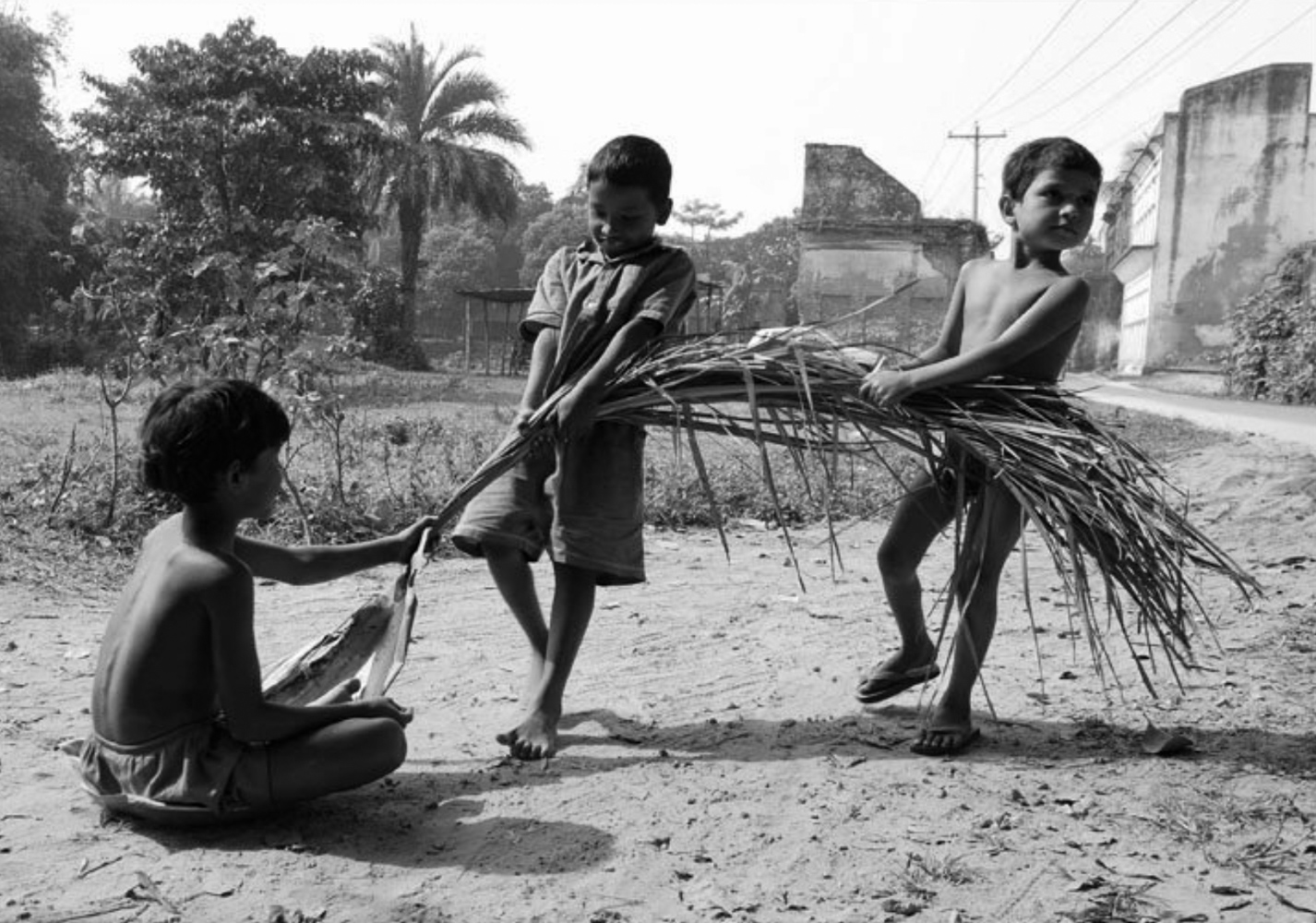
Exposure 1/400sec @ f/1.8 | ISO 200 | Focal Length 85mm
Shahnaz Parvin
Shahnaz Parvin was a distinguished award-winning photojournalist based in Bangladesh, celebrated for her profound ability to document the culture, people, and landscapes of South Asia. Recognized as one of the world's top photographers during her career, she was deeply committed to representing her homeland through a documentary lens. Her legacy remains defined by her extensive contributions to international photography platforms and her relentless passion for visual storytelling, which earned her numerous prestigious accolades before her untimely passing in 2016.
Resonance Score Breakdown
Transparency Note: The resonance score (11.4/20) is calculated based on social engagement metrics collected before the award announcement.
Expert Photography Reviews · 6
The Weight of Stone
Walls do not hold memory; they only hold the space where memory once lived. We build in brick and mortar, believing we are anchoring ourselves against the erosion of time. We carve our names, we stack our stones, and we wait for the future to acknowledge us.
Read the reflection →The Echoes of Play
In the archives of the British Museum, there are small, clay marbles that once rolled across the floors of Roman villas. They are worn smooth by the friction of thumbs and the grit of ancient dust.
Read the reflection →Reviews & Comments
Share your thoughts about this award-winning photograph. Your reviews contribute to the community engagement score.
What strikes me immediately in ‘An Ancient Play in an Ancient City’ is the raw, unforced authenticity. Shahnaz Parvin has a rare gift for stepping into a community and capturing moments of profound human dignity without intrusion. The subject’s expression and posture speak with complete honesty; there is no performance here, only life witnessed with deep empathy and respect. You waited for the exact right second, and the result is timeless.
Optically and technically, ‘An Ancient Play in an Ancient City’ delivers exceptional execution. The depth of field is measured to isolate the vital textural details while maintaining context in the background. Exposure values are tightly controlled, retaining subtle highlight gradations without crushing the shadow details. The shutter speed captures the organic cadence of the environment cleanly, proving that intentional camera craft is the bedrock of powerful imagery.
The structural balance in ‘An Ancient Play in an Ancient City’ demonstrates a rigorous spatial discipline. Shahnaz Parvin anchors the visual weight with precision, establishing a clear hierarchy that guides the eye across the frame without hesitation. The negative space functions not as an empty void, but as an intentional counterbalance to the central subject. There is a geometric integrity here that holds the entire scene together with commendable authority.
The shallow depth of field here is a bit of a cheat, but I’ll forgive it. One suspects the photographer didn’t just stumble upon these boys; she likely sat in that stifling Sonargaon heat until the ruins stopped feeling like a backdrop and started feeling like a playground. It’s a rare thing to see such genuine, unposed joy in a place so heavy with decay. She clearly put in the hours. I’ve been there; it’s exhausting work.
The ochre of these crumbling walls, reminiscent of a sun-bleached Morandi still life, anchors the scene, yet it’s the boys’ shirts—a startling, electric cobalt—that truly pierce the soul. It’s a chromatic collision I find utterly devastating; the way that vibrant, modern blue vibrates against the ancient, dusty masonry makes my heart ache for the fleeting nature of childhood. They’ve turned these silent, decaying ruins into a sanctuary of pure, unadulterated, living light.
The boys’ laughter doesn’t fill these ruins; it merely highlights the void. By blurring the crumbling masonry into a soft, indifferent haze, Parvin forces us to confront the fragility of their play against the weight of centuries. I’m unsettled by how the light clings to their skin, as if trying to anchor them to a history that’s already forgotten them. It’s a haunting reminder that we are all just shadows waiting for the sun to set.