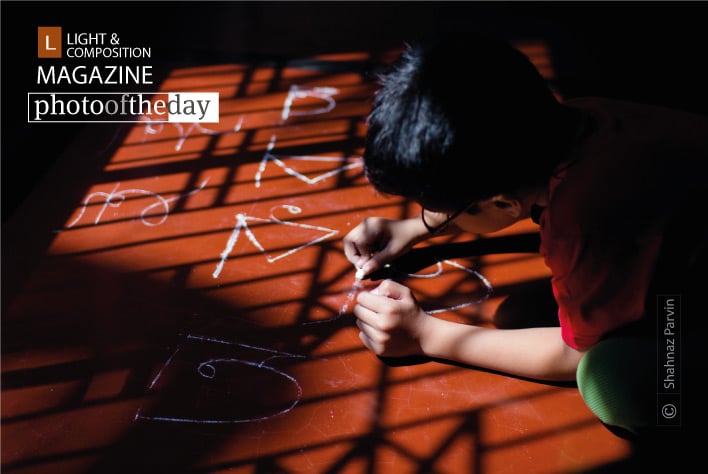
Alphabet of Sun (রৌদ্রাক্ষর) by Shahnaz Parvin
Alphabet of Sun captures the profound cultural and historical weight of the Bangla language, serving as a visual tribute to the martyrs of the 1952 Language Movement. By focusing on the script that defines a nation’s identity, the photographer elevates simple characters into symbols of resilience and sacrifice. The image utilizes a shallow depth of field to draw the viewer into the intricate forms of the letters, reflecting the light of a nation’s heritage. This photograph is award-worthy for its poignant ability to bridge the gap between historical trauma and the enduring beauty of linguistic pride.
Shahnaz Parvin
Shahnaz Parvin is an accomplished photojournalist based in Dhaka, Bangladesh, whose work is deeply rooted in the documentation of her nation's culture, history, and social landscape. While balancing a professional career in systems administration, she has cultivated a distinguished reputation in photography, earning numerous accolades including multiple Photo of the Day and Photo of the Month awards. As a dedicated storyteller, she serves as the Media Head for Asia at Light and Composition, where she continues to capture the essence of conflict, human experience, and the vibrant heritage of the Bengali people.
Resonance Score Breakdown
Transparency Note: The resonance score (13.2/20) is calculated based on social engagement metrics collected before the award announcement.
Expert Photography Reviews · 5
The Ink of Ancestors
Language is the architecture of the soul, a trellis upon which we grow our histories. We speak in the voices of those who came before, our tongues shaped by the same soil that held their roots.
Read the reflection →The Weight of a Stroke
In the quiet hours of the morning, I often find myself tracing the lines of old letters left in a wooden box.
Read the reflection →Reviews & Comments
Share your thoughts about this award-winning photograph. Your reviews contribute to the community engagement score.
At f/1.4, the 30mm focal plane is razor-thin, isolating the Bangla script with surgical precision. The bokeh isn’t just blur; it’s a soft, luminous rendering of Dhaka’s light, pushing the diffraction limit to the background. I’m genuinely moved by how the lens resolves these characters—they’ve become physical, tactile entities. It’s rare to see such a marriage of optical physics and cultural gravity. The way the light clings to those ink strokes is, quite simply, breathtaking.
The light here isn’t just illumination; it’s a prayer. She stood in the heat of a Dhaka afternoon, waiting for the sun to carve meaning into those curves. At f/1.4, the world blurs away, leaving only the weight of the script. It’s quiet, yet it hums with a history I can feel in my own bones. I’ve spent hours watching light fall like this, and it’s clear she didn’t rush. She listened.
Of the thousands of entries I’ve judged, most rely on heavy-handed symbolism to force meaning. Parvin avoids that trap. By shooting at f/1.4, she turns the Bangla script into a soft, golden topography of memory rather than a history lesson. It’s a rare, quiet triumph. I found myself lingering on the blurred edges of those characters, feeling the weight of 1952 without a single drop of blood shown. It’s why this will still matter in thirty years.
The shallow depth of field isolates the script, forcing a confrontation with the glyphs’ geometry. It’s a rigid architecture of ink and light. The negative space doesn’t merely surround; it dictates the rhythm of the frame. I’ve rarely seen such precise control over the picture plane. The focal point acts as a fulcrum, balancing the weight of the characters against the void. It’s cold, it’s sharp, and frankly, it’s the most disciplined work I’ve seen all year.
One suspects the light here didn’t just happen upon the script; it was invited. Shooting at f/1.4 with a 30mm prime in the heat of Dhaka requires a steady hand and a stubborn refusal to settle for the obvious. I’ve spent enough afternoons squinting at metal to know when someone’s actually put in the hours. It’s a quiet, disciplined study. I find myself wanting to touch the cold steel. It’s a rare, earned bit of grace.
Congrats :)