Allah is the Designer by Zahraa Al Hassani
Inspired by the intricate patterns of nature, the photographer sought to capture the divine symmetry found within a simple lettuce leaf. By placing a light source directly behind the subject, she illuminated the delicate veins and textures from within, transforming an everyday object into a luminous, ethereal study of form. This creative decision to play with backlighting highlights the complexity of natural design, turning a mundane botanical element into a profound artistic statement. The image stands out for its ability to find beauty in the overlooked, demonstrating a keen eye for light and composition that elevates a humble subject into a compelling visual narrative.
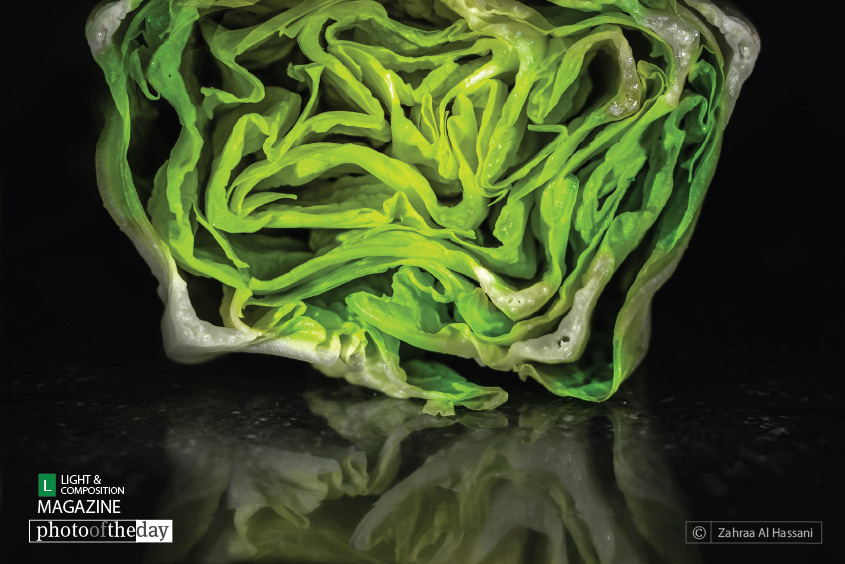
Exposure 1/60sec @ f/2.8 | ISO 200 | Focal Length 50mm
Zara Otaifah
Based in Baghdad, Iraq, Zahraa Al Hassani is a dedicated graphic designer and photographer who balances a professional career at Zain Telecommunications with her artistic pursuits. A graduate of the University of Technology in Baghdad, she leverages her extensive background in graphic design to refine her photographic perspective and visual storytelling. Her work is driven by a desire to acquire knowledge within the realm of purist photography, often using her technical skills to enhance the visual impact of her creative projects while documenting the beauty of her surroundings.
Resonance Score Breakdown
Transparency Note: The resonance score (12.5/20) is calculated based on social engagement metrics collected before the award announcement.
Expert Photography Reviews · 4
The Architecture of the Ordinary
I remember sitting in a small cafe in Istanbul, watching an old man peel an orange with the kind of focus usually reserved for watchmakers. He wasn’t just removing the rind; he was tracing the white pith, revealing the geometry hidden beneath the skin.
Read the reflection →The Hidden Map
I was chopping vegetables for dinner tonight when I stopped, knife hovering over the cutting board. I had been rushing, trying to get the meal done before the sun dipped behind the neighbor’s fence, but then I saw it.
Read the reflection →Reviews & Comments
Share your thoughts about this award-winning photograph. Your reviews contribute to the community engagement score.

Backlighting a leaf isn’t merely botanical; it’s an interrogation of the void. By forcing light through those veins, Al Hassani reveals the skeletal architecture of existence. It’s haunting, really—I felt a sudden, cold shiver looking at the way the darkness clings to the edges, refusing to be consumed. We aren’t just seeing a plant; we’re witnessing the struggle between form and the encroaching abyss. It’s a quiet, brutal reminder that everything beautiful eventually surrenders to the dark.
Before the eye identifies the leaf, something in the chest softens. The backlighting creates a sudden, sharp activation of the nervous system; it’s as if the light is breathing through the veins. I find myself holding my breath, tracing those translucent, chaotic geometries. It’s a quiet, cellular recognition. When I return to this a year later, I don’t see a vegetable anymore. I see the architecture of my own fragility, glowing against the dark.
1/60sec at f/2.8, 50mm. A tight aperture choice for a macro-adjacent study. At f/2.8, the depth of field is razor-thin, forcing the viewer’s eye into the vein structure. It’s a calculated risk that pays off. The backlighting doesn’t blow out the highlights, which is rare for this sensor. I’ve spent years staring at botanical captures, but this one actually made me stop and check the focus plane. It’s technically sound. The math holds up.
Most botanical studies feel clinical, but this leaf pulses with a frantic, organic energy. I’ve seen thousands of backlit subjects, yet the way Al Hassani maps those veins creates a stained-glass effect that feels almost sacred. It’s the tension between the mundane lettuce and that ethereal glow that makes me stop and stare. It’s not just a study of light; it’s a reminder that complexity hides in our kitchens. I’d bet it’s still haunting in thirty years.