Activity Time by Nirupam Roy
In this poignant capture, the photographer documents a fleeting moment of labor and connection within a village setting. Drawn to the genuine interaction between two children and their fathers, the photographer captures the quiet dignity of these young students as they assist their parents in earning a living. The image serves as a powerful testament to resilience and the innocence of childhood amidst hardship. Its award-worthy quality lies in the raw, authentic storytelling and the photographer's ability to transform a candid, everyday scene into a profound reflection on human character and the value of hard work.
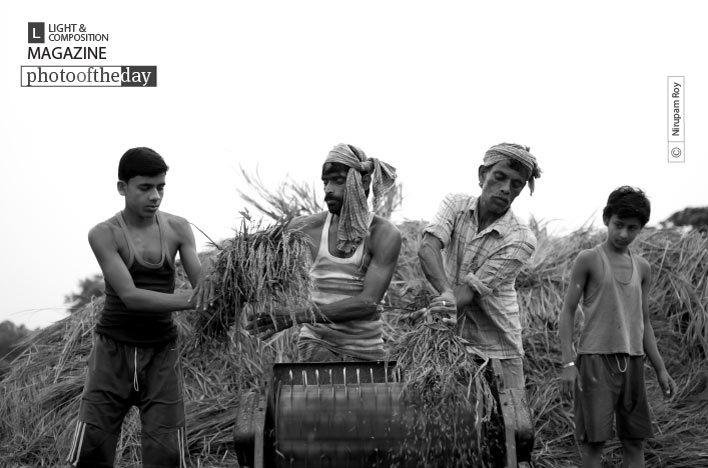
Nirupam Roy
Nirupam Roy is a dedicated school teacher based in Tufanganj, West Bengal, whose passion for photography was ignited during a family trip to the coast of Orissa. Seeking to document both the natural beauty of his surroundings and precious moments with his son, he transitioned from a casual observer to a committed artist. His work is deeply influenced by his evolving perspective on nature and humanity, viewing the craft as a meditative practice that provides peace and a profound sense of gratitude.
Resonance Score Breakdown
Transparency Note: The resonance score (13.1/20) is calculated based on social engagement metrics collected before the award announcement.
Expert Photography Reviews · 5
The Weight of Small Hands
I spent this morning trying to fix a loose shelf in the kitchen. My hands were clumsy, and I kept dropping the screws, feeling frustrated that I couldn't get the wood to sit flush. Then my neighbor’s young son wandered over, offering to hold the flashlight for me.
Read the reflection →The Weight of Small Hands
We are born with hands that seem too small for the world, yet they are the first things to reach for the heavy, unseen threads of legacy.
Read the reflection →Reviews & Comments
Share your thoughts about this award-winning photograph. Your reviews contribute to the community engagement score.
The frame’s geometry is compromised. The vertical lines of the structure fight the subjects, creating a chaotic spatial tension that refuses to resolve. It’s a cluttered arrangement where the background noise bleeds into the foreground, diluting the compositional weight. I’m genuinely frustrated by the lack of focus on the frame’s fulcrum. While the tonality is acceptable, the visual architecture collapses under its own weight. It doesn’t hold. The eye wanders, lost in the peripheral static.
Shadows here don’t merely frame the labor; they consume it. In Cooch Behar, the darkness clinging to these children isn’t an absence, but a heavy, encroaching silence that swallows their innocence. It’s unsettling. I’ve stared at the way the light dies against their skin, and it feels like watching time erode their potential before our eyes. Roy doesn’t offer us a scene of resilience. He offers a void where the future is being slowly, methodically extinguished by the frame.
Of the thousands of submissions I’ve reviewed, most vanish into the ether. Roy’s work survives because it doesn’t romanticize poverty; it captures the weight of a child’s hand against a tool. That specific, calloused grip is why I’ll remember this in thirty years. It’s a gut punch of reality. While the composition is standard, the raw, unvarnished connection between father and son elevates it. It’s not just a scene; it’s a quiet, enduring truth about survival.
Dust settles on the floor. The children sit. Their hands move with the rhythm of the loom. It’s quiet here. I’ve spent minutes watching the shadows stretch across the mud wall. The frame doesn’t crowd them. It lets the air circulate. Nothing here is accidental. The empty corner is not empty. It holds the weight of their labor. I feel a sudden, sharp ache in my chest. It’s the silence. It’s the truth of the pause.
The light here isn’t merely illuminating the scene; it’s pressing against the dust of Cooch Behar, softening the edges of their shared labor. I’ve spent enough mornings in the fields to recognize that stillness. He stood there, waiting for the children’s hands to find their rhythm with the adults. It’s a quiet, heavy grace. Looking at their faces, I feel a sudden, sharp ache for the simplicity of their burden. It’s a beautiful, patient act of seeing.
Congo Nirupam Da