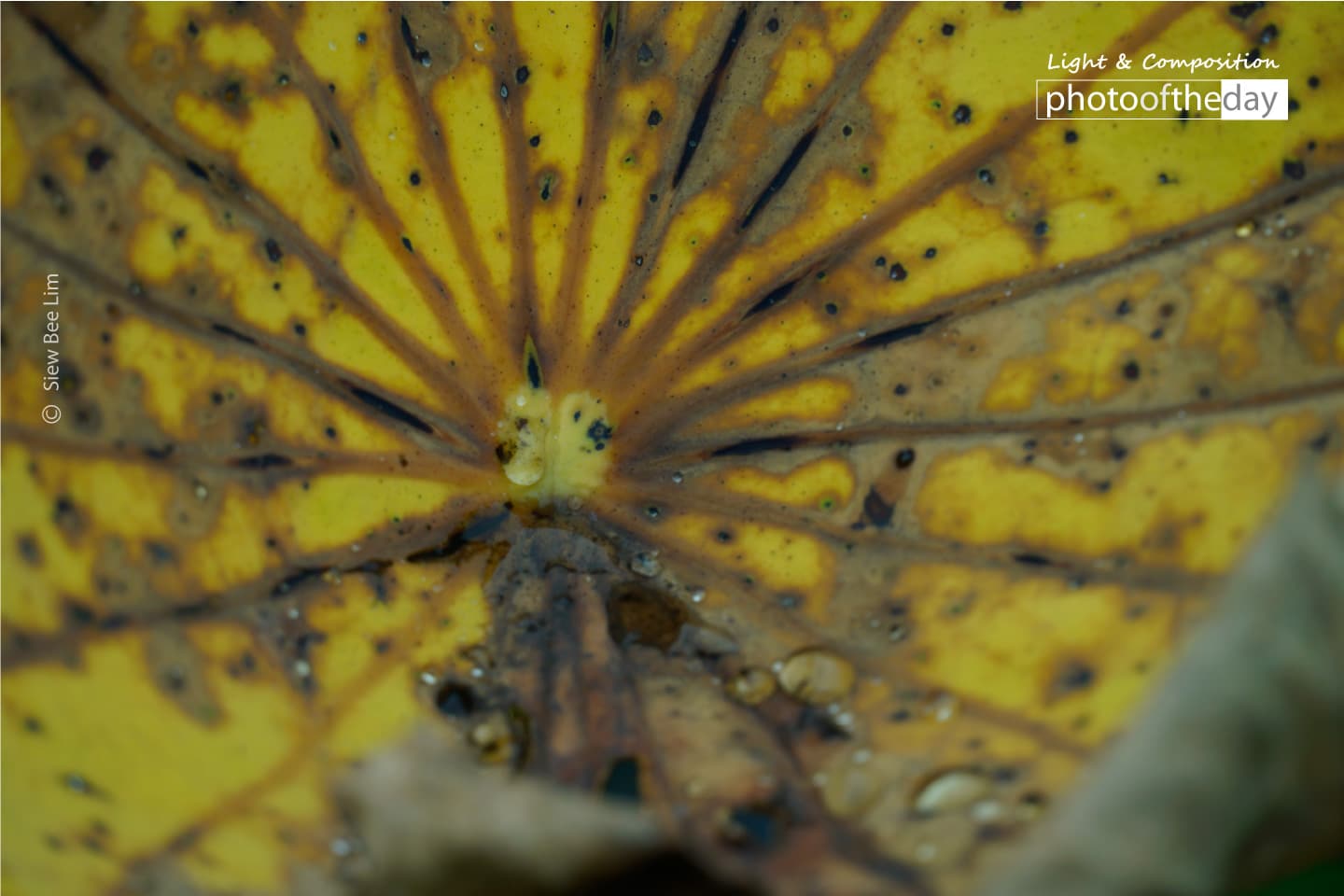
A Yellowish Lotus Leaf by Siew Bee Lim
Captured on a bright September morning at the Chinese and Japanese Gardens, this photograph highlights the delicate textures of a single lotus leaf. The photographer utilized side-lighting to accentuate the leaf's unique yellowish hue and intricate veins, creating a striking contrast against the pond's surface. By carefully timing the shot to capture the interplay of light and shadow, the image transforms a simple botanical subject into a compelling study of nature. This piece is award-worthy for its clean composition and the photographer's ability to find profound beauty in the quiet, overlooked details of the natural world.
Siew Bee Lim
Born in Singapore in 1965, Siew Bee Lim is a dedicated photographer who balances her professional background as a programmer with a lifelong passion for visual arts. Though she initially explored photography through darkroom techniques early in her career, she has recently returned to the craft with a renewed commitment to formal learning. Drawing inspiration from her appreciation of traditional Chinese painting and literature, she seeks to refine her artistic vision and technical execution through the Light & Composition platform, proving that a creative journey can flourish at any stage of life.
Resonance Score Breakdown
Transparency Note: The resonance score (11.7/20) is calculated based on social engagement metrics collected before the award announcement.
Expert Photography Reviews · 5
The Wisdom of Fading
There is a quiet dignity in the way a leaf surrenders its green. We often mistake the shift toward gold or brown as a sign of ending, yet it is merely a transition into a different kind of presence.
Read the reflection →The Architecture of Decay
In the quiet corners of a garden, we often mistake the fading of color for an ending. We are taught to prize the bloom, the vibrant, waxy perfection of the petal that reaches toward the sun with an almost desperate urgency.
Read the reflection →Reviews & Comments
Share your thoughts about this award-winning photograph. Your reviews contribute to the community engagement score.
Nature doesn’t wait for the shutter. I’m usually hunting concrete, but this leaf caught me off guard. The side-lighting hits those veins perfectly, turning a quiet pond into a high-stakes arena. One tenth of a second later and the sun shifts, the texture flattens, and the magic dies. It’s sharp, it’s clean, and honestly, it makes me want to put down my Leica and just breathe. You nailed the timing. It’s alive.
1/500sec at f/5.6, ISO 200. A conservative choice. The shutter speed is overkill for a static leaf, yet it freezes the micro-vibrations of the veins perfectly. I’m annoyed by how much I respect that sharpness. At f/5.6, the depth of field is thin enough to isolate the texture but deep enough to avoid focus errors. It’s a clinical execution. The data doesn’t lie; the photographer knew exactly what they were doing here. It’s technically sound.
It’s tempting to dismiss this as mere botanical study, but look at the venation. It functions like a structural grid, a datum for the leaf’s organic mass. The side-lighting doesn’t just reveal texture; it defines the threshold between solid and void, mimicking how light articulates a facade. I’m genuinely moved by how the yellow hue suggests a decaying material integrity. It’s a reminder that even nature’s architecture is subject to the relentless, beautiful erosion of time.
It’s a tidy bit of work, though one wonders if the morning sun did the heavy lifting here. The veins are crisp, certainly, but I’m left searching for the grit of a long vigil. Did she return until the light broke her spirit, or was this a lucky stroll? I’ve spent enough mornings shivering in damp reeds to appreciate the texture, yet I’m not convinced she’s paid the full price for this lotus.
The light hits that leaf and the frame just breathes. It’s a freeze-frame of a slow, organic decay, caught at the exact moment the yellow turns to gold. I’ve spent hours watching light shift on water, and this shot holds that tension perfectly. The shutter speed was a smart choice; it keeps the texture sharp while the background dissolves into a soft, cinematic blur. I’d have watched this leaf for hours. It’s a quiet, perfect cut.