A Small Boy by Keith Goldstein
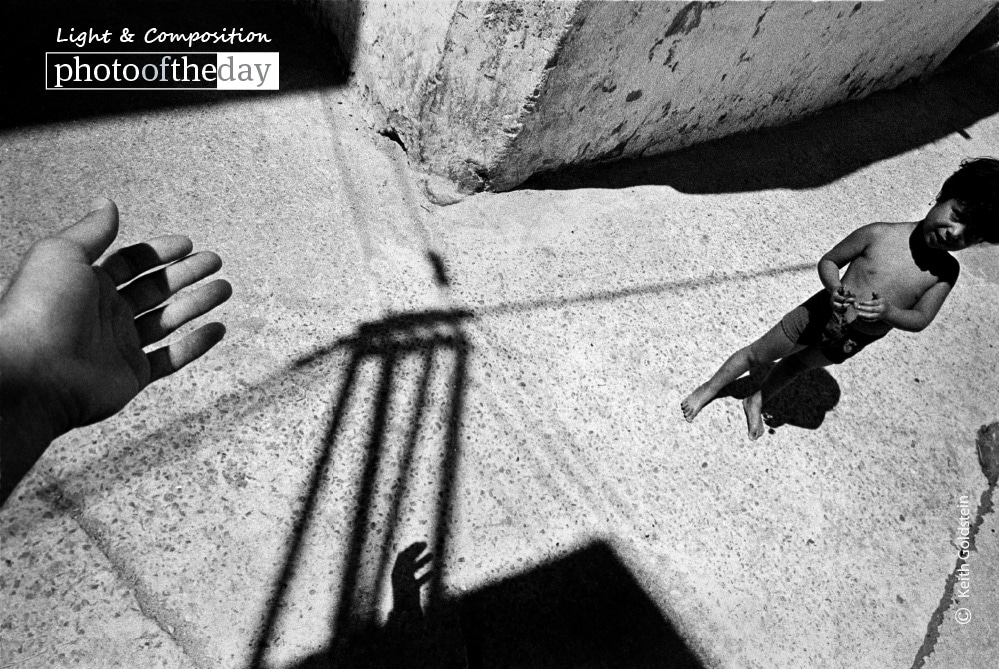
While wandering the maze-like streets of Asilah, Morocco, the photographer encountered a young boy near a beachside cafe. The moment was defined by a brief, silent interaction—a handshake attempt met with a curious, uncomprehending stare in Arabic. Captured with a Leica M4, the image preserves the raw, unscripted tension of this cross-cultural meeting. The photograph is award-worthy for its authentic street aesthetic and the profound sense of human connection, demonstrating the photographer’s ability to remain ready to document fleeting, intimate moments within the complex tapestry of daily life.
Keith Goldstein
Born in Brooklyn in 1957, Keith Goldstein is a seasoned fine art and editorial photographer based in Hamilton Heights, New York City. After earning his BFA from the School of Visual Arts and an MFA from the Cranbrook Academy of Art, he developed a deeply emotive style of expression that has been exhibited internationally since 1980. His extensive portfolio, featured in numerous prestigious publications and media outlets, reflects a philosophy of simplicity and creative freedom, utilizing minimal gear to explore the human experience through his lens.
Resonance Score Breakdown
Transparency Note: The resonance score (12.2/20) is calculated based on social engagement metrics collected before the award announcement.
Expert Photography Reviews · 8
The Weight of a Glance
In the quiet corners of a house, one often finds objects that have outlived their original purpose. A rusted key that no longer fits a lock, or a heavy iron spoon worn thin by decades of stirring.
Read the reflection →The Grit of Unspoken Things
The taste of salt is never just salt; it is the memory of a sea breeze clinging to the back of the throat, a dry, stinging reminder of a place you have left behind.
Read the reflection →Reviews & Comments
Share your thoughts about this award-winning photograph. Your reviews contribute to the community engagement score.
The boy’s gaze doesn’t invite us in; it interrogates the intruder. Why does the curator call this a connection when the child clearly feels like an object of curiosity? I find the power dynamic here deeply uncomfortable. Goldstein uses a wide-angle lens to press into a private moment, but who benefits from this exposure? Is this street photography, or just a tourist claiming a piece of Asilah for his portfolio? It’s a transaction, not a meeting.
Most street photography is noise, but this frame holds a rare, quiet gravity. The 21mm lens forces a proximity that usually feels invasive, yet here, it creates an intimacy that’s almost startling. I’ve seen thousands of shots of children in markets, but the boy’s guarded, uncomprehending gaze against the textured wall stops me cold. It’s the tension of that missed connection that’ll matter in thirty years. It’s a small, perfect ache of human distance.
The boy’s gaze doesn’t meet the lens; it retreats into the architecture of Asilah. Goldstein’s Leica captures the light, but it’s the encroaching shadow that defines the boy’s isolation. It’s a heavy, silent barrier between two worlds. I’ve stared at this frame for an hour, and I’m struck by a sudden, cold loneliness. The darkness here isn’t just a lack of illumination; it’s a refusal to be known. It’s where the truth actually hides.
Before the eye identifies the boy, something in the chest tightens. It’s that sudden, sharp activation of being a stranger in a foreign place. I’ve felt that exact, quiet hesitation in my own pulse. When I return to this, the boy’s uncomprehending stare feels less like a barrier and more like a mirror. It doesn’t just capture a handshake; it captures the precise, heavy weight of a moment where two worlds fail to touch.
The wall dominates. It’s a vast, sun-bleached expanse of nothing. The boy is small, a mere interruption in the stone. He doesn’t hold the frame; he anchors the silence. I’ve stood in these alleys, and I feel the heat radiating from the plaster. It’s heavy. The handshake didn’t happen, but the distance remains. Nothing here is accidental. The empty corner is not empty. It’s the weight of the pause. It’s enough.
Street photography is often just a frantic scramble for scraps. Goldstein’s frame, however, suggests he didn’t just stumble upon this boy; he likely lingered until the air settled. Using a 21mm lens at f/11 requires one to be uncomfortably close, practically breathing the same dust. It’s a bold, intimate distance. I’ve spent enough hours in the heat to know that look of confusion isn’t easily bought. He earned this quiet, fleeting friction. Well played.
We look at this boy’s face and we feel the weight of a language we don’t share. Keith didn’t just snap a shutter; he reached out a hand first. That hesitation, that silent, uncomprehending stare, it’s where the story lives. I’m moved by how he captured that bridge between two worlds that almost didn’t connect. It’s a quiet, honest moment that asks to be returned to. We’ve all been that stranger, haven’t we?
The shutter fires, and the world freezes in a stuttering, beautiful silence. It’s a wide-angle tension, that 21mm lens pulling the boy’s confusion into the frame like a close-up in a neorealist drama. I’ve felt that exact hesitation—the reach for connection met by a blank, unscripted wall. The cut would have been a mistake; the frame holds because it doesn’t resolve. It’s the shot the editor keeps, raw and perfectly, painfully still.