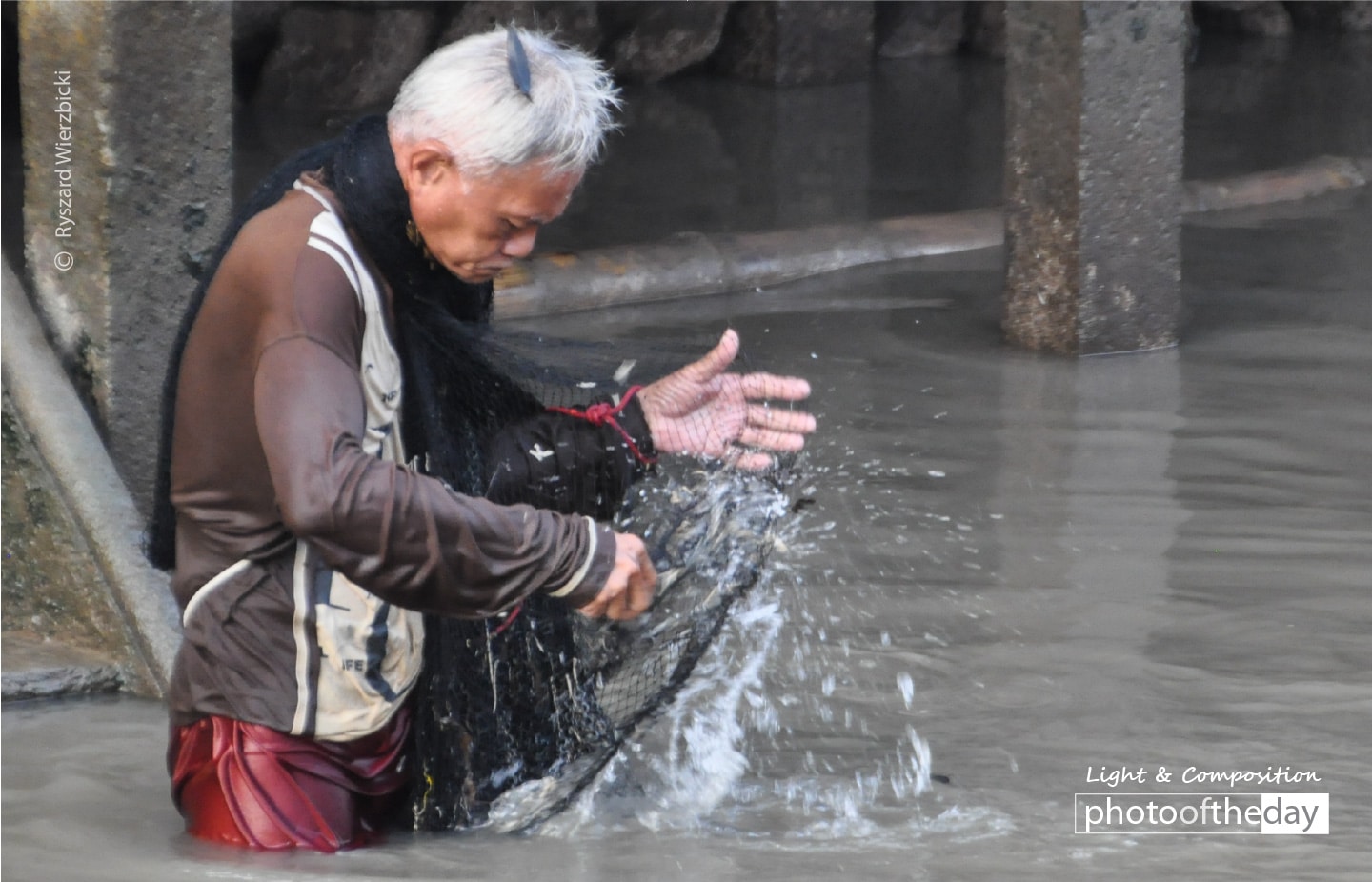
A Fisherman from Amphawa by Ryszard Wierzbicki
Captured at the authentic Amphawa floating market, this photograph documents the quiet, rhythmic life of a local fisherman amidst the bustling weekend activity of the riverside. The photographer skillfully isolates the subject from the surrounding food stalls and tourist crowds, focusing on the genuine labor that defines the village's character. By balancing the vibrant, chaotic energy of the market with the focused, traditional work of the fisherman, the image offers a poignant glimpse into a vanishing way of life. Its award-worthy quality lies in this masterful juxtaposition of cultural heritage and human perseverance, rendered with a keen eye for narrative detail.
Ryszard Wierzbicki
Born in 1963, Ryszard Wierzbicki is a Polish-born photographer and traveler currently based in Swindon, United Kingdom. After a diverse career in education and marketing, he transitioned into a life of exploration, focusing his lens on the cultures and landscapes of South-East Asia. His work is deeply informed by his background in social sciences and his commitment to charitable causes, reflecting a profound empathy for the people he encounters. Through his photography and travel forums, he shares his passion for documenting the authentic, often overlooked moments of human experience across the globe.
Resonance Score Breakdown
Transparency Note: The resonance score (11.8/20) is calculated based on social engagement metrics collected before the award announcement.
Expert Photography Reviews · 7
The Quiet in the Current
I spent this morning trying to fix a leaky faucet in the kitchen. It was one of those small, nagging chores I had put off for weeks. I kept turning the wrench, listening to the drip, and feeling a strange sort of impatience.
Read the reflection →The Quietude of Labor
Seneca once remarked that it is not the man who has too little, but the man who craves more, who is poor.
Read the reflection →Reviews & Comments
Share your thoughts about this award-winning photograph. Your reviews contribute to the community engagement score.
We watch the fisherman in Amphawa, his hands moving with a rhythm that predates the tourists crowding the banks. He isn’t performing; he’s simply existing within his labor. I feel a quiet ache looking at his weathered skin, a reminder of a world slipping through our fingers. Ryszard didn’t just point a lens here; he sat in the silence of that boat until the man’s story became his own. It’s a portrait that asks to be returned to.
You didn’t just snap a market scene; you found the silence inside the noise. I’ve spent enough time on those canals to know how easy it is to get distracted by the tourists, but you kept your eyes on the man. And that’s what matters. You waited for his rhythm to cut through the chaos. It’s a quiet, heavy truth. I felt a sudden, sharp ache of nostalgia looking at his hands. You were really there.
There’s a quiet dignity in the way this fisherman holds his oars, but I wonder if he knew he was being watched. He’s isolated, yet he feels like he’s performing for a lens rather than living his life. I’ve spent years in markets like this; the eyes tell me he’s guarded. It’s a clean composition, sure, but it lacks that raw, unscripted vulnerability I crave. This face has a whole life in it, but it’s still hidden.
Why resolve the fisherman’s face when the motion of the water tells the real story? Wierzbicki’s choice to let the boat dissolve into a smear of light is far more honest than a crisp, tourist-friendly snapshot. It’s closer to Hiroshi Sugimoto’s long-exposure theatres than conventional travel reportage. I’m genuinely moved by how he’s abandoned the obsession with sharpness to capture the rhythm of the market. He’s traded clarity for a much deeper, kinetic truth.
Amphawa’s chaos usually swallows everything, but Wierzbicki found the pocket. That fisherman’s posture is the anchor. If he’d shifted his weight a fraction earlier, the rhythm would’ve died. I’ve spent years chasing that specific stillness in a moving crowd, and honestly, it makes my pulse jump. It’s not just labor; it’s a heartbeat caught before the tide turns. One tenth of a second later and the frame collapses into noise. He nailed the timing. Pure, honest work.
The fisherman’s boat creates a powerful horizontal vector, bisecting the frame at a precise 1:2 ratio. That dark, rhythmic hull anchors the composition, while the vertical oars establish a secondary grid that cuts through the water’s chaotic reflections. I’m genuinely captivated by how the geometry forces the eye to oscillate between the subject’s stillness and the surrounding turbulence. It’s a beautifully solved spatial equation; the tension between those rigid lines and the fluid environment is just perfect.
Most entries in this category rely on the chaos of the market to hide a lack of focus. Wierzbicki avoids that trap. By isolating the fisherman’s weathered hands against the dark, rhythmic water, he captures a quiet dignity that’s disappearing. I’ve seen thousands of market shots, but this one actually made me hold my breath. It’s the stillness in the oars that anchors the frame. Thirty years from now, people will still recognize this man’s exhaustion.