A Boy from Tangiers by Keith Goldstein
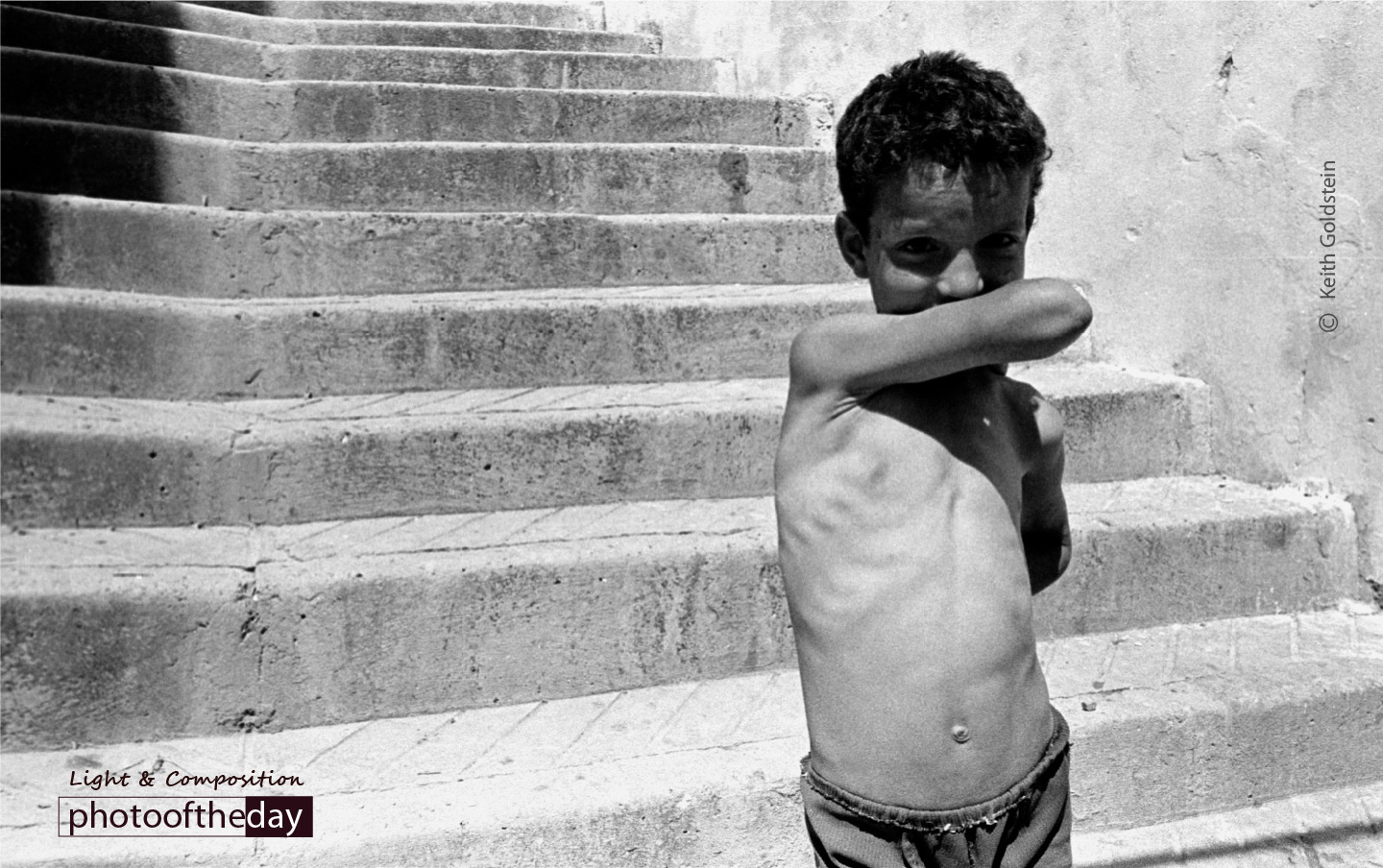
Captured during a summer study abroad in 1980, this portrait reflects the photographer's immersive experience wandering the historic alleys of Tangiers. By blending into the local environment, the photographer gained intimate access to the daily lives of residents, including this young boy. The image masterfully contrasts the boy’s shy, guarded posture and shirtless form against the rigid, rhythmic geometry of the stone steps behind him. This photograph is award-worthy for its authentic street-level perspective, capturing a fleeting, tender moment of human connection that transcends the cultural and linguistic barriers of the time.
Keith Goldstein
Born in Brooklyn in 1957, Keith Goldstein is a distinguished fine art and commercial photographer based in Hamilton Heights, New York City. After earning his BFA from the School of Visual Arts and an MFA from the Cranbrook Academy of Art, he developed a deeply emotive photographic style shaped by mentors like David Attie and Carl Toth. With a career spanning over four decades, Goldstein has exhibited internationally and contributed to numerous prestigious publications, consistently championing a minimalist, unencumbered approach to capturing the human experience.
Resonance Score Breakdown
Transparency Note: The resonance score (10.2/20) is calculated based on social engagement metrics collected before the award announcement.
Expert Photography Reviews · 3
The Architecture of Silence
We are all built of layers, like the stone walls of an old city that have forgotten the hands that stacked them. There is a particular kind of stillness that settles in the chest when we are young, a quiet waiting that feels like a held breath before the wind changes.
Read the reflection →The Weight of Quiet
There is a particular stillness that belongs only to the young, a state of being where the world has not yet asked them to become anything other than what they are. We spend our lives learning to build walls, to curate our expressions, and to guard the soft edges of our spirits.
Read the reflection →Reviews & Comments
Share your thoughts about this award-winning photograph. Your reviews contribute to the community engagement score.
That boy’s guarded posture screams of an intrusion he couldn’t escape. In the field, I’ve learned that if a subject freezes like that, you’ve already failed; you’re a predator, not a guest. It’s a cold extraction, not a connection. I feel a genuine ache in my chest looking at his vulnerability against those hard, unforgiving stones. Did the photographer even ask permission, or was this just another trophy taken from someone who couldn’t say no?
The jury’s obsession with clarity here feels stifling. Why demand the boy’s skin be rendered with clinical precision? I’m far more drawn to the way the motion blur softens his guarded posture, turning the stone steps into a rhythmic, abstract blur. It’s closer to Sugimoto’s long-exposure theatres than standard street reportage. I’d trade that sharpness for more of this intentional ambiguity. It’s a haunting, fleeting ghost of 1980, and I find that beautifully unsettling.
Tangiers, 1980. The boy’s posture is pure vulnerability against that brutal, rhythmic stone. If Goldstein had waited another heartbeat, the tension would’ve vanished into the shadows. I’ve spent years chasing this exact kind of intimacy, and honestly, it makes my pulse jump. It’s not just a portrait; it’s a collision. One tenth of a second later and the geometry collapses, the connection breaks. He caught the boy’s guard down. That’s the street, raw and unrepeatable.