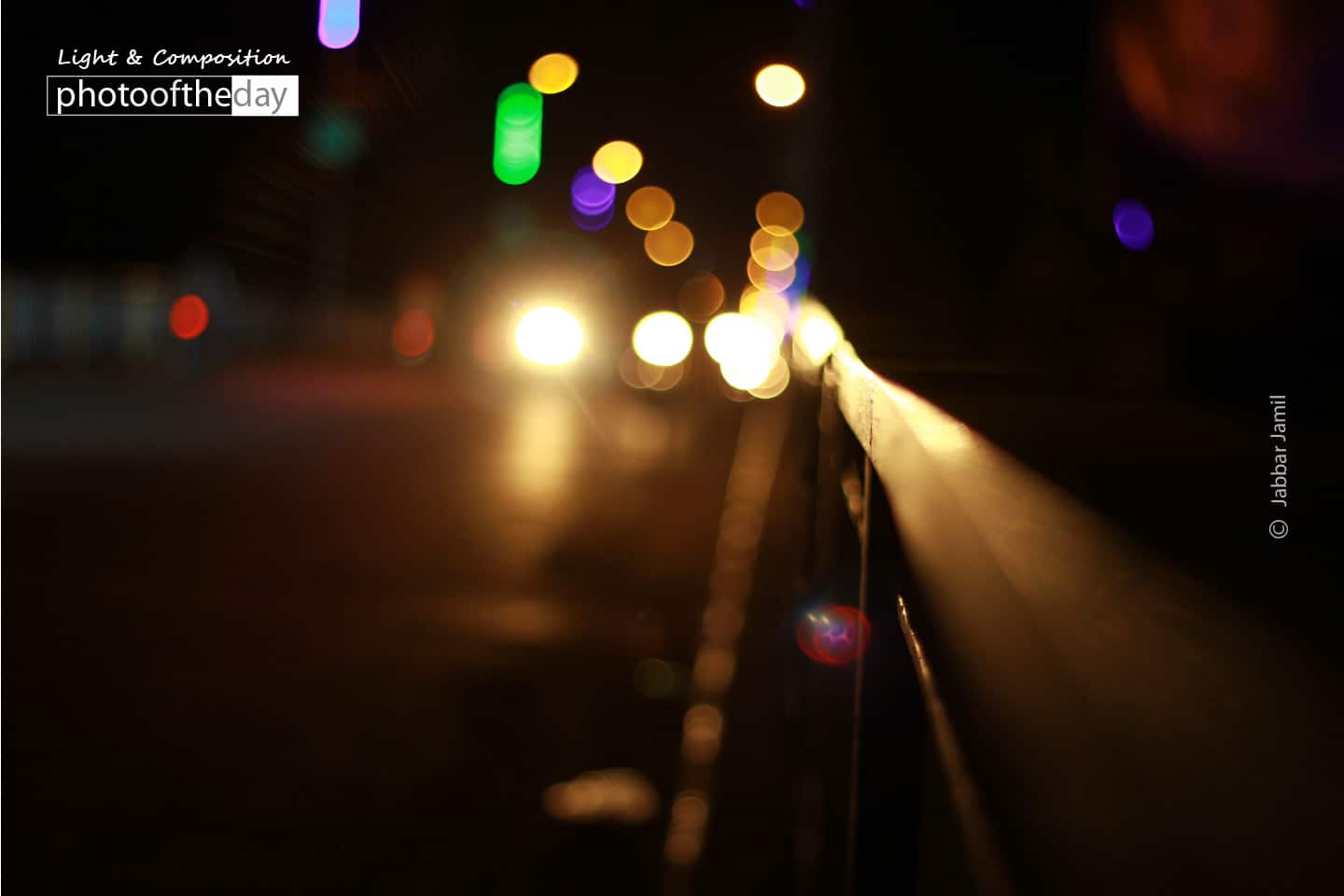
Bokehlicious by Jabbar Jamil
Captured on an old overhead bridge in Sialkot, this photograph masterfully utilizes the vibrant interplay of city traffic and decorative overhead lighting to create a stunning bokeh effect. The photographer recognized the potential of the urban environment, transforming the mundane flow of night traffic into a canvas of soft, luminous orbs. While the scene lacked natural foreground elements, the technical execution highlights a keen eye for light and atmosphere. This image stands out for its ability to elevate a standard urban transit point into a compelling visual study of night photography, demonstrating the power of patience and perspective in street settings.
Jabbar Jamil
Based in Sialkot, Pakistan, Jabbar Jamil is a dedicated street photographer who views his craft as a vital bridge to the outside world. Through his lens, he explores the raw reality of his surroundings, finding that photography serves as both a creative outlet and a therapeutic escape from the stresses of daily life. His work is defined by a commitment to documenting the world exactly as he sees it, often finding profound meaning in scenes that are not inherently beautiful, thereby fostering deeper connections with the humanity he encounters.
Resonance Score Breakdown
Transparency Note: The resonance score (11.7/20) is calculated based on social engagement metrics collected before the award announcement.
Expert Photography Reviews · 3
The Architecture of Absence
We often mistake the city for its infrastructure—the concrete, the steel, the transit arteries that pulse with the rhythm of the commute. But a city is not merely a collection of physical objects; it is a social document written in the language of movement and light.
Read the reflection →The Architecture of Distraction
In the nineteenth century, the invention of the streetlamp was heralded as the final conquest of the night. We were told that by banishing the shadows, we would finally see the world as it truly was, stripped of the terrors that hide in the dark.
Read the reflection →Reviews & Comments
Share your thoughts about this award-winning photograph. Your reviews contribute to the community engagement score.
Sialkot’s traffic becomes a smear of neon, yet I’m left wanting more than just pretty orbs. It’s a safe, polite abstraction. Why stop at mere bokeh? I’d have preferred the chaos of the city to bleed into the frame, pushing toward the kinetic energy of a Futurist painting. It’s technically competent, sure, but it doesn’t challenge the eye. It’s too comfortable. I crave the friction of a lens pushed until the city finally breaks apart.
The bokeh here isn’t just aesthetic; it’s a precise mapping of the lens’s exit pupil at a wide aperture. By pushing the focal plane beyond the Sialkot traffic, Jamil forces the point-source lights into perfect circular diffusion discs. I’m genuinely moved by how the chromatic aberration at the edges of these orbs adds a soft, prismatic fringe. It’s a beautiful reminder that even mundane urban transit can be rendered as pure, refracted physics. It’s simply brilliant.
The frame collapses under the weight of its own diffusion. While the bokeh provides a rhythmic pulse, it lacks a structural anchor to ground the picture plane. The eye drifts, searching for a fulcrum that doesn’t exist. It’s a visual drift I find exhausting. Without a sharp foreground element to puncture the haze, the composition dissolves into mere decorative noise. It’s pretty, sure, but it doesn’t hold. The architecture of the frame remains entirely unresolved.