The Architecture of Absence
We often mistake the city for its infrastructure—the concrete, the steel, the transit arteries that pulse with the rhythm of the commute. But a city is not merely a collection of physical objects; it is a social document written in the language of movement and light. When we look at the urban landscape at night, we see the traces of human activity, the collective effort of thousands of people moving toward their own private destinations. Yet, in this blur of motion, the individual is often erased. We see the glow of the machine, the efficiency of the grid, and the decorative markers of progress, but we lose the person behind the wheel or the pedestrian waiting for a bus. Who is being served by this flow? Is this space designed for the citizen to inhabit, or is it merely a corridor to be traversed as quickly as possible? When the city becomes a spectacle of light, does it invite us to belong, or does it simply ask us to pass through?
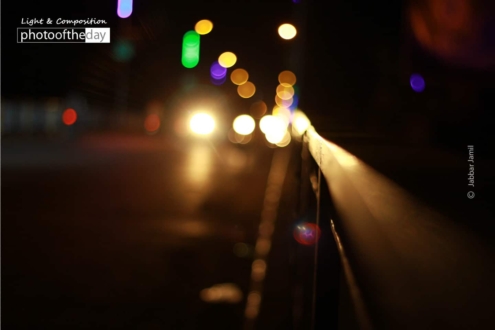
Jabbar Jamil has captured this tension in the image titled Bokehlicious. By turning the transit infrastructure of Sialkot into a soft, glowing abstraction, he forces us to consider what remains when the human element is obscured by the city’s own brilliance. Does this view make the city feel more welcoming to you, or does it highlight the distance between the infrastructure and the people who live within it?