Lemon Farmers by Saniar Rahman Rahul
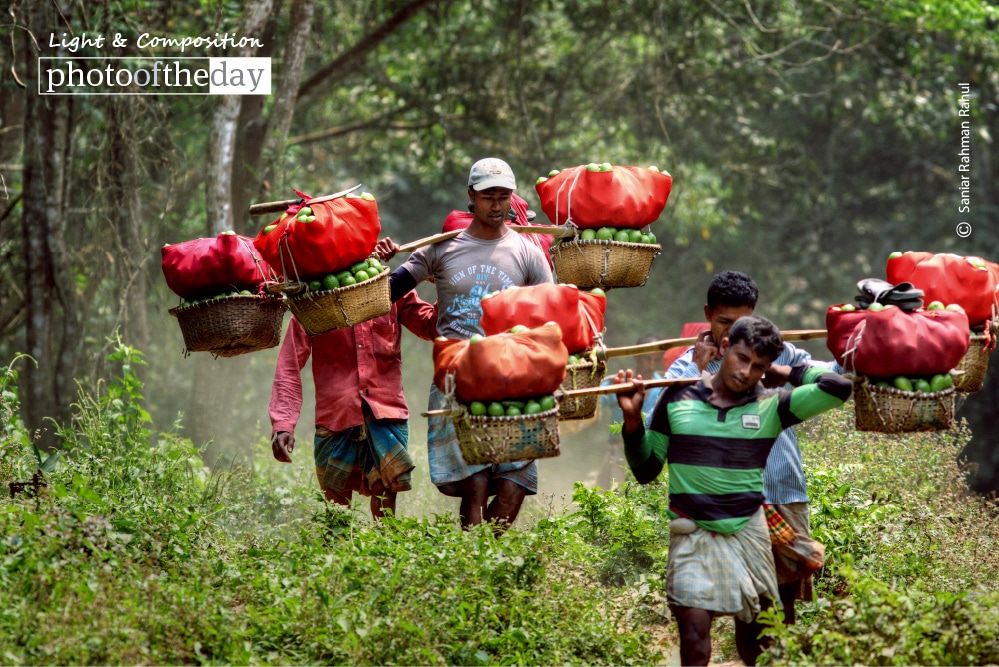
In the lush, rugged terrain of the Chittagong Hill Tracts, Saniar Rahman Rahul captures the daily journey of local lemon farmers as they navigate the dense forest paths toward Bandarban. The photograph documents the physical labor and resilience of these individuals, whose transition to lemon farming has provided a vital economic lifeline. By utilizing a long focal length, the photographer isolates the subjects against the verdant backdrop, emphasizing the scale of their trek. This image is award-worthy for its poignant documentary approach, highlighting the intersection of human perseverance and the transformative power of sustainable agriculture in rural Bangladesh.
Saniar Rahman Rahul
Based in Dhaka, Bangladesh, Saniar Rahman Rahul is a distinguished photographer and Art Director at Grey Worldwide. His creative journey began in childhood, inspired by his father’s photography, and was later refined through an extensive career in graphic design and advertising that began in 1995. Rahul’s work is deeply rooted in his professional expertise in visual communication, allowing him to document the human experience with a keen eye for composition and narrative depth. He continues to be a recognized figure in the international photography community, having earned accolades for his evocative documentary storytelling.
Resonance Score Breakdown
Transparency Note: The resonance score (12.3/20) is calculated based on social engagement metrics collected before the award announcement.
Expert Photography Reviews · 8
The Weight of the Harvest
We often speak of the city as a place of steel and glass, yet the true geography of survival is written in the dirt paths that connect the periphery to the center.
Read the reflection →The Weight of the Harvest
I keep a small, dried lemon peel in a ceramic bowl on my desk, its edges curled like parchment and its scent long since surrendered to the air.
Read the reflection →Reviews & Comments
Share your thoughts about this award-winning photograph. Your reviews contribute to the community engagement score.
Of the thousands of documentary frames I’ve reviewed, most vanish within a week. Rahul’s work survives because of that compression. By using a 300mm lens, he flattens the Chittagong terrain, forcing the farmers into a claustrophobic, emerald struggle against the slope. It’s not just labor; it’s a visual weight I can feel in my own shoulders. Most photographers would have shot wide to show the scenery, but this tight focus makes their endurance truly permanent.
Green hills swallow the path. The farmers are small, mere punctuation marks against the vast, verdant slope. Rahul uses the lens to pull them close, yet they remain distant. It’s a quiet ache. I find myself holding my breath, waiting for them to crest the ridge. Nothing here is accidental. The empty corner is not empty. It’s the weight of the climb. They’ve left so much space for the silence to settle in. It’s beautiful.
The compression of the 300mm lens flattens the Chittagong terrain, turning the forest into a dense, vertical datum against which these farmers labor. I’m struck by how the foliage acts as a porous wall, obscuring the threshold of their journey. It’s a claustrophobic, beautiful tension. By omitting the horizon, Rahul forces us to confront the solid mass of the landscape. It doesn’t just document a trek; it captures the crushing, rhythmic weight of the space itself.
We look at these farmers navigating the Chittagong hills and we feel the weight of their baskets pressing into their spines. Rahul didn’t just capture a trek; he listened to the rhythm of their labor. The long lens pulls them from the green, isolating their fatigue. It’s a quiet, heavy grace. I find myself holding my breath, hoping they reach the market soon. This is a portrait of endurance that asks to be returned to.
You’ve captured the weight of those baskets, and it’s heavy. I can feel the humidity of the Chittagong hills just looking at the way they lean into the climb. Because you used that long lens, you didn’t intrude; you let them exist in their own struggle. I’ve walked paths like that, and it’s exhausting work. You waited for the right moment to frame their resilience. There’s something honest happening here. It’s a real, human journey.
The compression of that 300mm lens flattens the Chittagong hills into a decorative, verdant wallpaper. It’s a choice that isolates these farmers, but does it strip them of their agency? I feel a sharp discomfort watching them become mere aesthetic elements in a lush landscape. Why does the frame prioritize the texture of the forest over the grit of their labor? Are we documenting their resilience, or are we just consuming their struggle as a picturesque commodity?
The verdant crush of the Chittagong hills threatens to swallow these farmers whole. Rahul’s lens compresses the foliage into a suffocating wall, yet it’s the shadows clinging to the baskets that truly haunt me. They aren’t mere absences; they’re the physical weight of survival. I’ve stared at these dark, jagged pockets for an hour, feeling the crushing humidity of their labor. It’s a brutal, beautiful resistance against the light that tries to bleach their struggle into insignificance.
The compression here is almost aggressive. By choosing a 300mm lens, Rahul flattens the Chittagong hills into a dense, suffocating wall of green. It’s a claustrophobic choice that feels far more honest than a wide-angle documentary sweep. I’m genuinely struck by how the farmers seem trapped within the foliage. Why resolve the background so sharply? I’d have loved to see the forest dissolve into pure texture, pushing this closer to abstract expressionism than reportage.
amazed like in a very part of the world people work differently, one harder than others
Very Nice Capture.