On the Streets of New York by Patricia Saraiva
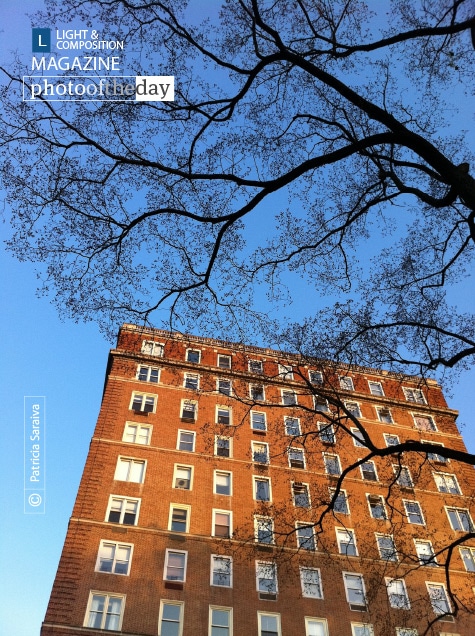
During her inaugural visit to New York, the photographer was captivated by the city's urban landscape, finding a particular affinity for the trees that punctuate the concrete environment. By selecting a unique, low-angle perspective, she transformed a simple street scene into a striking visual study of nature within the metropolis. This photograph is award-worthy for its ability to find profound beauty in the mundane, demonstrating a keen eye for composition and a creative approach to mobile photography that elevates a common subject into an artistic statement.
Patricia Saraiva
Born in Apucarana, Brazil, in 1969, Patricia Saraiva is a dedicated plastic surgeon who discovered her passion for photography while documenting the lives of her two children. Her artistic journey has since evolved from personal family records to professional exhibitions, including her notable 2011 showcase, “Barcelona Balconies.” Based in Belo Horizonte, she seamlessly balances her medical career with a commitment to capturing the world around her, whether through professional equipment or a mobile phone, constantly seeking to refine her craft and share her vision with a global audience.
Resonance Score Breakdown
Transparency Note: The resonance score (12.6/20) is calculated based on social engagement metrics collected before the award announcement.
Expert Photography Reviews · 4
The Architecture of Roots
In the nineteenth century, botanists began to map the hidden communication networks beneath the forest floor, discovering that trees are never truly solitary.
Read the reflection →Roots in the Concrete
I was walking to the subway this morning, staring at my shoes to avoid the rush of people, when I stopped dead in my tracks. A tiny patch of green had pushed its way through a jagged crack in the sidewalk.
Read the reflection →Reviews & Comments
Share your thoughts about this award-winning photograph. Your reviews contribute to the community engagement score.
The city’s concrete usually demands our haste, but here, the light caught the leaves in a quiet, upward prayer. She must have knelt on the pavement, waiting for the sun to graze those branches just so. It’s a rare stillness for Carnegie Hill. I’ve spent my life chasing such light, and looking at this, I feel a sudden, sharp ache for the peace she found in that fleeting, golden moment of urban grace.
1/180sec at f/4.6, ISO 160, 24mm. The iPhone 4 sensor is a bottleneck, yet the exposure is competent. That fixed aperture forces a deep depth of field, rendering the background clutter unavoidable. It’s a compromise. I’ve spent years loathing mobile optics, but the low angle here actually justifies the hardware’s limitations. It’s technically rigid, sure, but it works. I’m surprised to admit it, but the geometry holds up despite the sensor’s obvious, noisy struggle.
The low-angle perspective forces the architecture into a rigid, vertical geometry. It’s a calculated disruption of the urban plane. The tree’s canopy acts as a necessary fulcrum, balancing the heavy concrete massing against the sky. I’ve grown weary of street photography that lacks this structural discipline, but here, the negative space holds. It doesn’t collapse. The frame is tight, precise, and entirely unforgiving. It’s a rare moment where the iPhone’s limitations don’t compromise the visual architecture.
Most street photography from 2014 feels dated, but this iPhone 4 shot holds up because it ignores the noise of the city. By dropping to the pavement, Saraiva forces the trees to dominate the frame, turning concrete into a mere pedestal. I’ve seen thousands of urban studies, yet this one still makes me feel that specific, quiet relief of finding nature in a grid. It’s a rare, enduring reminder that perspective is everything.