
Good Morning Sunshine, by Zahraa Al Hassani
That’s how my boy was welcoming the morning sunshine, opening two arms widely to the new start of a new day, with full of energy, love, and hope.
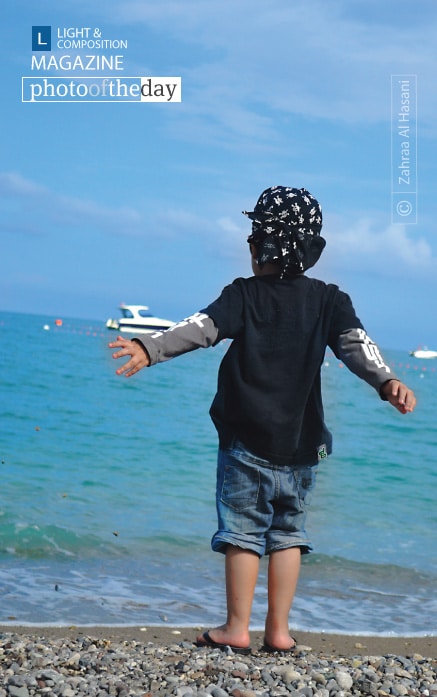
Nikon D3100 | Exposure 1/2000sec @ f/5.3 | ISO 400 | Focal Length 45mm
Good Morning Sunshine, by Zahraa Al Hassani
Award Winner: Photo of the Day | November 06
Award Score: 56 (Value 11, Clarity 11, Composition 12, Style 11, Skill 11)
Photo of the Day Award Category: Candid Photography
Photograph Location: Baghdad | Iraq
Photographer: Zahraa Hashim Salih Al Hasani (Baghdad,Iraq) Registered
Zahraa Al Hassani is a passionate photographer, and works as designer in Zain Telecommunications for more than 6 years. Graduating from the University of Technology Bagdad, her first job was at Wacther Company Ltd. as a graphic designer for constructions. A year later she joined Iraqi-American Chamber for Commerce and Industry. As senior graphic designer and photographer in Marketing Communication at Zain Telecommunications, she helps over submitting her consultancy to better enhance company image to be shown in elegant pattern. Blessed with one child, Zahraa and her family lives in Bagdad, Iraq. Resources in Iraq are mostly limited, thus she used her photography skills to get a visuals for her designs. She started photography with Sony H7 and Carel Zias lenses, and eventually moved to Nikon. Graphic Design has helped her to strengthen her photographic perspective. Zahraa believes she is here to acquire knowledge from the trove of purist photography.
Website: http://ngm.nationalgeographic.com/zahraa812
Flickr: http://www.flickr.com/photos/31190914@N06/
Gallery: http://zahraa812graphic.deviantart.com/
500px: http://500px.com/organizer
Facebook Page: https://www.facebook.com/Zahraa.H.Photography
Pinterest: http://pinterest.com/zahraa812/
Twitter: https://www.twitter.com/ZahraaHasani







Leave a Reply
Want to join the discussion?Feel free to contribute!