Jumeirah Beach Residence by Avi Chatterjee
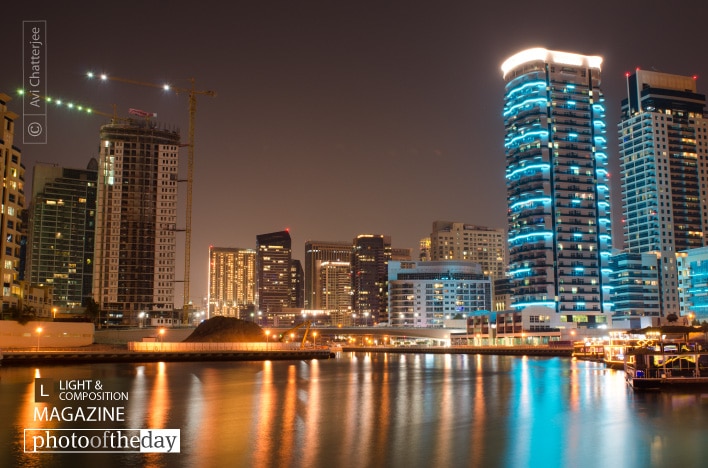
Capturing the luminous allure of Dubai’s Jumeirah Beach Residence, the photographer utilized a long-exposure technique to transform the urban landscape into a vibrant nocturnal masterpiece. By balancing the architectural geometry of the high-rise clusters against the reflective serenity of the man-made lake, the image highlights the sophisticated interplay between modern infrastructure and ambient light. This photograph is award-worthy for its technical precision in night photography, successfully translating the bustling energy of one of Dubai’s most premium residential districts into a tranquil, evocative visual narrative that celebrates the city's unique aesthetic character.
Avi Chatterjee
Born in Kolkata, India, in 1982, Avi Chatterjee is a Dubai-based photographer and technical sales consultant who transitioned from engineering to the creative arts. After acquiring his first DSLR in 2012, he founded the studio Time Machine Works, specializing in macro, wedding, food, and product photography. Drawing deep inspiration from his wife’s artistic background, Chatterjee has dedicated himself to professional growth, blending his technical expertise with a refined eye for composition to capture the diverse landscapes and cultural vibrancy of the United Arab Emirates.
Resonance Score Breakdown
Transparency Note: The resonance score (13.0/20) is calculated based on social engagement metrics collected before the award announcement.
Expert Photography Reviews · 6
The Weight of Glass
We build towers to touch the sky, yet we only succeed in creating taller mirrors. In the desert, the night is supposed to be absolute, a vast and hollow silence. Instead, we fill it with artificial constellations, stacking light upon light until the stars are forced to retreat.
Read the reflection →The Architecture of Silence
In the middle of the nineteenth century, the gas lamp began to change the way we understood the night. Before that, darkness was a solid thing, a boundary that dictated the rhythm of our lives.
Read the reflection →Reviews & Comments
Share your thoughts about this award-winning photograph. Your reviews contribute to the community engagement score.
30 seconds at f/10, ISO 100, 24mm. It’s a textbook execution of long-exposure architecture. The f/10 aperture keeps the diffraction manageable while ensuring the JBR towers remain sharp from base to crown. I’ve seen enough blown-out Dubai night shots to appreciate this restraint. The sensor didn’t clip the highlights, which is rare for this much artificial light. It’s technically sound, even if the composition feels a bit safe. I’d have preferred a tighter frame, but the math holds up.
At f/10, the diffraction limit hasn’t yet softened the architectural edges, keeping the Nikkor’s resolution razor-sharp across the focal plane. I’m genuinely moved by how the 24mm wide-angle geometry renders those vertical lines without distracting chromatic aberration. It’s a clinical, cold precision that somehow feels warm. The long exposure has smoothed the water into a perfect mirror, turning the city’s light into a coherent, luminous data set. It’s a rare, beautiful marriage of physics and urban soul.
The water holds the towers. It’s a mirror, not a lake. I’ve spent minutes watching the light bleed into the dark, waiting for the hum of the city to fade. It doesn’t. The stillness here is heavy, almost physical. Nothing is accidental. The empty corner isn’t empty; it’s a breath held in the night. I feel a sudden, sharp ache for this quiet. It’s rare to find such restraint in a place built for noise.
Thirty seconds of stillness. Avi stood there while the city breathed, letting the long exposure soften the water into a mirror for those towering, electric giants. It’s a quiet ache, seeing the neon pulse against the dark, silent tide. I’ve spent enough nights waiting for the world to settle to know he felt that same hum in his bones. It’s not just architecture; it’s the way the light finally stops running and begins to listen.
The verticality here is aggressive, yet the frame holds. Chatterjee’s geometry forces a rigid dialogue between the neon-drenched high-rises and the obsidian water. It’s a calculated equilibrium. The long exposure flattens the surface, creating a mirror that anchors the chaotic architecture. I’ve grown weary of Dubai’s visual excess, but this structure demands respect. The negative space isn’t empty; it’s a fulcrum. It doesn’t just sit there. It exerts a gravitational pull that keeps the composition from collapsing.
Before the eye identifies the architecture, a strange stillness settles in the chest. The long exposure turns the water into a dark, velvet void, pulling my pulse down to match its rhythm. It’s a quiet, synthetic lullaby. When I return to this a year later, I still feel that phantom humidity on my skin. It’s lonely, isn’t it? The way those glowing windows suggest a thousand lives, yet leave me entirely, beautifully alone with the light.
Waw! beautiful picture.