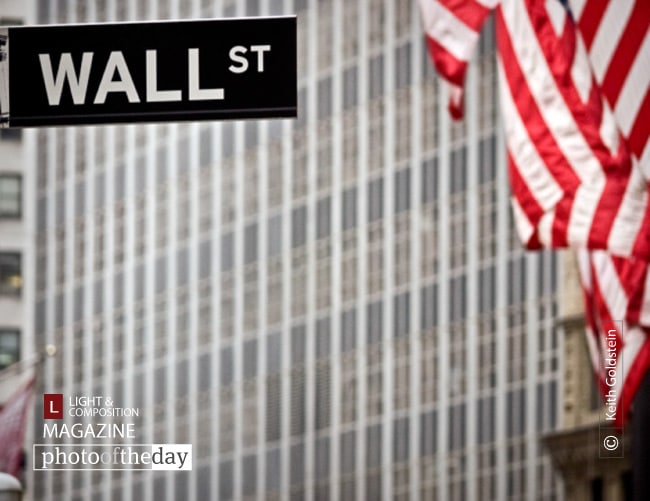
Wall Street by Keith Goldstein
Captured in the heart of New York City’s financial district, this image frames Wall Street as a convergence of global economic power and transient tourism. The photographer utilized a Panasonic Lumix G1 to document the iconic architecture, balancing the rigid, historic lines of the district with the dynamic energy of the crowds. By choosing a mid-range focal length and a steady aperture, the photographer successfully isolates the grandeur of the New York Stock Exchange against the bustling urban environment. The result is a compelling travel narrative that elevates a familiar landmark into a thoughtful study of place and perspective.
Keith Goldstein
Born in Brooklyn in 1957, Keith Goldstein is a seasoned fine art and commercial photographer based in Hamilton Heights, New York City. After earning his BFA from the School of Visual Arts and an MFA from the Cranbrook Academy of Art, he developed a deeply emotive approach to the medium, often favoring a minimalist kit to maintain creative freedom. With a career spanning over four decades, his work has been featured in numerous prestigious publications and exhibitions, reflecting a lifelong commitment to exploring the world through a singular, unencumbered lens.
Resonance Score Breakdown
Transparency Note: The resonance score (14.2/20) is calculated based on social engagement metrics collected before the award announcement.
Expert Photography Reviews · 3
The Architecture of Echoes
We are taught that history is written in ink, but it is actually carved in stone and held in the hollows of canyons built by men.
Read the reflection →The Weight of Stone and Step
In the nineteenth century, geologists began to speak of the earth not as a static stage, but as a slow-moving history written in layers of sediment.
Read the reflection →Reviews & Comments
Share your thoughts about this award-winning photograph. Your reviews contribute to the community engagement score.
Wall Street isn’t a place of commerce here; it’s a tomb of light. Goldstein’s frame traps the architecture in a rigid, suffocating geometry, yet it’s the shadows pooling beneath the Stock Exchange that haunt me. They don’t just hide the tourists; they swallow the city’s frantic pulse. I’ve stared at these dark recesses until my eyes ached. It’s a cold, moral clarity. When light refuses to touch the stone, we finally see the weight of our own greed.
Wall Street is a graveyard of snapshots, yet here, one finds a modicum of patience. It’s clear Goldstein didn’t just wander by with a tourist’s haste. He’s waited for the light to graze the stonework just so, isolating the Exchange from the usual urban clutter. I’ve spent enough miserable hours on street corners to recognize the discipline required to keep the frame clean. It’s a respectable effort, even if it doesn’t quite break my heart.
Before the eye identifies the stone columns, a sudden constriction tightens the chest. It’s the weight of the architecture, I think. Goldstein’s Wall Street doesn’t just capture a landmark; it forces a physiological recognition of our own insignificance against that cold, granite permanence. When I return to it, the crowd’s blur feels like a phantom limb. It’s unsettling, really—that feeling of being both entirely present and utterly erased by the city’s relentless, vertical ambition.