Ottoman Architecture by Mehmet Masum
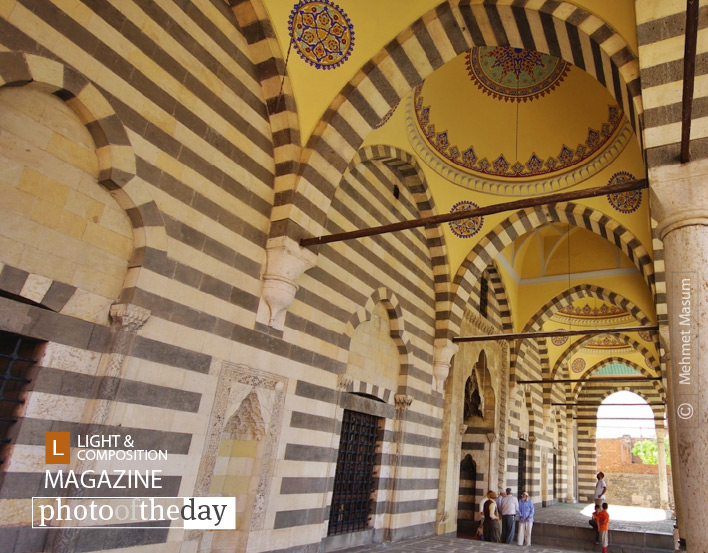
Captured at the historic Behram Pasha Mosque in Diyarbakir, this image highlights the architectural ingenuity of a structure built in 1572. The photographer meticulously framed the entrance to emphasize the compressed stone masonry, a technique that predates modern pre-stressed concrete by four centuries. By focusing on these intricate structural details, the image serves as a bridge between ancient craftsmanship and contemporary engineering. The photograph is award-worthy for its ability to transform a historical site into a compelling visual study, showcasing both the photographer's keen eye for architectural significance and his technical precision in capturing the mosque's enduring legacy.
Mehmet Masum
Based in Diyarbakir, Turkey, Mehmet Masum Suer is an accomplished international photographer and former journalist with a career spanning several decades. His work focuses on documenting the rich cultural and historical heritage of the region, with a particular emphasis on the architectural landmarks of Diyarbakir, Mardin, and Hasankeyf. Through his professional photography and documentary projects, Suer has gained international recognition, with his images frequently featured in global tourism publications, exhibitions, and media outlets across Turkey, Iraq, and the United States.
Resonance Score Breakdown
Transparency Note: The resonance score (11.6/20) is calculated based on social engagement metrics collected before the award announcement.
Expert Photography Reviews · 8
The Memory of Stone
There is a quiet patience in stone that we, in our frantic, fleeting lives, have forgotten how to read. We build with paper and glass, things that tremble at the first sign of a storm, while the old masters understood that to build is to invite the earth to hold its breath.
Read the reflection →The Weight of Time
I spent an hour this morning trying to fix a loose hinge on my kitchen cabinet. It was a small, stubborn thing that had been bothering me for weeks. As I tightened the screw, I found myself thinking about the people who built this house decades ago.
Read the reflection →Reviews & Comments
Share your thoughts about this award-winning photograph. Your reviews contribute to the community engagement score.
Behram Pasha’s stone doesn’t merely hold weight; it traps time within its pores. Masum captures the masonry, yet it’s the encroaching gloom that truly anchors the frame. I’ve stared at these arches until my own pulse slowed to match the rhythm of the 1572 mortar. It’s a heavy, silent confrontation. When light dies in those deep, recessed corners, the architecture finally begins to think. It’s a brutal, beautiful refusal to be anything but eternal.
Stone blocks. The weight of centuries. I’ve stood before these arches, and it’s the silence that hits me first. Masum doesn’t crowd the frame. He lets the masonry breathe. The light falls across the threshold, carving out a space for the eye to rest. It’s a quiet geometry. Nothing here is accidental. The empty corner is not empty. It’s a pause. I find myself holding my breath, waiting for the stone to speak.
The ochre of these sixteenth-century stones, a shade reminiscent of the sun-baked dust in a Morandi still life, vibrates against the cool, shadowed recesses with such profound, melancholic grace that one’s breath catches in the throat. It’s a chromatic dialogue between the heat of history and the encroaching silence of the shade, a palette so tactile I’ve found myself wanting to press my palms against the masonry, feeling the ancient, sun-drenched warmth beneath my fingertips.
Most architectural shots are just postcards, but this one captures the weight of 1572. By tightening the frame on those compressed stone joints, Masum forces us to confront the engineering genius of the Behram Pasha Mosque. It’s not just a building; it’s a lesson in endurance. I’ve seen thousands of arches, yet this one makes me feel the actual pressure of the masonry. It’s a rare, quiet triumph that will still matter in thirty years.
The stone here doesn’t just hold weight; it breathes. I imagine Mehmet standing in the quiet courtyard, waiting for the sun to soften against those ancient, compressed arches. It’s a rare stillness. When I look at the way the light clings to the masonry, I feel a sudden, sharp ache for the centuries of prayers that have warmed these walls. He didn’t rush this. He listened until the building finally let him in.
One suspects the light here didn’t just happen; it was invited. Framing the Behram Pasha masonry requires a patience that’s increasingly rare in our digital rush. I’ve spent enough hours shivering against stone to recognize the commitment required to let that shadow fall exactly where it belongs. It’s a quiet, disciplined piece of work. I find myself wanting to run my fingers over those compressed stones. It’s a photograph that’s clearly been earned.
The stone masonry’s compression dictates the frame’s internal logic. It’s a rigid geometry. The archway functions as a fulcrum, balancing the heavy, dark voids against the textured, sun-drenched facade. There’s a brutalist clarity here that I’ve rarely seen in such historical subjects. It doesn’t rely on sentiment. The spatial tension holds perfectly, though the slight tilt in the vertical alignment bothers me. It’s a disciplined study, yet that minor deviation prevents total structural perfection.
At f/5.6, the Pentax lens avoids the diffraction limit, rendering the Behram Pasha masonry with clinical sharpness. The focal plane sits perfectly across the compressed stone, resolving texture that the naked eye would blur into mere shadow. I’m genuinely moved by how the light clings to those ancient edges; it’s a rare, tactile precision. It doesn’t just document history; it forces us to confront the physics of stone, revealing a structural integrity that’s simply breathtaking to behold.
Ottoman architecture always amazes me. They were quite forward thinking for their time. Diyarbakir is still on my list of places to go but I am expecting great things from the place.