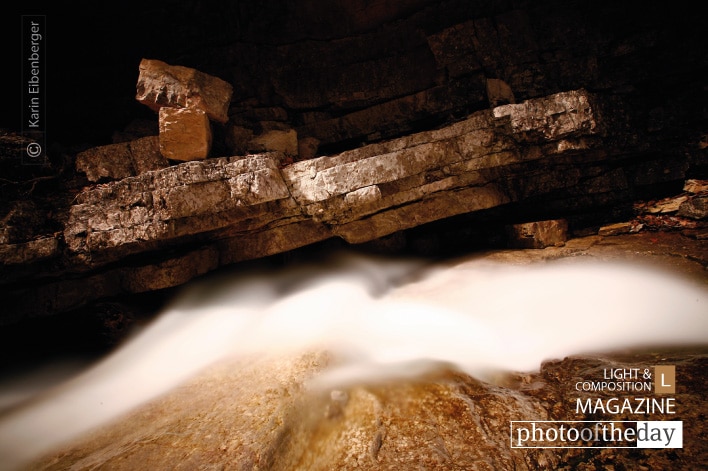
Krenngraben by Karin Eibenberger
On a day defined by dull, overcast light, the photographer ventured into a narrow valley near her hometown in Austria, determined to find beauty in the quiet landscape. Upon discovering striking rock formations with water cascading over them, she employed a long exposure technique paired with a neutral density filter to transform the scene. This creative decision smoothed the rushing water into a silky, ethereal veil, contrasting beautifully with the solid, textured rocks. The image is award-worthy for its masterful control of light and motion, turning a seemingly unpromising, cloudy day into a serene and evocative study of nature's fluid dynamics.
Karin Eibenberger
Born and raised in Waidhofen, Austria, Karin Eibenberger is a multifaceted professional who balances a career in biomedical engineering with a deep-seated passion for the outdoors. Currently based in Baltimore, Maryland, she brings a unique perspective to her photography, shaped by her academic background in literature and her extensive travels. Her work serves as a powerful medium for communication, aiming to inspire viewers by capturing the raw beauty of the natural world. Whether trekking through Alaska or exploring local valleys, she consistently utilizes her camera to translate personal emotions into compelling visual narratives.
Resonance Score Breakdown
Transparency Note: The resonance score (11.9/20) is calculated based on social engagement metrics collected before the award announcement.
Expert Photography Reviews · 7
The Breath of Stone
We often mistake stillness for silence, forgetting that even the hardest granite is engaged in a slow, rhythmic conversation with the rain.
Read the reflection →The Persistence of Flow
In the study of geology, we are taught that stone is the ultimate witness to time. It is stubborn, unyielding, and seemingly permanent. Yet, if you sit by a stream long enough, you begin to realize that the stone is merely a slower version of the water.
Read the reflection →Reviews & Comments
Share your thoughts about this award-winning photograph. Your reviews contribute to the community engagement score.
Spot on with this write-up, I honestly feel this site needs
a lot more attention. I’ll probably be returning to see more, thanks for the
info!
Eighty-one seconds in a damp Austrian ravine isn’t a casual afternoon. Most would’ve packed up when the clouds turned dull, but Eibenberger clearly stayed until the light lost its ego. I’ve spent enough hours shivering in similar valleys to recognize the patience required for that silky, deliberate flow against the grit of the stone. It’s a quiet, cold victory. One doesn’t get results like this without getting properly soaked. I rather respect that.
The flat, directionless light of a cloudy day is a gift for those who listen. Karin didn’t rush the water; she let it breathe for eighty-one seconds. It’s a quiet, ethereal veil draped over the ancient stone of Krenngraben. I’ve stood in such damp, silent valleys, and I can feel the chill of the mist on her skin. She waited until the land surrendered its movement, turning the chaotic rush into a singular, holy stillness.
The slate-grey stone, reminiscent of a Morandi still life, anchors the frame, yet it’s the water’s spectral luminescence—a ghostly, pale cerulean—that truly haunts the senses. One finds oneself breathless before this ethereal fluidity, where the light doesn’t merely fall but dissolves into a mist of crushed pearls. It’s a melancholic, muted symphony of cool tones that feels, quite frankly, like a soft, damp ache against the skin on a lonely, overcast Austrian afternoon.
At f/16, Eibenberger dances dangerously close to the diffraction limit, yet the 16mm glass holds the micro-contrast of those wet, jagged stones with startling fidelity. The 81-second exposure integrates the photon flux into a laminar, ethereal flow that our retinas simply can’t resolve in real-time. It’s a beautiful, temporal abstraction. I’ve stared at the way the water clings to the rock’s texture, and honestly, the sheer, silky precision of it makes my heart ache.
The frame’s architecture relies on the rigid geometry of the rock face to anchor the fluid motion. It’s a precarious balance. The long exposure flattens the water into a singular, tonal plane, yet the jagged stone edges provide the necessary friction. I’ve grown weary of such ethereal veils, but here, the spatial tension holds. The composition doesn’t collapse under the weight of its own softness. It’s a disciplined study in structural contrast.
Eighty-one seconds of stillness. The water isn’t rushing anymore. It’s a ghost, a veil draped over stone. I’ve spent minutes staring at the dark, jagged edges of the Krenngraben. They don’t demand attention. They just exist. It’s a quiet I rarely find in my own life. Nothing here is accidental. The empty corner isn’t empty; it’s a breath held in the dark. I feel my own pulse slowing down. It’s enough.
Most long exposures of water look like cheap cotton candy, but Eibenberger’s Krenngraben avoids that trap. By anchoring the silky flow against those jagged, unyielding rocks, she’s created a tension that feels permanent. I’ve stared at this for years, and it still pulls me into that cold, Austrian silence. It’s the restraint that wins here; she didn’t over-process the gloom. It’s a quiet, enduring piece of work that I’m genuinely glad exists in our archive.