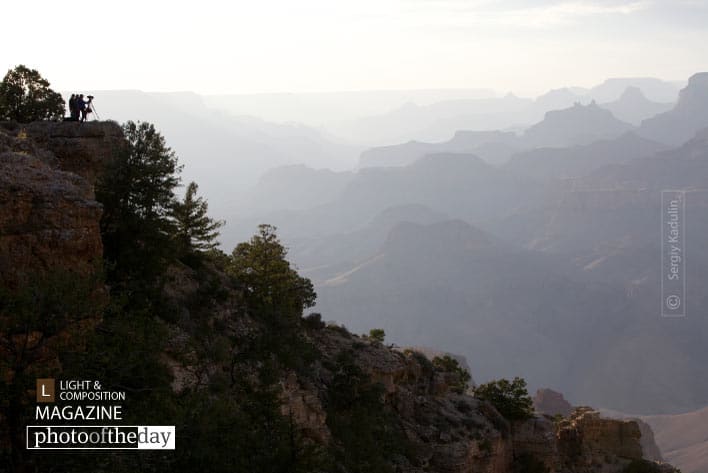
Sunset Photographers by Sergiy Kadulin
During a three-week journey across the American West, the photographer captured this evocative scene while departing the Grand Canyon at sunset. Observing a group of fellow photographers silhouetted against the vast, rugged cliffside, the photographer stepped aside to frame the shot, intentionally balancing the human element against the immense scale of the landscape. This image is award-worthy for its masterful use of perspective, which successfully conveys both the profound depth of the canyon and the quiet, shared reverence of those witnessing its grandeur. The warm, fading light perfectly highlights the textures of the rock, grounding the epic scale of nature in a singular, human moment.
Suraj Krishnamurthy Cheemangala
Suraj Krishnamurthy is a resident of Norway who effortlessly merges his passion for photography with his career as an IT Helpdesk professional. His photographic journey is fueled by a deep appreciation for capturing the beauty and emotion in everyday life, constantly seeking new techniques and challenges to refine his craft. In his IT role, Suraj is known for his precision and patience in resolving technical issues, while his creativity in photography enriches his technical expertise. Current Location Norway Instagram https://www.instagram.com/sucheetra_snapshots?igsh=NmFwM2p5ZjkwNHdt&utm_source=qr/ Best Achievements, Educational Background, and Exhibitions YPS INTERNATIONAL DIGITAL SOLUTION - Acceptance in travel section Award Winner Photo of the Day Camera Gears Camera :Nikon d7200,IPhone 15 pro max Lenses : AF-S NIKKOR 70–200 mm f/2.8E
Resonance Score Breakdown
Transparency Note: The resonance score (12.0/20) is calculated based on social engagement metrics collected before the award announcement.
Expert Photography Reviews · 7
The Salt of the Earth
The smell of dry, sun-baked stone always brings me back to the feeling of grit between my toes. It is a coarse, honest scent—the smell of earth that has been scorched by the day and is only now beginning to exhale.
Read the reflection →Small Souls, Big Spaces
I was standing on the subway platform this morning, surrounded by a hundred people, yet everyone was looking down at their phones. We were all so close, shoulder to shoulder, but completely sealed off in our own little worlds.
Read the reflection →Reviews & Comments
Share your thoughts about this award-winning photograph. Your reviews contribute to the community engagement score.
It’s a curious thing to photograph the photographers. One wonders if Kadulin spent the afternoon shivering on that ledge or simply stumbled upon the scene while heading for the car. The composition is tidy, certainly, but it lacks the grit of a long vigil. I’ve spent enough hours waiting for light to know when a shot is earned. This feels like a pleasant observation, not a hard-won victory. It’s pretty, but it didn’t cost enough.
Most Grand Canyon shots are just postcards, but this one captures the voyeurism of our craft. By framing the photographers instead of the abyss, Kadulin highlights our collective obsession with capturing the uncapturable. I’ve seen thousands of sunset silhouettes, yet the way these figures lean into the void makes me feel a strange, quiet envy. It’s not about the rocks; it’s about the people trying to own them. Thirty years from now, that’s what will matter.
The frame’s geometry relies on the silhouettes to anchor the canyon’s immense, chaotic strata. It’s a precarious balance. The human figures provide a necessary fulcrum, preventing the composition from dissolving into mere geological texture. I’m genuinely irritated by the slight tilt of the horizon line, which disrupts the otherwise rigid spatial tension. Still, the negative space above the ridge holds the weight of the light. It’s structural discipline, finally, that saves the frame from sentimentality.
The canyon wall swallows them. Small, dark shapes against the stone. They’ve become part of the geology. I’m struck by the stillness. It’s not just a sunset; it’s a surrender. The frame holds the weight of the rock and the lightness of the people. Nothing here is accidental. The empty corner is not empty. It’s a breath. I find myself holding mine, waiting for the light to finally leave the cliff. It’s enough.
The canyon floor is already surrendering to shadow, yet these figures remain, anchored by the final, honeyed glow of a dying sun. I’ve felt that same ache—the reluctance to leave when the light finally begins to whisper. They aren’t just taking pictures; they’re listening to the stone. It’s a quiet, shared prayer. Looking at them, I feel a sudden, sharp longing to be back on that rim, waiting for the world to go silent.
The canyon’s ochre depths, reminiscent of a Turner sunset, bleed into the bruised violet of the shadows, creating a chromatic tension that’s truly intoxicating. It’s the way the light clings to the rock like molten copper that catches my breath, forcing one to acknowledge how these silhouettes, rendered in the ink-black of a Morandi still life, anchor the vast, geologic indifference of the landscape within a fragile, human, and deeply resonant chromatic harmony.
At f/10, the 70-200mm lens avoids the diffraction limit, rendering the canyon’s sedimentary strata with clinical, biting sharpness. The focal plane holds the rock’s micro-textures while the silhouettes soften into the atmospheric haze. It’s a rare moment where optics and geology collide. I’m genuinely moved by how the light’s refraction across those jagged edges creates such profound depth. You don’t just see the scale; you feel the physics of the light grounding those tiny human figures.