Tropical Caterpillar by Shahnaz Parvin
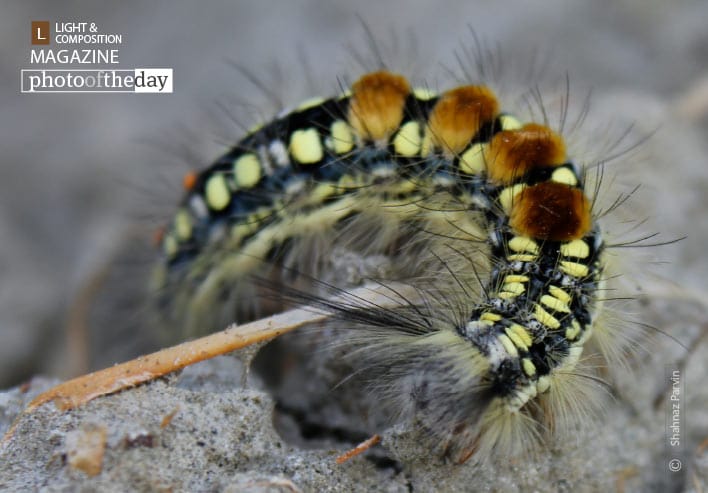
Captured during the photographer's early exploration of the natural world, this image highlights the overlooked beauty of a caterpillar. By focusing on a subject often ignored in favor of the more vibrant butterfly, the photographer draws a poignant parallel to human society, where individuals frequently receive recognition only after achieving high status. The composition emphasizes the intricate textures and quiet existence of the caterpillar, transforming a small, humble detail into a compelling visual narrative. This thoughtful perspective and technical precision earn the photograph its place as a celebrated example of close-up nature photography.
Mya Kidder
Mya Kidder, age 15, enjoys taking portraits of the people around her. She feels that everyone has a story to tell through their expression and that emotions really paint a picture about an individual. People all have something unique to show, and she tries to capture this in her photos. Through her pictures, she also tries to build each person’s confidence. Current Location Kensignton, London Instagram http://instagram.com/kathryn.kidder Best Achievements & Exhibitions None Award Winner Photo of the Day Camera Canon DSLR, Rebel Lenses and Gears 18-55mm lens Platinum 58 mm MC-CPL
Resonance Score Breakdown
Transparency Note: The resonance score (14.9/20) is calculated based on social engagement metrics collected before the award announcement.
Expert Photography Reviews · 5
The Beauty of the Unfinished
I spent an hour this morning watching a spider weave a web in the corner of my porch. It was tedious, slow work, and I found myself feeling impatient. I wanted the finished product—the perfect, shimmering trap—not the messy, repetitive loops of the process.
Read the reflection →The Architecture of Becoming
We are so often in love with the finished thing—the bloom, the flight, the sudden brilliance of wings against a summer sky. But there is a quiet, heavy holiness in the waiting.
Read the reflection →Reviews & Comments
Share your thoughts about this award-winning photograph. Your reviews contribute to the community engagement score.
It’s easy to snap a bug in the garden, but one wonders how long she sat in the Faridpur humidity before the light hit those bristles just so. The focus is sharp, and the texture holds up under scrutiny. I’ve spent enough damp mornings waiting for a subject to stop fidgeting to appreciate the stillness here. She didn’t just find this; she committed to the crawl. It’s a quiet, earned bit of work. Respect.
At f/5.6, the focal plane is razor-thin, isolating the caterpillar’s setae with clinical sharpness. I’m genuinely moved by how the lens resolves those microscopic hairs against the soft, creamy bokeh—a perfect function of the 55mm’s aperture. There’s no chromatic aberration to distract from the texture, just pure, resolved light. It’s a rare moment where the sensor captures what our eyes simply can’t hold. It’s not just a bug; it’s a masterclass in optical precision.
The frame’s geometry is compromised. While the caterpillar’s segments provide a rhythmic cadence, the focal plane drifts, losing the critical anterior detail. It’s a structural failure. The negative space doesn’t anchor the subject; it merely dissipates the composition’s weight. I’ve spent years demanding rigor, and frankly, this lack of discipline irritates me. The diagonal axis attempts a tension that the shallow depth of field simply can’t support. It’s a missed opportunity for true formal coherence.
Most macro work I’ve seen this year relies on garish saturation to force attention. Parvin avoids that trap. By isolating the caterpillar’s segmented, velvet-like texture against a muted, blurred backdrop, she forces us to confront a creature we usually step over. It’s a quiet, humble study that refuses to scream for relevance. Honestly, I found myself leaning in closer, mesmerized by the subtle gradients. It’s the kind of patient observation that will still matter in thirty years.
A single creature. It clings to the green. I find myself holding my breath, afraid to disturb the stillness. The blur behind it isn’t just background. It’s the weight of the air in Faridpur. Nothing here is accidental. The empty corner is not empty. It’s a quiet invitation to look closer at what we usually walk past. I’ve spent minutes just watching it exist. It’s enough. It’s more than enough.