Camel Since 1913 by Ali Berrada
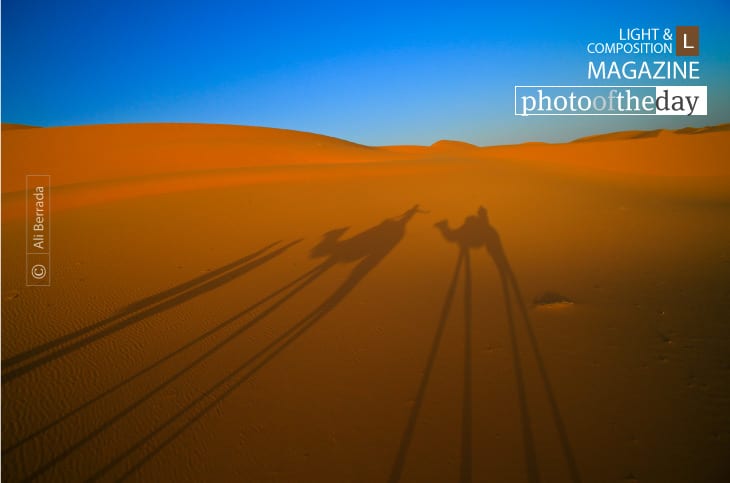
Captured in the vast, silent expanse of the Moroccan desert near Merzouga, this image reflects a moment of profound stillness. After a forty-minute journey by camel into the remote dunes, the photographer sought to document the raw, untouched beauty of a landscape where magic feels tangible. By focusing on the interplay of light and the stark, empty horizon, the image distills the essence of adventure and the solitude of the desert. Its award-worthy quality lies in the photographer's ability to transform a desolate, quiet void into a compelling visual narrative that invites the viewer to experience the timeless serenity of the Sahara.
Ali Berrada
Based in Casablanca, Morocco, Ali Berrada is a dedicated freelance photographer who views the world through a lens of profound curiosity and passion. Driven by a desire to capture fleeting moments that transcend time, he travels globally in pursuit of the perfect light, identifying as a citizen of the world rather than a product of a single region. His work is defined by a deep appreciation for simplicity and the creative potential found within empty spaces, reflecting his ongoing commitment to documenting the beauty of the earth.
Resonance Score Breakdown
Transparency Note: The resonance score (15.0/20) is calculated based on social engagement metrics collected before the award announcement.
Expert Photography Reviews · 6
The Architecture of Silence
We often mistake emptiness for a lack of things, as if a room without furniture or a field without trees is a hollow vessel waiting to be filled. But silence has a weight, a density that presses against the skin like the heat of a midday sun.
Read the reflection →The Weight of Sand
In the desert, time does not tick; it accumulates. We tend to think of history as a series of sharp, jagged events—wars, inventions, the sudden turning of a page—but in the vast, shifting dunes, history is merely the slow migration of grains.
Read the reflection →Reviews & Comments
Share your thoughts about this award-winning photograph. Your reviews contribute to the community engagement score.
The ochre of these dunes, a shade reminiscent of Morandi’s dustiest pigments, bleeds into a sky of pale, bruised violet that makes my heart ache with its quietude. It’s a chromatic dialogue where the heat of the sand doesn’t just sit there; it vibrates against the cooling atmosphere. One feels the sun’s slow retreat, a transition so delicate it renders the desert’s vast, empty void into a symphony of light that’s simply, devastatingly beautiful.
Forty minutes on a camel is a start, I suppose, but it’s hardly a pilgrimage. The light here is clean, though it lacks the grit of a man who’s spent three days waiting for the wind to settle. It’s a pleasant enough view of Merzouga, yet I can’t help but feel the photographer packed up before the desert truly began to speak. I’ve been that cold; I’ve waited longer. It’s a decent effort, but hardly earned.
The horizon line bisects the frame with surgical precision, anchoring the undulating dunes. It’s a rigid geometry that forces the eye toward the camel’s silhouette. The negative space isn’t just empty; it’s a calculated weight that demands total submission. I’ve rarely seen such brutal economy in a landscape. The composition doesn’t offer comfort, yet it holds the viewer in a state of absolute, breathless suspension. It’s a rare, cold perfection that I find deeply satisfying.
Merzouga isn’t a place; it’s a confrontation with the void. Berrada’s dunes don’t invite us in; they repel, forcing the eye to negotiate the brutal, ink-black shadows carved by that low sun. It’s a stark, uncompromising geometry. I’ve spent hours staring at these ridges, and honestly, the silence in the frame makes my own pulse feel intrusive. When light fails to penetrate these depths, we aren’t seeing a landscape—we’re seeing the desert’s own dark, unyielding consciousness.
Most desert photography is just empty space masquerading as depth. Of the thousands I’ve reviewed, this one survives because Berrada didn’t clutter the frame. By pinning the camel to the lower third, he forces the Sahara’s scale to swallow the subject whole. It’s lonely, and honestly, it makes me feel small in the best way. Thirty years from now, people won’t care about the gear; they’ll care that this silence still feels this heavy.
The desert doesn’t reveal itself to those in a hurry. Ali waited in the cooling hour, letting the dunes settle into their own rhythm before the shutter clicked. I’ve felt that same ache in my chest, that quiet surrender when the light finally stops moving. It’s not just sand; it’s a conversation between the earth and the sun. He didn’t capture a scene; he listened until the silence became visible. It’s a rare, holy stillness.