Solidarity, Revolution, Hope by Swati Iyer
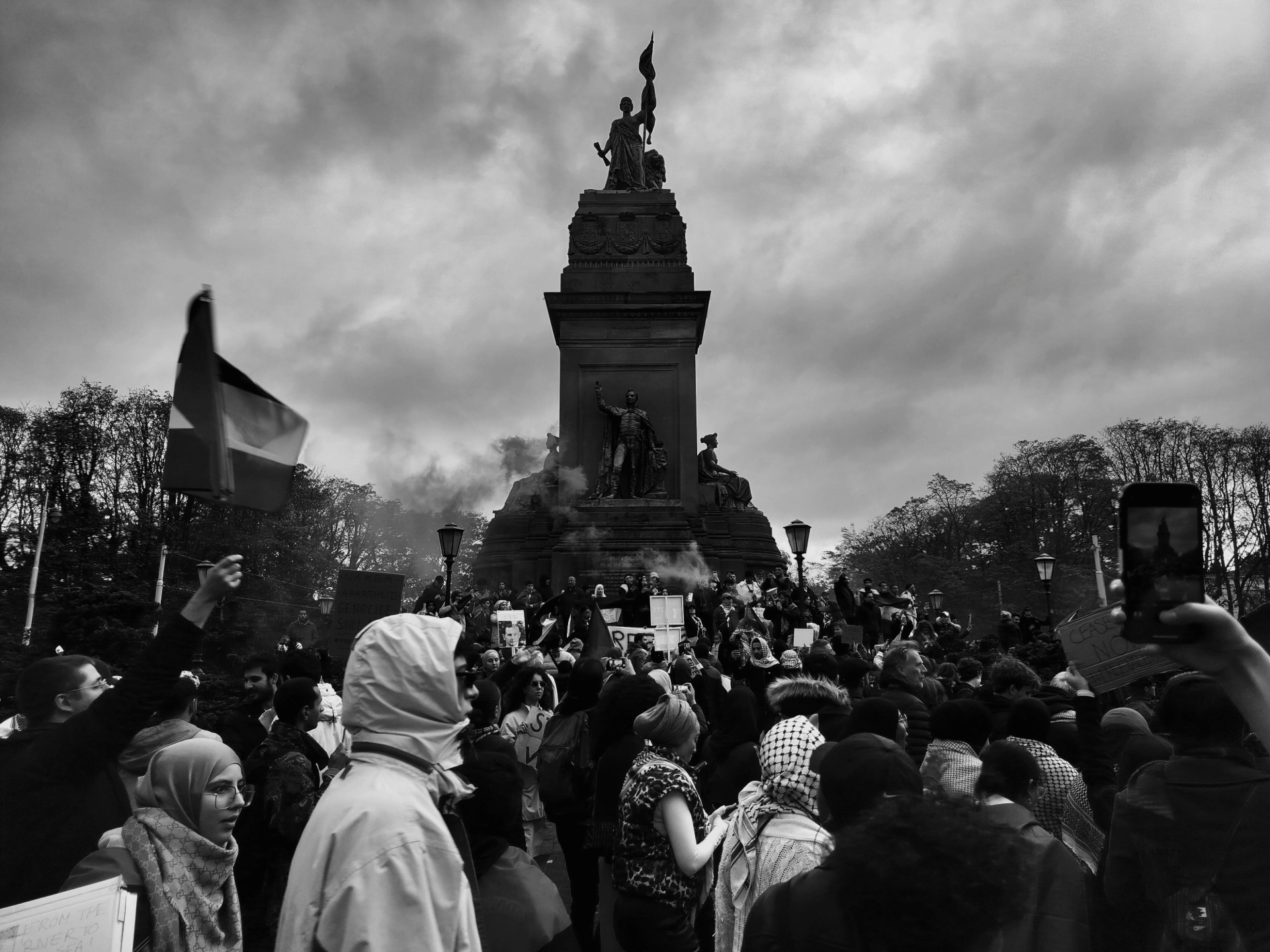
Captured during a pivotal protest for a ceasefire in The Hague, this photograph stands as a poignant testament to the spirit of revolution and the pursuit of justice. The photographer frames the demonstration against the backdrop of the city's historic independence monument, creating a powerful juxtaposition between the struggle for modern human rights and the symbols of past liberation. By focusing on the raw energy of the crowd, the image serves as a stark, evocative reminder of collective hope and solidarity, earning its place as an award-worthy document of a significant historical moment.
Swati Iyer
Based in the vibrant city of The Hague, Swati Iyer is a Dutch photographer recognized for her ability to find profound artistry within the ordinary. With a keen eye for detail, she masterfully captures the essence of her surroundings, whether documenting the quietude of nature or the dynamic pulse of modern urban life. Swati seamlessly integrates both DSLR and mobile photography into her practice, utilizing the spontaneity of her equipment to preserve fleeting, emotionally resonant moments that define the human experience.
Resonance Score Breakdown
Transparency Note: The resonance score (7.3/20) is calculated based on social engagement metrics collected before the award announcement.
Expert Photography Reviews · 8
The Grey Before the Change
There is a specific, heavy grey that settles over the city when the wind turns from the North Sea. It is not the soft, diffused grey of a gentle mist, but a hard, metallic slate that seems to press against the glass, demanding attention.
Read the reflection →The Weight of Many Hands
When I was ten, my cousin Emeka and I tried to move a fallen cedar log from the path behind our house. It was heavy, wet with rot, and smelled of deep, dark earth. We pushed until our faces turned the color of plums, but the wood did not budge.
Read the reflection →Reviews & Comments
Share your thoughts about this award-winning photograph. Your reviews contribute to the community engagement score.
Stripped of pigment, one finds the silver-grey of a winter morning in The Hague, where the light doesn’t merely illuminate but bruises the stone, echoing the monochromatic austerity of a Morandi still life. It’s a stark, charcoal-dusted ache that I’ve felt in my own bones, a tonal gravity that pulls the eye toward the collective pulse of the crowd, where the absence of colour forces us to confront the raw, unvarnished temperature of human desperation.
The crowd’s surge is caught just as the lead protester’s weight shifts forward, heels off the pavement, arms fully extended in a reach for the sky. It’s the precise millisecond where kinetic energy peaks before the inevitable collapse of momentum. I’ve spent my life chasing that exact tension. It’s not just a protest; it’s a physical exhale. The timing is perfect. I felt my own lungs tighten just looking at that desperate, singular reach.
The vertical axis of the monument anchors the frame, creating a rigid 1:3 ratio against the chaotic, kinetic energy of the crowd. I’m struck by how the diagonal vectors of the protest signs intersect the monument’s base, effectively resolving the tension between historical stasis and modern movement. It’s a beautifully calculated spatial equation. When the geometry aligns this precisely, I can’t help but feel the sheer, rhythmic pulse of the collective struggle. It’s a perfect visual proof.
1/100sec at f/1.7, ISO 80, 24mm. It’s a mobile sensor pushed to its limit. The f/1.7 aperture creates a shallow plane that struggles to resolve the crowd’s density, leading to aggressive digital sharpening artifacts. I’m annoyed by the chromatic aberration bleeding into the monument’s edges. It’s a technical compromise that undermines the historical weight of the scene. You’ve captured the energy, but the optics don’t hold up under scrutiny. It’s a fragile document.
Before the eye identifies the protest, something in the chest tightens. It’s the weight of the crowd against the cold stone of The Hague’s monument. I feel a sudden, sharp ache in my throat—a phantom echo of their collective shout. When I return to this, I don’t see a revolution; I see the way our bodies crave belonging. It’s a restless, haunting rhythm that follows me into sleep, long after the frame fades.
We look at this crowd in The Hague and we hear the hum of a thousand shared breaths. Swati Iyer didn’t just point a lens; she listened to the rhythm of their collective pulse. Against the cold stone of the monument, these faces aren’t just protesters—they’re storytellers of a future they’re fighting to build. It’s haunting, really. I’ve stared at these eyes for an hour, and I still feel the weight of their hope.
You didn’t just shoot a protest; you felt the weight of those bodies against the stone. I’ve stood in crowds like that, and the tension in your frame is real. Because you kept the camera steady, I can feel the desperation in their hands. It’s not about the monument behind them, but the pulse of the people in front of it. You waited for the right rhythm. There’s something honest happening here. It’s raw, and it matters.
The light in The Hague doesn’t offer the soft grace of a mountain dawn; it’s a flat, honest grey that demands we pay attention to the human spirit. Swati stood amidst the press of bodies, waiting for the collective breath of the crowd to align with the stone monument. It’s a heavy, urgent stillness. I’ve felt that same tension in my own work, and honestly, it makes my heart ache for the peace they’re seeking.